

Practice Makes Perfect with These G&T Admission Test Resources
Jun 12, 2026
Understanding Gifted and Talented (G&T) Admission Tests
At its core, a Gifted and Talented assessment is designed to measure a child's cognitive abilities rather than their mastery of specific school subjects like history or science. These tests look for innate potential—the way a child processes information, identifies patterns, and solves problems they haven't seen before.
Several standardized tests are commonly used across the United States to identify these traits:
- OLSAT (Otis-Lennon School Ability Test): This test measures verbal, nonverbal, and quantitative reasoning. It is particularly known for assessing how well a child can follow directions and understand complex relationships between words.
- NNAT (Naglieri Nonverbal Ability Test): This is a culturally neutral, nonverbal test. It uses shapes and geometric designs to assess problem-solving skills, making it an excellent tool for visual learners or students for whom English is a second language.
- CogAT (Cognitive Abilities Test): Often considered the "gold standard," the CogAT evaluates reasoning in three distinct batteries: Verbal, Quantitative, and Nonverbal.
- Stanford-Binet V: A comprehensive intelligence test often used for private school admissions or specialized gifted identification.
- WPPSI (Wechsler Preschool and Primary Scale of Intelligence): Used for younger children, focusing heavily on WPPSI Spatial Skills Practice and verbal comprehension.
- SCAT and KBIT: These are shorter assessments often used as initial screenings to see if a child should move forward with more intensive testing.
To help you visualize the differences, here is a comparison of the three most common tests you will encounter when looking for a Gifted and Talented Practice Test.
| Test Type | Primary Focus | Content Style |
|---|---|---|
| OLSAT | Verbal & Logical Reasoning | Words, pictures, and numbers |
| NNAT | Nonverbal Reasoning | Shapes, colors, and matrices |
| CogAT | Multi-battery Reasoning | Verbal, Quantitative, and Nonverbal |
Identifying the Right Test for Your District
Before you dive into G&T admission practice tests, you must identify exactly which assessment your local school district utilizes. Requirements vary significantly by geography. For instance, California GATE (Gifted and Talented Education) requirements might differ from the Houston Vanguard (HISD Gifted) program or the LAUSD GATE protocols.
In many California districts, the NNAT or CogAT are favorites, whereas Texas programs often incorporate achievement-based metrics alongside cognitive scores. We recommend starting with a diagnostic evaluation. At Bright Kids, we provide these evaluations to help parents see where their child stands today, allowing you to tailor your prep to the specific regional variations of the exam your child will face.
Navigating the NYC G&T Admission Practice Tests and Requirements
As of May 2026, the NYC Department of Education continues to use a rigorous selection process for its specialized programs. Admission is generally split into two categories: Citywide programs and District programs.
- Citywide Programs: These are the most competitive, typically requiring a score in the 97th percentile or higher.
- District Programs: These serve local neighborhoods and generally require a score at or above the 90th percentile.
The NYC assessment traditionally comprises 78 multiple-choice questions. It is a hybrid model, utilizing the OLSAT for the verbal component (30 questions) and the NNAT for the nonverbal component (48 questions). While there is no strict time limit, most children finish in under two hours.
If you are preparing for the upcoming May 2026 testing cycle, it is vital to use materials like OLSAT Test Sample Questions that reflect this specific mix. Our NYC-specific curriculum is updated annually to ensure that every logic puzzle and verbal prompt mirrors the current standards set by the DOE.
Scoring and Percentile Benchmarks
Understanding your child's score can be confusing. The "raw score" (the number of questions answered correctly) is converted into a "percentile rank" based on age-based norms. This means a 5-year-old is only compared to other 5-year-olds, not to older children.
In the highly competitive landscape of NYC admissions, many families aim for the 99th percentile to ensure a spot in their top-choice school. If your child's results show a high percentile, it indicates they performed better than that percentage of their peers. For a deeper dive into how these numbers are crunched, you can review our guide on the Gifted and Talented Practice Test.
Core Skills and Sample Questions for G&T Success
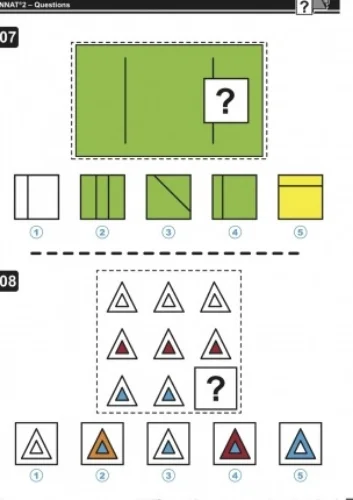
The skills required for G&T success evolve as a child grows. For Kindergarten, the focus is on foundational cognitive skills: attentive listening, basic categorization, and identifying simple patterns. By 1st Grade, the tests shift toward "achievement," requiring children to apply acquired knowledge to more complex problems.
Key question types include:
- Following Directions: An examiner reads a prompt (e.g., "Point to the picture that shows a bird flying above a tree"), and the child must identify the correct image.
- Aural Reasoning: Assessing how well a child understands spoken information.
- Pattern Completion: Identifying the missing piece in a geometric design.
- Reasoning by Analogy: This is a cornerstone of the NNAT. A child must see that "A is to B as C is to D." You can find specific exercises for this in our NNAT Reasoning by Analogy resource.
- Number Series: Determining the next number in a logical sequence. Practice these with CogAT Number Series Exercises.
- Figure Matrices: Solving 2x2 or 3x3 grids where objects change based on specific rules. We offer CogAT Figure Matrices Exercises to help master this tricky section.
Building Confidence Through G&T Admission Practice Tests
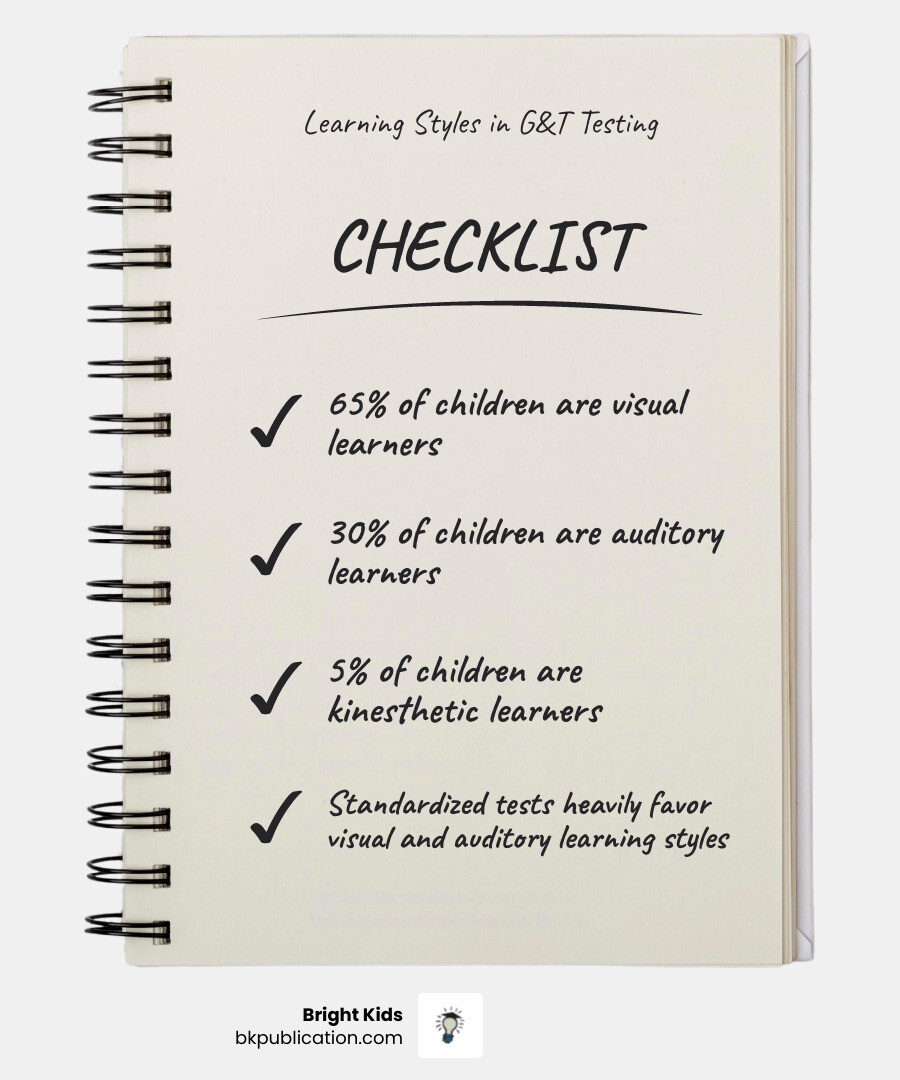
Did you know that 65% of children are visual learners? Another 30% are auditory learners, and a small 5% are kinesthetic (hands-on) learners. Standardized tests, which are heavily visual and auditory, can be intimidating if a child isn't used to the format.
Using G&T admission practice tests helps build "mechanical mastery." This includes learning how to sit still for extended periods, how to listen to an examiner without interrupting, and how to properly mark a bubble sheet. When a child knows what to expect, they can move from a "fixed mindset" (worrying about being "smart enough") to a "growth mindset" (treating the test like a fun brain workout). Our methodology focuses on this psychological readiness just as much as the academic content.
Effective Strategies for G&T Admission Practice Tests at Home
You don't need to turn your living room into a high-pressure classroom. In fact, we advise against it! The most effective home strategy is consistency over intensity.
- The 20-Minute Rule: Keep practice sessions short—about 20 to 30 minutes. This respects a young child's attention span and prevents burnout.
- Everyday Logic: You can build G&T skills during daily activities. Ask your child to spot patterns in the floor tiles at the grocery store or sort the laundry by color and size (categorization).
- Explain the "Why": When your child gets a practice question right, ask them, "How did you know that was the answer?" This reinforces the logical path they took to get there.

One of the biggest mistakes parents make is "cramming" the week before the test. This usually leads to parental anxiety, which children pick up on instantly. Instead, treat practice questions like puzzles or "brain games." If your child gets stuck, reframe it as a "brain workout"—a positive challenge that makes them stronger.
Choosing the Best G&T Admission Practice Tests and Resources
When selecting resources, quality matters more than quantity. The market is full of outdated materials that don't reflect the current difficulty levels of the OLSAT or NNAT.
Bright Kids practice questions and full-length mock tests are designed to be "at-level" or slightly "above-level" to ensure your child is never surprised on test day. Our PrepPacks include:
- Timed simulations to get used to the clock.
- Instant feedback so you can correct logic errors in real-time.
- Progress tracking to see which areas (Verbal vs. Nonverbal) need more focus.
Frequently Asked Questions about G&T Testing
What is the best age for a child to take a G&T test?
Most experts agree that the ideal window for reliable cognitive testing is between 6 and 9 years old. However, many districts, including NYC, begin testing for Kindergarten entry (around age 4 or 5). Early identification allows children to enter enriched environments sooner, but cognitive maturity varies, so don't be discouraged if your child needs a second try in a later grade.
Can my child retake the G&T admission test if they don't qualify?
In most cases, yes. Most districts allow children to test once per annual cycle. If your child doesn't qualify this year, they are often eligible to try again the following year. Use the time in between to build foundational skills without the pressure of an immediate deadline. Some districts also maintain waitlists or consider alternative assessments like teacher nominations.
How do G&T tests differ from standard school exams?
Standard school exams test curriculum knowledge (e.g., "What is 5 + 5?"). G&T tests measure abstract reasoning and cognitive flexibility (e.g., "If a circle turns into a square, what does a triangle turn into?"). They are independent of what is taught in the classroom, which is why specific G&T admission practice tests are so helpful—they introduce children to a way of thinking they might not encounter in their daily schoolwork.
Conclusion
Preparing for gifted and talented admissions is a journey, not a sprint. With 17 years of expertise and thousands of families helped, we've seen how the right preparation can transform a child's educational trajectory. By using comprehensive G&T admission practice tests, focusing on core reasoning skills, and maintaining a positive, playful atmosphere at home, you give your child the best possible chance at success.
Ready to start your child’s journey toward academic enrichment? Explore our full range of resources and more info about G&T services to find the perfect fit for your family’s needs. At Bright Kids, we believe that with the right tools, every child can reach their full potential.