

Mastering NNAT Patterns and Spatial Reasoning for Students
Apr 08, 2026
What Is NNAT Reasoning by Analogy (and Why It Matters for Your Child)
NNAT reasoning by analogy is one of four question types on the Naglieri Nonverbal Ability Test (NNAT), where students look at a matrix of geometric shapes and figure out how the images relate to each other — then use that logic to identify the missing piece.
Here's a quick breakdown of what to know:
- Format: A 2x2 or 3x3 grid of geometric shapes with one cell missing
- Task: Identify the relationship (or "analogy") between shapes across rows and columns, then choose the answer that completes the pattern
- Skills tested: Pattern recognition, visual-spatial reasoning, and logical thinking
- Grade range: Appears on NNAT Levels A through G — from kindergarten through 12th grade
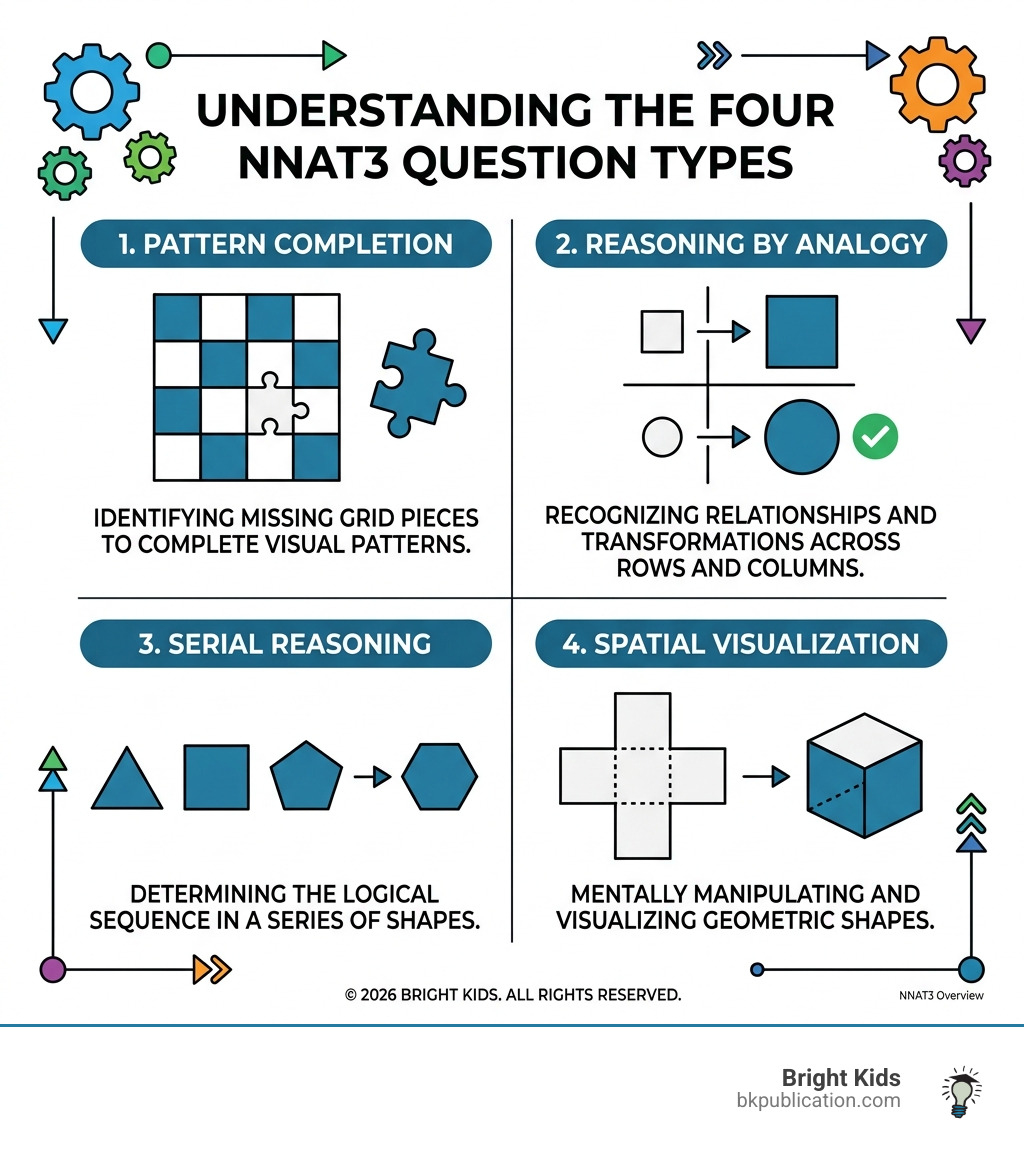
- Test context: The NNAT has 48 questions total, completed in about 30 minutes, across four types: Pattern Completion, Reasoning by Analogy, Serial Reasoning, and Spatial Visualization
Think of it like this: the top row shows a relationship between two shapes. The bottom row starts the same kind of relationship — and your child has to figure out what comes next.
It sounds simple. But for many students, the jump from "I see shapes" to "I see the rule connecting shapes" takes real practice.
I'm Bige Doruk, founder of Bright Kids, and over nearly two decades of helping more than 10,000 students prepare for gifted and admissions assessments — including extensive work with NNAT reasoning by analogy — I've seen exactly where kids get stuck and what actually helps them break through. In this guide, I'll walk you through everything: how these questions work, what transformations to look for, and how to practice effectively at home.
Understanding NNAT Reasoning by Analogy
At its core, NNAT Reasoning by Analogy is about recognizing structural relationships. On the test, this appears as a matrix—usually a 2x2 grid for younger children (Levels A and B) or a 3x3 grid for older students. The challenge isn't just identifying the shapes, but understanding the logic of how one shape transforms into another.
Imagine a square in the top-left box that is white. In the top-right box, that same square is now shaded blue. If the bottom-left box shows a white circle, the "analogy" dictates that the bottom-right box must contain a blue circle. The rule is: "Shape stays the same, but the color changes from white to blue."
The Matrix Format and Visual Logic
The matrix format is a classic tool in cognitive assessment because it requires students to think both horizontally (across rows) and vertically (down columns). This dual-axis reasoning is a hallmark of high-level visual logic. In academic research, such as the study on Neural Analogical Matching, analogy is described as a core component of human cognition. It allows us to take what we know about one situation and apply it to another. For a student, this means looking at the first row as a "solved" example and treating the second or third row as the "problem" to be solved using the same rules.
The Structure of NNAT Reasoning by Analogy Questions
Each question presents a puzzle with one missing cell, usually marked by a question mark. To solve it, the student must isolate specific attributes of the objects, such as:
- Object Transformation: Does the shape change from a triangle to a square?
- Row Logic: What happens as we move from left to right?
- Column Logic: What happens as we move from top to bottom?
In more complex 3x3 grids, the logic might involve multiple steps. For instance, an object might rotate 90 degrees in the second cell and then another 90 degrees in the third. Understanding these "relational propositions" is vital. Research in An Analogy Ontology for integrating analogical processing and first-principles reasoning suggests that human-like flexibility in reasoning comes from matching these structured representations. When your child solves an analogy, they are performing a "structural alignment" between the known parts of the grid and the unknown parts.
Why Visual Analogies Matter for Gifted Admissions
Why do schools in New York, Chicago, and Los Angeles rely so heavily on the NNAT? Because it is a "nonverbal" test, meaning it doesn't rely on a child's English language skills or their cultural background. It measures raw aptitude—the ability to solve novel problems.
NNAT Reasoning by Analogy is a perfect measure of this because it tests:
- Problem-Solving: Can the child find a rule in a sea of visual information?
- Cultural Fairness: A child from a non-English speaking home in Miami has the same opportunity to succeed as a native speaker in Fairfax, as the shapes are universal.
- Cognitive Development: It tracks the transition from concrete thinking (seeing a shape) to abstract reasoning (seeing a transformation).
Core Skills and Visual Transformations
To master nnat reasoning by analogy, a student must become a "visual detective." They need to look past the "what" (it’s a circle) and focus on the "how" (how did it change?).
Pattern Recognition and Spatial Reasoning
Pattern recognition is the ability to see a recurring theme. In the NNAT, this often involves visual-spatial reasoning, which is how we perceive and manipulate objects in our mind's eye. Interestingly, modern research on Large Language Models as Analogical Reasoners shows that even advanced AI performs better when it "recalls" similar problems to guide its reasoning. We teach our students to do the same: recall the "types" of changes they have seen before to predict the answer.
Common Transformations to Identify
When we work with students at Bright Kids, we teach them to look for a specific "menu" of changes. If they can identify which "ingredient" changed, they can find the answer.
- Shading/Color Changes: A shape goes from clear to striped, or from yellow to blue.
- Mirroring (Reflection): A shape flips across a central axis (like looking in a mirror).
- Size Alteration: An object grows larger or shrinks as it moves across the row.
- Position Shifts: An object moves from the top-left corner to the bottom-right.
- Rotational Symmetry: The object turns clockwise or counter-clockwise (often by 45, 90, or 180 degrees).
- Line Symmetry: Recognizing if a shape is a "fold-over" match of another.
Mastering Complex NNAT Reasoning by Analogy Patterns
As students move into Level D (3rd and 4th grade) and Level F (7th and 8th grade), the patterns become multi-dimensional. You might see:
- Doubling Shapes: One circle becomes two overlapping circles.
- Horizontal Separation: Two overlapping images move away from each other.
- Element Isolation: A complex design is "broken apart," and only one piece (like the inner star) moves to the next box.
We often recommend using a Gifted and Talented Practice Test to expose children to these specific, high-level transformations early on. By isolating one element at a time—looking only at the outer shape first, then only at the shading—the complexity becomes manageable.
NNAT Levels and Grade-Specific Expectations
The NNAT is divided into levels based on the student's grade. While all levels test the same core abilities, the "Reasoning by Analogy" section evolves significantly as the child grows.
NNAT Level Breakdown
| NNAT Level | Grade Level | Focus of Analogy Questions |
|---|---|---|
| Level A | Kindergarten | Simple 2x2 matrices; basic color and shape changes. |
| Level B | 1st Grade | Introduction of 3x3 grids; mirroring and simple rotation. |
| Level C | 2nd Grade | More complex shading; orientation changes. |
| Level D | 3rd & 4th Grade | Multi-step transformations (e.g., size + color change). |
| Level E | 5th & 6th Grade | Abstract geometric relationships; parts of a whole. |
| Level F | 7th & 8th Grade | Complex 3x3 matrices; spatial visualization integration. |
| Level G | 9th - 12th Grade | Highly abstract patterns; minimal visual cues. |
Progression of Difficulty
In Kindergarten (Level A), a question might simply ask a child to find the matching colored shape. By the time a student reaches Level F in middle school, they are dealing with 48 questions in 30 minutes that require them to track three or four moving parts simultaneously across a 3x3 grid. The time limit—averaging about 37 seconds per question—means that speed and accuracy are equally important.
Strategies for Solving NNAT Reasoning by Analogy Questions
How do we take a frustrated student and turn them into an analogy expert? It starts with a plan.
The "Bridge Sentence" Strategy
This is our favorite tool at Bright Kids. We encourage students to create a "bridge sentence" that connects the first two boxes.
- Example: "The big red triangle becomes a small blue triangle."
- Application: Now, apply that exact sentence to the bottom row: "The big red square becomes a... (small blue square)."
If the student can verbalize the rule, they are much less likely to be tricked by "distractor" answer choices that look almost right but miss one detail.
Step-by-Step Solving Techniques
- Verbal Prompting: For younger kids, we ask: "How do the objects change in the first row? Do they change the same way in the second?"
- Prediction Method: Cover the answer choices. Have your child draw or describe what they think belongs in the empty box before they look at the options. This prevents them from being swayed by clever distractors.
- Element Tracking: If a shape has an outer border, an inner color, and a dot in the middle, track them one by one. Does the border change? No. Does the color change? Yes. Does the dot move? Yes.
- Elimination Strategy: Cross out answers that clearly break the rule. If the rule is "the shape must be blue," eliminate all red and yellow options immediately.
For more practice with these types of matrix-based puzzles, our CogAT Figure Matrices Exercises provide excellent cross-training, as the logic required is very similar to the NNAT.
Avoiding Common Mistakes
- The "Partial Pattern" Trap: A student sees that the color changed and picks the first blue shape they see, failing to notice that the shape also needed to rotate.
- Ignoring Columns: Sometimes the pattern is easier to see by looking from top to bottom rather than left to right. Encourage your child to check both.
- Over-complicating: Usually, the logic is elegant. If a child is coming up with a 10-step explanation, they’ve likely missed a simpler "mirror" or "rotation" rule.
How Reasoning by Analogy Differs from Other NNAT Sections
To succeed on the full test, students must switch gears between four different types of thinking. Understanding the "vibe" of NNAT Reasoning by Analogy compared to the others is helpful:
- Pattern Completion: This is like a jigsaw puzzle. You are looking for the piece that physically fits into a larger design to make it whole.
- Serial Reasoning: This is about sequences. If you have a line of shapes (A, B, C...), what is D? It’s a linear progression.
- Spatial Visualization: This is the most difficult for many. It involves imagining what happens when you combine two shapes or fold a piece of paper.
- Reasoning by Analogy: Unlike the others, this is strictly about relationships. It asks: "If this happened to that, what happens to this other thing?" It requires a "logical leap" that the other sections do not.
Research from the QRG at Northwestern emphasizes that while spatial visualization is about manipulation, analogy is about "mapping" attributes. This is why a student might be a genius at Pattern Completion but struggle with Analogies—they are different "muscles" in the brain.
Parent Guide: Practicing at Home
You don't need to be a math whiz to help your child with NNAT Reasoning by Analogy. Here are some practical ways to build these skills in everyday life:
- Interactive Games: Play "What's the Rule?" Use household objects. "If my big spoon is next to my small spoon, and my big fork is here... what goes next to it?"
- Visual Puzzles: "Spot the Difference" books and Tangrams are fantastic for building spatial awareness and detail orientation.
- Workbook Practice: Consistent, low-stress practice is key. Use high-quality materials that mimic the actual NNAT interface (especially if they will be taking the test online).
- Establish a Routine: 15 minutes of "brain puzzles" three times a week is much more effective than a four-hour "cram session" the weekend before the test.
- Verbalize Everything: Ask your child to explain why they picked an answer. The act of explaining the logic solidifies the "bridge sentence" habit.
Frequently Asked Questions about the NNAT
What is the time limit for the NNAT?
The NNAT is generally administered with a 30-minute time limit for 48 questions. This applies across most grade levels. Because the test is timed, we emphasize "efficient accuracy"—learning to spot the rule quickly without rushing into silly mistakes.
Should my child guess if they don't know the answer?
Yes! There is no penalty for incorrect answers on the NNAT. If your child is stuck, they should eliminate the obviously wrong choices and then make an educated guess. A blank box is always zero points, but a guess gives them a 20-25% chance of getting it right.
How is the NNAT different from the CogAT or OLSAT?
The NNAT is entirely nonverbal and uses only geometric shapes. The CogAT (Cognitive Abilities Test) has verbal, quantitative (math), and nonverbal sections. The OLSAT (Otis-Lennon School Ability Test) also includes a heavy verbal component. Many school districts, particularly in New York City and across California, use the NNAT because it provides a fairer assessment for English Language Learners (ELL).
Conclusion
Mastering NNAT Reasoning by Analogy is about more than just passing a test; it’s about developing the logical "mapping" skills that will help your child in everything from computer coding to high-level mathematics. By understanding the matrix format, learning to spot transformations like mirroring and rotation, and practicing with "bridge sentences," your child can approach test day with confidence.
At Bright Kids, we’ve spent 17 years perfecting the art of nonverbal test prep. Our NYC-based tutoring and comprehensive workbooks are designed to mimic the real exam experience, ensuring there are no surprises on test day. Whether you are in New York, San Francisco, or anywhere nationwide, we are here to support your child's journey into gifted and talented programs.
Master NNAT preparation with our expert resources and give your child the tools they need to succeed!