

Stanford-Binet Kindergarten Book Guide: Raising a Little Einstein
Apr 06, 2026
The Best Stanford-Binet Practice Books to Prepare Your Child for Gifted Testing
A Stanford-Binet Practice book is one of the most effective tools you can use to prepare your child for gifted school admissions and IQ-based assessments. Here are the top options available right now:
| Product | Price | Best For | Format |
|---|---|---|---|
| Stanford-Binet Preparation Guide (Pre-K & K) | $400 | Ages 4-8, full prep | Physical book + manipulatives |
| Premium Stanford-Binet Ultimate Bundle | $450 (was $500) | Complete coverage | Workbooks + card games |
The Stanford-Binet Intelligence Scales, Fifth Edition (SB5), has been the gold standard for measuring cognitive ability since 1916. It is used to assess children for gifted programs across the country — most notably for Hunter College Elementary School (HCES) admissions in New York City.
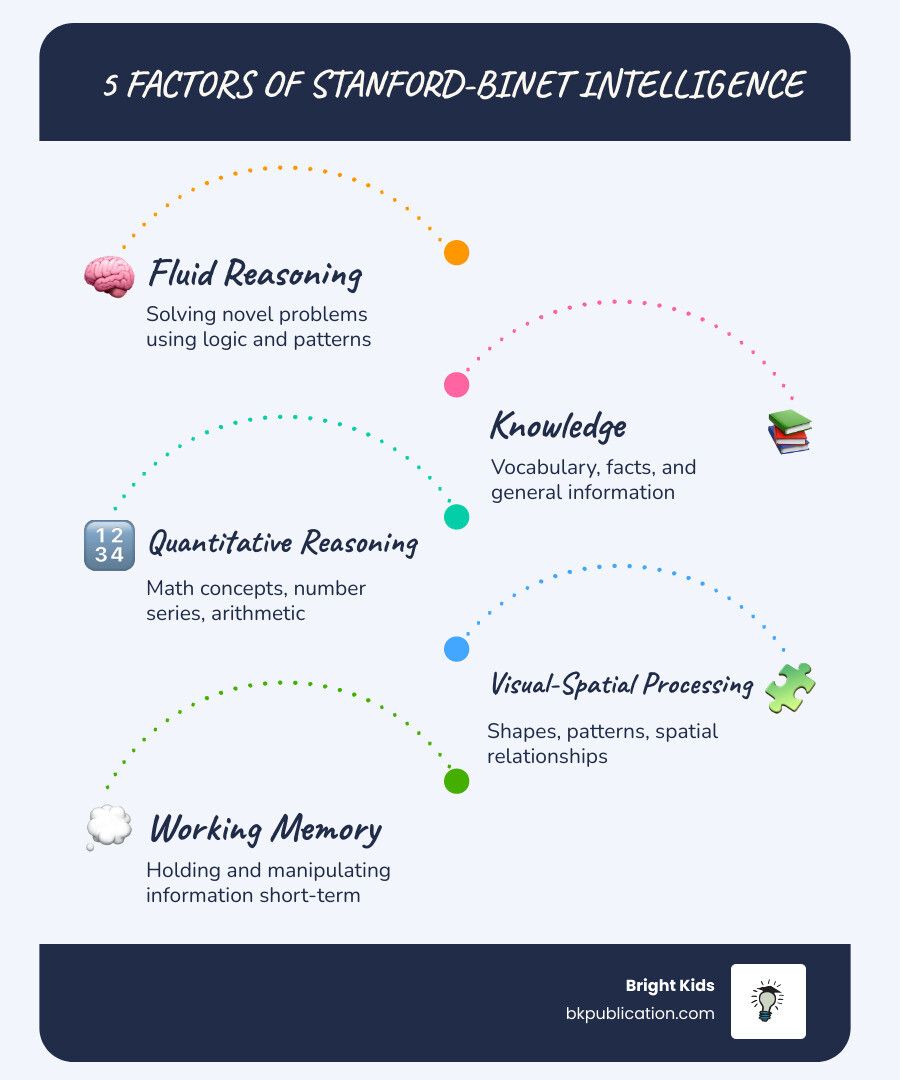
For parents, the stakes feel high. And they are. Getting your child into a top gifted program often comes down to a single test score — one that measures five cognitive factors: fluid reasoning, knowledge, quantitative reasoning, visual-spatial processing, and working memory.
The good news? Preparation works. Familiarizing your child with the test format, question types, and pacing can meaningfully reduce test anxiety and improve performance — without turning study time into stress time.
I'm Bige Doruk, founder of Bright Kids and author of multiple Stanford-Binet resources used by thousands of families preparing for gifted admissions. Over nearly two decades, I've helped more than 10,000 students build the cognitive skills and test confidence they need to succeed. In this guide, I'll walk you through the best preparation materials available so you can choose what's right for your child.
Understanding the Stanford-Binet Intelligence Scales (SB5)
When we talk about intelligence testing, the Stanford-Binet name carries a lot of weight. The current version, the SB5, is an individually administered assessment designed to document the cognitive strengths and weaknesses of anyone from age 2 to 85+. For parents of young children, we typically focus on the "Early SB-5," a version tailored for preschoolers and kindergarteners (ages 2 to 5 years and 11 months).
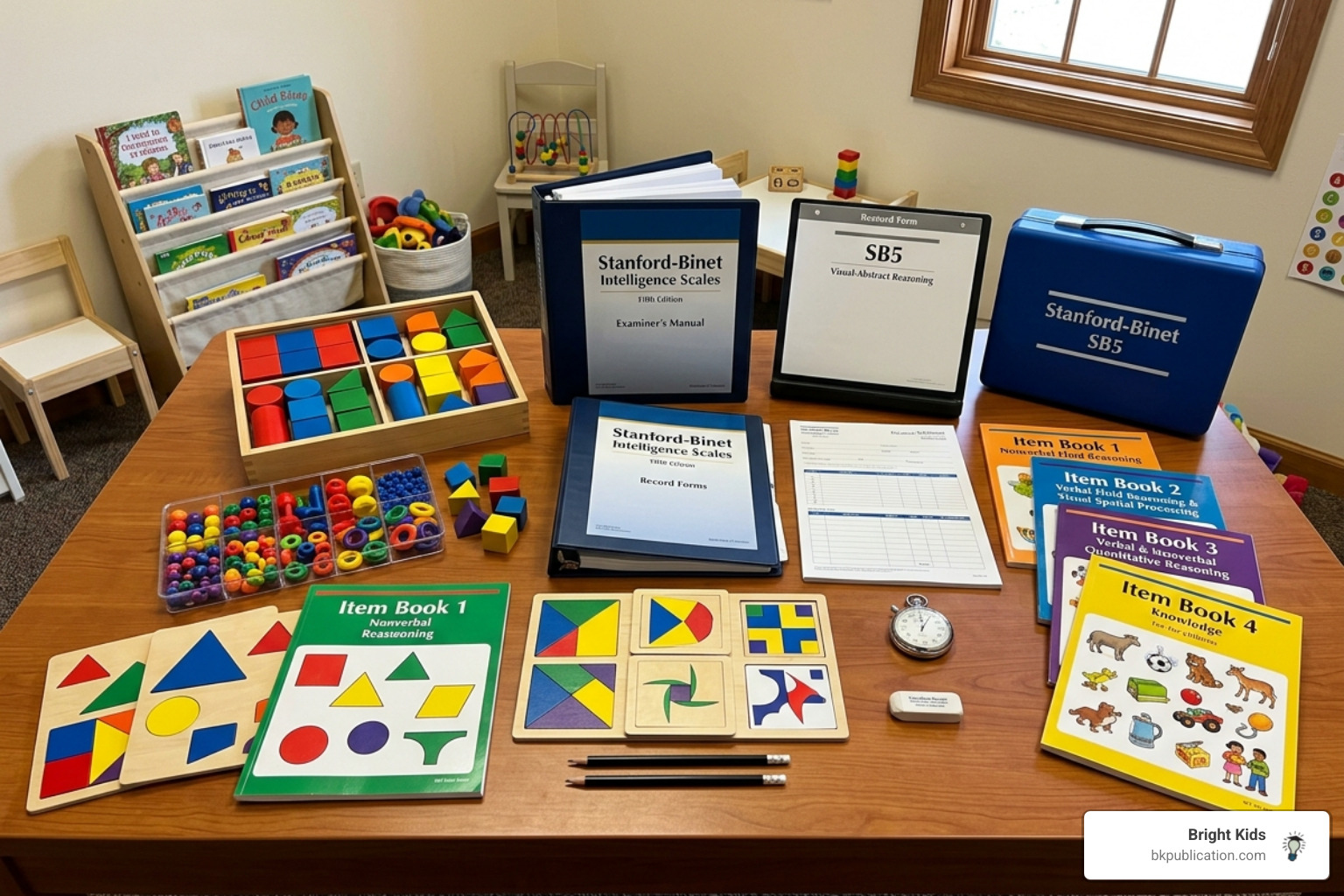
The SB5 isn't just a "bubble sheet" test. It is a sophisticated battery of subtests that requires a Level C qualification for professional administration. This means the person giving the test to your child is usually a psychologist or a highly trained educational professional. They use a variety of tools, from picture books to physical blocks, to see how a child’s mind works.
The test was built on a massive normative sample of 4,800 individuals, ensuring that the results are representative across different ethnicities, regions, and socioeconomic backgrounds. If you want to dive deep into the technical side of how the test is structured, the Essentials of Stanford-Binet Intelligence Scales (SB5) Assessment is the definitive professional resource.
The Five Factors of Intelligence
The SB5 doesn't just give one "IQ score." It breaks intelligence down into five distinct cognitive factors. A high-quality Stanford-Binet practice book will target each of these specifically:
- Fluid Reasoning: The ability to solve new problems that don't depend on past knowledge. Think of this as "raw brainpower"—using logic to see patterns or solve puzzles.
- Knowledge: This measures the "crystallized" information a child has picked up from their environment, such as vocabulary and social understanding.
- Quantitative Reasoning: This isn't just 1+1=2. It involves understanding number concepts, patterns, and mathematical logic.
- Visual-Spatial Processing: This is the ability to see how objects fit together in space. Can your child visualize a completed puzzle or rotate a shape in their mind?
- Working Memory: This is the "scratchpad" of the brain. It measures how well a child can hold information in their head and manipulate it (like repeating a sequence of numbers backward).
Stanford-Binet and HCES Admissions
In New York City, the Stanford-Binet is famous for its role in the Hunter College Elementary School (HCES) admissions process. HCES is a tuition-free, publicly funded gifted school that is open exclusively to Manhattan residents.
The school uses a customized adaptation of the Stanford-Binet 5 to identify students for its kindergarten program. Because the competition is so fierce, many parents look for a specialized Stanford-Binet Practice Book or kit that mirrors the specific sections used by Hunter, such as the verbal and non-verbal reasoning components.
Why Your Child Needs a Stanford-Binet Practice Book
You might wonder, "If it's an IQ test, shouldn't it just measure natural ability?" While the SB5 does measure cognitive potential, the format of the test can be very intimidating for a four-year-old. Imagine being led into a room with a stranger who starts asking you to solve puzzles with blocks and answer abstract questions. If a child is confused by the instructions or scared by the environment, they won't perform at their true potential.
Using a Stanford-Binet practice book helps in several key ways:
- Anxiety Reduction: Familiarity breeds confidence. If your child has seen similar patterns or played with similar blocks at home, the actual test feels like just another "game day."
- Strategy Building: We teach children how to look at a problem. For example, in a matrix reasoning task, we teach them to look at the rows and columns systematically.
- Instructional Clarity: Sometimes a child knows the answer but doesn't understand what the examiner is asking. Practice helps them decode the "language" of the test.
If you're curious where your child stands right now, taking a Gifted and Talented Practice Test can serve as a great baseline to see which areas need the most focus.
Simulating the Testing Environment
One of the unique features of our Stanford-Binet Preparation Guide is the inclusion of physical manipulatives. The SB5 isn't just about looking at pictures; it involves hands-on tasks. Our premium guides include:
- Blocks and Tangrams: To practice visual-spatial construction.
- Puzzle Pieces: For pattern completion and part-whole relationships.
- Classification Cards: To help children learn how to group objects by "Knowledge" and "Fluid Reasoning" categories.
By using these physical tools, you are simulating the actual testing environment, which is much more effective than just looking at a computer screen or a flat piece of paper.
Early Preparation for Pre-K and Kindergarten
We generally recommend starting preparation for children between the ages of 4 and 8. At this age, a child's brain is incredibly plastic. They aren't just "learning the test"; they are developing cognitive skills that will help them throughout their academic careers.
Preparing for the Stanford-Binet is essentially a high-level workout for the brain. Whether they end up in a gifted program or a traditional classroom, the logic, memory, and spatial skills they gain from a stanford binet practice book will give them a significant head start.
Key Skills Targeted in Stanford-Binet Preparation
A comprehensive Stanford-Binet practice book must cover both the Verbal and Non-Verbal domains across all five factors. For a glimpse into the actual items used in the Fifth Edition, professionals often refer to the Stanford-Binet V (SB-V) Item Book 2, which contains the specific tasks for various levels. Our materials are designed to reflect these tasks while remaining engaging for young children.
Verbal vs. Non-Verbal Subtests
The SB5 is balanced. If your child is a "math whiz" but struggles with vocabulary, or vice versa, the test is designed to find their unique profile.
| Subtest Category | Skills Measured | Example Task |
|---|---|---|
| Verbal | Language, social knowledge, verbal logic | "How are a fly and a butterfly different?" |
| Non-Verbal | Visual patterns, spatial logic, math | Completing a grid of shapes (Matrix Reasoning) |
Mastering Logic and Analogies in a Stanford-Binet practice book
Analogies and classifications are the bread and butter of the Fluid Reasoning factor. We teach children to identify relationships between words or objects.
- Verbal Analogies: "Brother is to sister as niece is to..." (Answer: Nephew).
- Classifications: "Which one doesn't belong: Bear, Snake, Cow, Dog, Tiger?" (Answer: Snake—it's the only one without legs).
- Logical Deduction: We help children work through "if-then" statements and syllogisms, which are often the trickiest parts of the test for young kids.
Quantitative and Visual-Spatial Skills in a Stanford-Binet practice book
For the Quantitative Reasoning section, a Stanford-Binet practice book focuses on more than just counting. It involves "Arithmetic Reasoning"—solving word problems like: "John has $.41 in change. If he has six coins, what must they be?"
Visual-spatial skills are practiced through tangrams and form boards. We provide practice items that require the child to look at a complex design and figure out which pieces are needed to recreate it. This builds the spatial orientation skills necessary for the "Visual-Spatial Processing" factor of the SB5.
Top Features of Premium Preparation Materials
When you are looking for a Stanford-Binet practice book, you shouldn't just look for a stack of photocopied questions. Premium materials are designed to be a "school in a box."
Our Stanford-Binet Preparation Guide (Pre-K & Kindergarten) is priced at $400 because it is much more than a book. It includes over 500 practice items, but it also comes with the actual physical blocks, tangrams, and cards your child will encounter during the test. This "all-in-one" approach is why we’ve been trusted by families for over 17 years.
Interactive Card Games and Workbooks
Sometimes, sitting down with a big workbook feels too much like "work." That's why we developed interactive card games. These allow you to practice on the go—in the car, at a restaurant, or before bed.
- Describe That Word: Builds the "Knowledge" factor and vocabulary.
- Figural Analogies: Uses shapes to teach logic.
- Name That Category: Helps with classification skills.
- Quantitative Reasoning: Turns math logic into a fun challenge.
Choosing the Right Stanford-Binet practice book
How do you know which book is right?
- Check the Age Range: Ensure the book is specifically for Pre-K/Kindergarten (ages 4-6) or the older 7-10 range.
- Look for Strategy Guides: A good book doesn't just give the answer; it explains why the answer is correct and how to find it.
- Comprehensive Bundles: If you are preparing for HCES or a top-tier private school, the Ultimate Bundle ($450) is usually the best value, as it combines the main guide with all the specialized workbooks and card decks.
Frequently Asked Questions about Stanford-Binet Preparation
What is the difference between the official test kit and a practice book?
This is a common point of confusion. An official SB5 test kit (like those from WPS) costs about $1,429 and is only sold to licensed professionals (Level C). It contains the manuals and scoring software used for the actual assessment.
A Stanford-Binet practice book, like the ones we provide at Bright Kids, is designed for parents. It contains similar (but not identical) items and manipulatives so your child can practice the skills and format without "spoiling" the actual test questions.
How long should a child practice before the actual exam?
We recommend starting 2 to 3 months before the test date. The goal isn't to cram. We suggest short, 15-to-20-minute sessions a few times a week. This keeps the experience positive and prevents the child from feeling burnt out. Consistency is much more important than intensity!
What are the typical shipping and return policies for these books?
At Bright Kids, we know that timing is everything when a test date is approaching.
- Shipping: We offer same-day shipping for orders placed before 1 pm EST.
- Returns: We accept returns within 10 days of delivery, provided the materials are unopened and in their original shrink wrap.
- Important Note: Because these are high-value intellectual property items, we cannot offer refunds once the shrink wrap is broken or for digital PDF downloads.
Conclusion
Preparing your child for the Stanford-Binet doesn't have to be a stressful ordeal. With the right Stanford-Binet practice materials, it can actually be a bonding experience that builds your child's confidence and sharpens their cognitive skills.
At Bright Kids, we pride ourselves on providing the most comprehensive, "test-mimicking" materials on the market. Whether you are aiming for the Hunter College Elementary School or simply want to understand your child's cognitive profile, we are here to help. Our combination of expert-authored books and world-class tutoring has helped thousands of "Little Einsteins" reach their full potential.
Ready to start your journey? Explore our Stanford-Binet and HCES preparation materials here and give your child the tools they need to shine.