

The Ultimate Guide to Cracking CogAT Number Series Patterns
Apr 09, 2026
Why CogAT Number Series Exercises Are the Key to Quantitative Battery Success
CogAT number series exercises are one of the most important practice tools for students preparing for the Cognitive Abilities Test (CogAT) Quantitative Battery. Here's a quick snapshot of what they involve:
Quick Answer: What Are CogAT Number Series?
- Students are shown a sequence of numbers (or pictures for younger grades) and must identify the pattern
- They then select the number that comes next from multiple-choice options
- Patterns range from simple (+2 each time) to complex (alternating +7, -3)
- The subtest appears in every CogAT level, from Kindergarten through 12th grade
- Question counts range from 14 questions (Level 5/6, Kindergarten) to 18 questions (Levels 8-18)
These exercises don't test memorized math facts. They test how your child thinks — specifically, whether they can spot a rule, verify it, and apply it quickly under timed conditions.
That distinction matters. A child who practices number series regularly builds the kind of flexible, logical thinking that gifted program screeners are designed to identify.
The Quantitative Battery is one of three CogAT sections — alongside Verbal and Nonverbal — and Number Series makes up roughly one-third of it. That means strong performance here can meaningfully move your child's overall score.
I'm Bige Doruk, founder of Bright Kids, and over nearly two decades of helping more than 10,000 students prepare for assessments like the CogAT, number series exercises have consistently been one of the highest-leverage areas where focused practice produces real results. In this guide, you'll find everything you need to help your child understand, practice, and master this critical subtest.
Understanding CogAT Number Series Exercises
When we talk about the CogAT (Cognitive Abilities Test), we are looking at an assessment that measures a child’s learned reasoning abilities. Unlike a standard math test that asks a student to multiply 12 by 15, CogAT number series exercises ask the student to look at a string of numbers—like 6, 21, 9, 18, 12—and figure out the "secret code" that connects them.
This subtest is a core component of the Quantitative Battery. It specifically targets quantitative reasoning and abstract thinking. To succeed, a student must move beyond rote calculation and engage in sequence prediction. They need to identify a logical rule, verify that it works for every step of the sequence, and then use that rule to find the missing link.
When we help students with these exercises, we aren't just teaching them math; we are teaching them how to interpret their CogAT scores by understanding the underlying logic. High performance in this area correlates with strong mental math skills and the ability to solve complex, multi-step problems in the real world.
Why CogAT Number Series Exercises Matter for Quantitative Reasoning
You might wonder why identifying whether a sequence goes +2 or -3 matters so much for a child’s academic future. The answer lies in cognitive flexibility. The ability to detect patterns is a foundational skill for higher-level mathematics, computer science, and even scientific inquiry.
By practicing these exercises, students learn to see numerical relationships rather than isolated digits. This shifts their perspective from "What is the answer?" to "How do these things relate to one another?" If you are getting to know CogAT for parents, it is helpful to realize that these questions are designed to find students who can adapt their thinking when a pattern suddenly changes. This type of pattern detection is exactly what gifted and talented programs are looking for.
How to Approach CogAT Number Series Exercises for Beginners
For a child seeing these for the first time, a long string of numbers can feel overwhelming. We always recommend a step-by-step analysis.
- Look at the first two numbers: What is the difference? Did the number get bigger or smaller?
- Check the next pair: Does the same rule apply? If the first jump was +3, is the second jump also +3?
- Identify the rule: Once you see a consistent change, you’ve found the rule.
- Apply the rule to the final number: This gives you your answer choice.
Grade-Level Variations: From Abacus to Algebra
The CogAT is a "leveled" test, meaning the difficulty and format change based on the student's age and grade. A 5-year-old is not looking at the same screen as a 12-year-old. Understanding these levels—from Level 5/6 (Kindergarten) up to Level 18 (12th Grade)—is vital for effective practice.
| CogAT Level | Grade Level | Number Series Questions | Format Type |
|---|---|---|---|
| Level 5/6 | Kindergarten | 14 | Picture-based (Abacus) |
| Level 7 | 1st Grade | 16 | Picture-based (Abacus) |
| Level 8 | 2nd Grade | 18 | Picture-based (Abacus) |
| Level 9 | 3rd Grade | 18 | Numerical Sequences |
| Level 10-18 | 4th-12th Grade | 18 | Numerical Sequences |
Adapting to Primary Level CogAT Number Series Exercises
In Kindergarten through 2nd Grade (Levels 5/6 to 8), the test focuses on visual reasoning. Instead of seeing the number "5," a child might see an image of an abacus with five beads.
The task remains the same: identify the pattern of beads. Does each abacus have two more beads than the last? Or does the pattern go: 2 beads, 4 beads, 3 beads, 5 beads? At Level 5/6, there are 14 questions, increasing to 18 questions by Level 8. For these primary levels, the test is typically audio-led, meaning a proctor or a recording reads the instructions to ensure that reading ability doesn't interfere with measuring cognitive potential.
Advancing to Multi-Step Numerical Sequences
Starting in 3rd Grade (Level 9), the training wheels come off. The abacus images disappear, and students are faced with purely numerical sequences. The test moves to an online format without audio support.
At this stage, the complexity increases significantly. Students aren't just looking for simple addition; they might encounter alternating operations (like multiply by 2, then subtract 1). This requires a level of algebraic thinking where the student must hold one part of the pattern in their head while solving the next. Across Levels 9 through 18, the subtest consistently features 18 questions, making it a marathon of mental agility.
Mastering Common Patterns and Solving Strategies
Success in CogAT number series exercises comes down to recognizing the "Big Three" pattern types. We teach our students to look for these specifically:
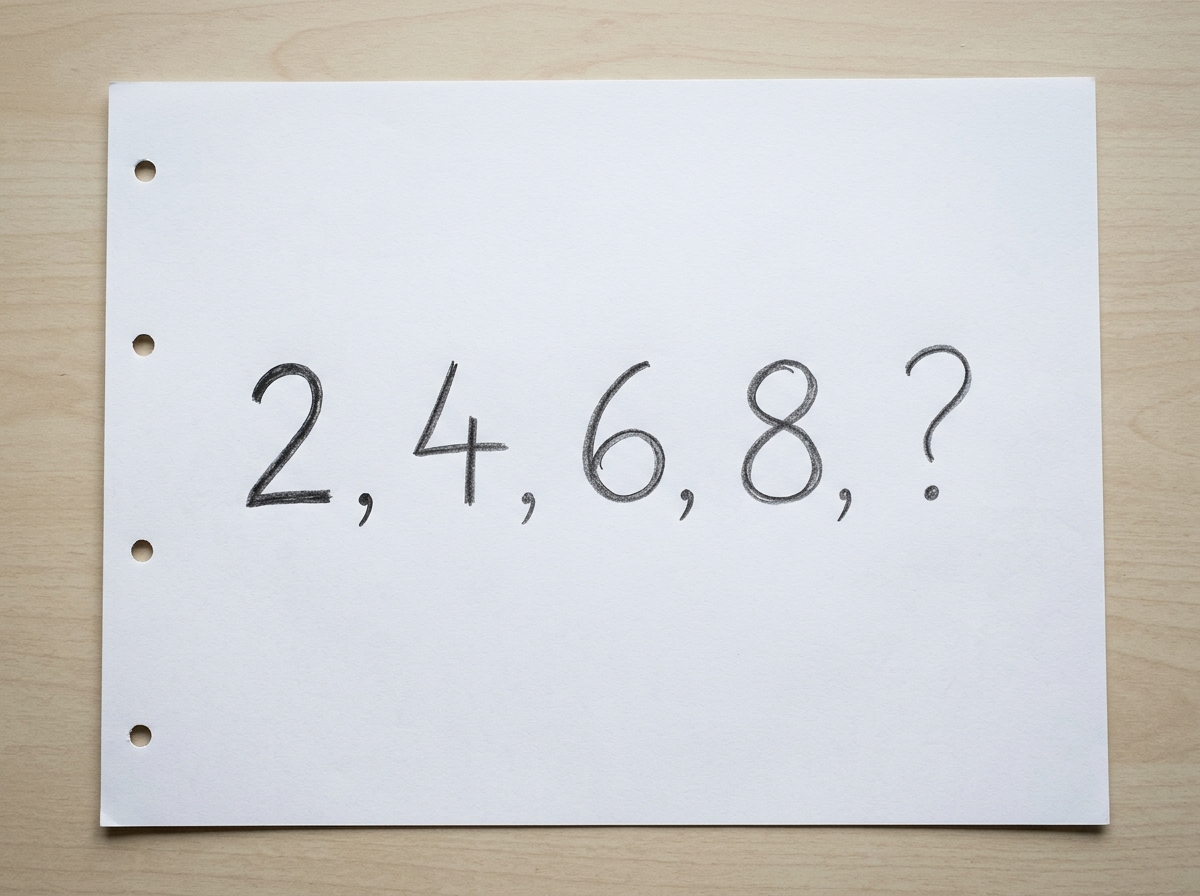
- Arithmetic Sequences: The same number is added or subtracted every time (e.g., 2, 4, 6, 8... Rule: +2).
- Alternating Rules: Two different rules take turns (e.g., 5, 12, 9, 16, 13... Rule: +7, -3).
- Geometric/Progressive Rules: The difference between numbers changes in a predictable way (e.g., 2, 4, 8, 16... Rule: x2).
Identifying Arithmetic and Alternating Patterns
Most students find consistent increments (like +5 or -2) fairly quickly. The real challenge begins with multi-step logic. For example, in a sequence like 2, 4, 3, 5, 4, the student must realize that the pattern is +2, then -1, then +2, then -1.
A smart way to build skill is to practice sequence verification again and again. Encourage your child to use a simple "think-aloud" approach: say each step out loud while looking at the numbers. For example, if they notice, "It goes up by 2, then down by 1," they are already identifying the rule. That habit makes patterns easier to spot and helps children check their logic before choosing an answer.
Advanced Strategies for Complex Series
As students reach Level 11 (5th Grade) and beyond, the patterns become even more deceptive. Some sequences might even alternate between numbers and letters! For instance, a series might look like: D, 16, F, 17, H, 18.
To solve this type of question, students can use variable isolation by separating the letters from the numbers and looking for two different rules. For example, the letters may move by skipping one each time, while the numbers increase by 1. This simple step makes mixed patterns much easier to spot and check.
When a pattern is truly stuck, we teach the "educated guessing" rule. Since there is no penalty for wrong answers on the CogAT, it is better to pick the most likely pattern and move on than to waste three minutes on a single question.
Test Day Success: Timing and Common Pitfalls
The CogAT is a timed test. Usually, students have about 20 to 25 minutes per battery section. With 18 questions in the Number Series subtest, that leaves less than a minute per question.
Common mistakes we see include:
- Calculation Errors: A student correctly identifies the "+7" rule but accidentally adds 7 to 13 and gets 19 instead of 20.
- Overthinking: Looking for a complex multiplication rule when the pattern is a simple addition.
- Running Out of Time: Spending too long on the first five questions and having to rush the last ten.
To avoid these, focus on stamina building. Practice simulations are the best way to get a child used to the "pacing" of the test. They need to learn when to trust their first instinct and when to double-check their work.
Frequently Asked Questions about CogAT Number Series
How many questions are in the Number Series subtest?
The number of questions depends on the level of the test, which corresponds to the student's grade. Level 5/6 (Kindergarten) has 14 questions. Level 7 (1st Grade) has 16 questions. From Level 8 through Level 18 (2nd Grade through 12th Grade), the subtest consistently features 18 questions.
What is the difference between Number Series and Number Puzzles?
While both are part of the Quantitative Battery, they test different skills. Number Series requires identifying the next number in a sequence based on a pattern. Number Puzzles, on the other hand, involve balancing equations (e.g., 14 = ? + 6) to make both sides of an equal sign equivalent. Number Series is about "what comes next," while Number Puzzles are about "what is missing to make this equal."
Can practicing these exercises improve my child's overall score?
Absolutely. Many children have the raw intelligence to succeed but are tripped up by the unfamiliar format of the CogAT. Targeted practice with CogAT number series exercises builds familiarity with the test format and sharpens the logical reasoning skills necessary to identify complex patterns quickly under timed conditions. It turns a "scary" test into a series of solvable puzzles.
Conclusion
At Bright Kids, we believe that every child has the potential to succeed when given the right tools and strategies. For 17 years, we have helped families in New York, Chicago, Los Angeles, and across the nation navigate the complexities of gifted program admissions.
Mastering CogAT number series exercises is about more than just a test score—it's about developing reasoning habits that will serve your child throughout their academic career. By breaking down sequences, identifying rules, and practicing under timed conditions, your child can walk into test day with confidence.
Ready to start practicing? Explore our comprehensive range of CogAT materials and practice CogAT with Bright Kids to give your child the edge they need.