

Top Rated Tools for WPPSI Spatial Skills Practice Success
Apr 13, 2026
Understanding the WPPSI-IV Visual Spatial Index (VSI)
To effectively approach wppsi spatial skills practice, we first need to understand what the test is actually looking for. The Visual Spatial Index (VSI) is a primary index score on the WPPSI-IV that measures a child’s ability to understand visual details and domesticate spatial relationships. It’s not just about "seeing" a picture; it’s about visual visualization—the mental ability to flip, rotate, and break down objects in the mind's eye.
The VSI primarily assesses part-whole relationships and geometric analysis. Can your child see a completed design and understand which individual blocks or pieces are required to build it? This requires a high level of visual-motor integration, where the eyes and hands work in perfect harmony.
On the WPPSI-IV, the VSI is derived from two key subtests:
- Block Design: The "gold standard" of spatial testing. Children use multicolored cubes (red, white, or half-and-half) to replicate a 2D pattern shown in a stimulus book. This measures nonverbal concept formation and simultaneous processing.
- Object Assembly: This subtest involves fitting puzzle pieces together to form a familiar object within a strict time limit. It tests how well a child can synthesize disparate parts into a meaningful whole.
According to WPPSI-IV Subtests and Composites - Pearson Support, these tasks are designed to be game-like to keep young children engaged. Scoring ranges typically fall between 40 and 160, with 100 being the mean. A score of 110–119 is considered "High Average," while 120–129 is "Superior." If your child hits the 130+ mark, they are in the "Very Superior" range, which is often a prerequisite for elite gifted programs in cities like New York or Chicago.
Essential Tools for WPPSI Spatial Skills Practice
When we talk about the best tools for wppsi spatial skills practice, we aren't just talking about apps on a tablet. Because the WPPSI-IV is a hands-on assessment, the best practice tools are physical objects that a child can touch and manipulate.

Multicolored Cubes and Block Sets
Since Block Design is a cornerstone of the VSI, having a set of red and white cubes is essential. Look for blocks that have solid red sides, solid white sides, and sides split diagonally with both colors. Practice starts simply—matching one block to a picture—and moves toward complex 9-block patterns. This builds visual-spatial synthesis, where the child learns to ignore the "seams" between blocks to see the overall geometric pattern.
Tangrams and Pattern Boards
Tangrams are ancient Chinese puzzles consisting of seven flat shapes (tans) which are put together to form shapes. These are incredible for abstract reasoning. They force a child to rotate triangles and squares in their mind to fit a specific silhouette, directly mirroring the mental requirements of the WPPSI.
Logic Puzzles and Matrix Exercises
Spatial skills aren't just about blocks; they are about logic. We often recommend Cogat Figure Matrices Exercises as a supplement. While designed for the CogAT, these exercises help children understand how shapes change, rotate, and relate to one another in a grid format, which strengthens the underlying fluid reasoning that supports spatial success.
Age-Appropriate WPPSI Spatial Skills Practice
It is crucial to tailor your wppsi spatial skills practice to your child's specific age band. The WPPSI-IV is split into two distinct developmental groups:
- Ages 2:6–3:11: At this stage, the test is shorter (5 subtests). Spatial practice should focus on simple Object Assembly (3-4 piece puzzles) and basic block stacking. The goal is to develop foundational motor skills and the ability to follow simple visual instructions.
- Ages 4:0–7:3: The test expands to 14 subtests. Here, the complexity of Block Design increases significantly. Children are expected to work faster and solve more intricate patterns.
Research into the Visual Spatial Index suggests that while some children have a natural "motor-free" spatial talent (they can solve the puzzle in their head), the WPPSI requires them to actually build it. If your child is a "thinker" but struggles with "doing," focus more on fine motor activities like threading beads or using tweezers to build finger strength.
Top Educational Bundles for WPPSI Spatial Skills Practice
At Bright Kids, we’ve found that the most successful families use a "hybrid" approach: a mix of structured workbooks and hands-on kits.
- Comprehensive Workbooks: These familiarize children with the 2D representations they will see in the test stimulus book. It helps them learn to translate a flat image into a 3D structure.
- Hands-on Kits: These should include physical items like "zoo location" mats (for working memory) and uncut puzzles.
- Skill-Building Curriculum: Instead of just "teaching to the test," look for bundles that offer thinking activities. This includes tasks like "finding the missing piece" or "identifying the rotated shape," which build long-term cognitive flexibility.
How to Integrate Spatial Training into Daily Routines
You don't need to sit at a desk for hours to improve spatial reasoning. In fact, the best wppsi spatial skills practice happens on the living room floor.

The Power of Play Frequency
The statistics are clear: children who engage in spatial play (puzzles, blocks, board games) more than six times per week show a distinct advantage. We recommend turning "family game night" into a daily 15-minute "brain boost" session.
Gender-Neutral and Socioeconomic Considerations
Research indicates that boys sometimes score higher on block design, but this gap disappears when girls are given equal exposure to construction toys like Legos or Lincoln Logs. Similarly, children from all socioeconomic backgrounds can excel if they are provided with these simple, low-cost tools early on.
WISC-V Insights for Older Children
As children age out of the WPPSI and move toward the WISC-V, their spatial skills become even more critical for academic success in subjects like Geometry. Insights from WISC-V Visual Spatial — EdPsyched show that these skills are highly predictive of success in STEM careers. Starting early with the WPPSI creates a "spatial foundation" that lasts through high school.
Verbalizing Reasoning During WPPSI Spatial Skills Practice
One of our "secret weapons" at Bright Kids is encouraging metacognition—thinking about thinking. When your child is working on a block design, don't let them work in silence. Encourage them to use spatial vocabulary.
Ask questions like:
- "Does that triangle point toward the window or toward me?"
- "Which piece is the 'corner' piece?"
- "I see a big square made of four little squares. Can you see it too?"
By using logic verbalization, children bridge the gap between their visual-spatial strengths and their verbal comprehension. This is especially helpful for children who might have a relative weakness in one area; they can use their stronger verbal skills to "talk themselves through" a difficult spatial problem.
Supporting Your Child’s Unique Cognitive Profile
Every child has a unique "cognitive thumbprint." During a WPPSI-IV Assessment for NYC Children, you might discover that your child has a "spiky" profile—perhaps they are in the 98th percentile for Visual Spatial skills but only the 50th for Verbal Comprehension.
Leveraging Strengths and Addressing Weaknesses
If spatial skills are a relative strength, use them to support other areas. For example, if your child struggles to remember a list of words (Working Memory), ask them to "visualize" the items in a room (a spatial strategy).
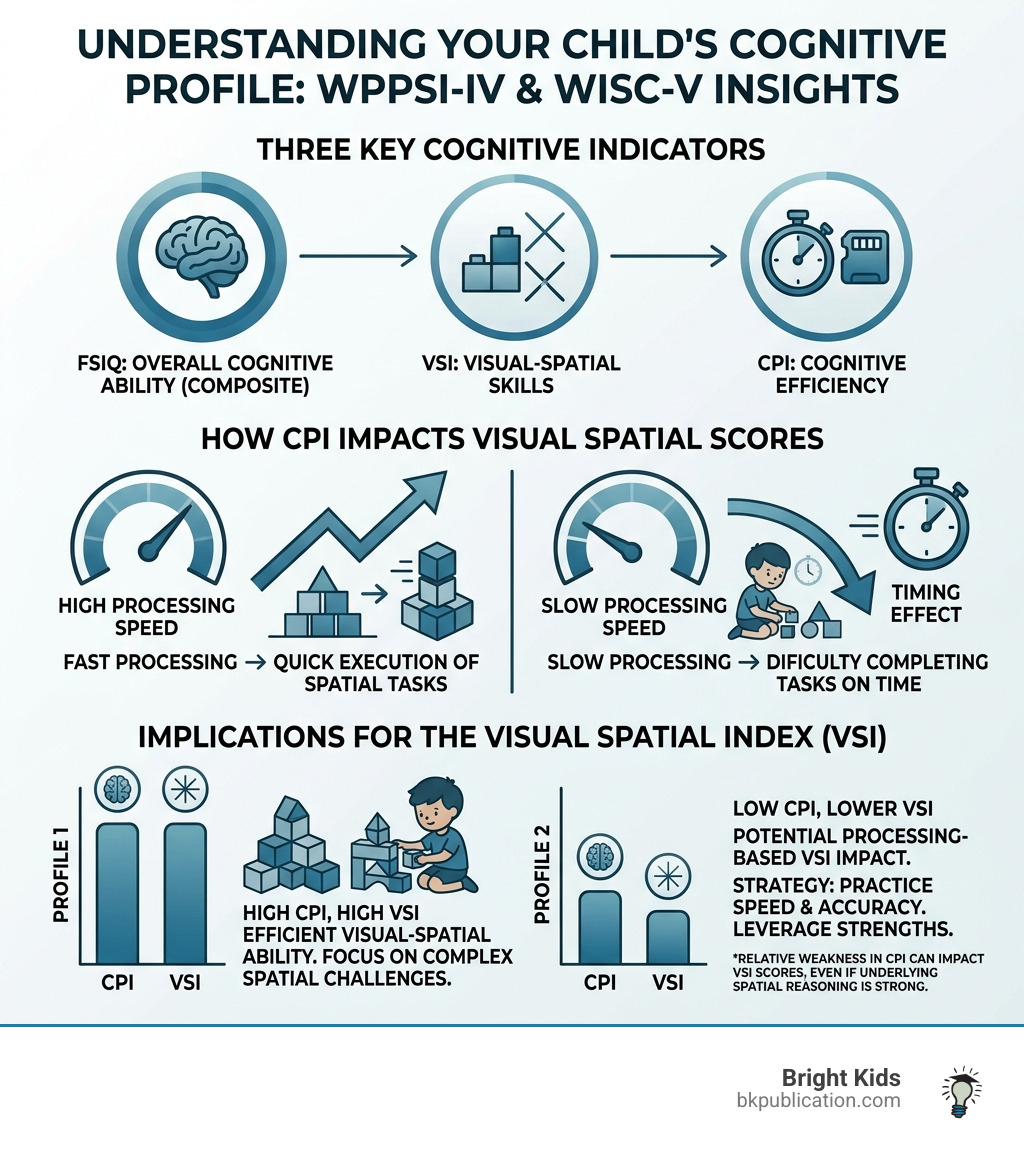
Conversely, if the VSI is a relative weakness, it might be tied to the Cognitive Proficiency Index (CPI), which includes Processing Speed and Working Memory. If a child is slow to move the blocks or forgets the pattern as soon as they look away, the issue might not be "spatial" at all—it might be an efficiency issue. In these cases, we focus on timed games to help them get comfortable with the "ticking clock" of the assessment.
Frequently Asked Questions about WPPSI Spatial Skills
What is a "good" score on the Visual Spatial Index?
In testing, "good" is relative to your goals. However, a standard score of 100 is the exact average. Most competitive gifted and talented programs look for scores in the Superior (120–129) or Very Superior (130+) ranges. If your child scores a 118 (88th percentile), that is a very strong "High Average" score that indicates they are performing better than 88% of their peers.
How often should my child practice with blocks and puzzles?
Consistency beats intensity. It is much better to do 15 minutes of play, six times per week, than a two-hour marathon on Sunday. Young children have short attention spans; if you push too hard, they will associate "spatial tasks" with "stress." Keep it light, keep it fun, and keep the blocks within easy reach in the playroom.
Can spatial skills practice improve overall IQ scores?
Yes! While IQ is often thought of as "fixed," research shows that skill-based preparation improves a child's ability to demonstrate their true potential. Spatial practice builds nonverbal concept formation and cognitive flexibility. These aren't just "test skills"—they are the building blocks for long-term academic success in math, science, and reading comprehension.
Conclusion
At Bright Kids, we believe that every child has the potential to excel when given the right tools and a supportive environment. WPPSI spatial skills practice is about more than just a test score; it’s about giving your child the visual "vocabulary" they need to navigate a complex world.
Whether you are in NYC, Chicago, or Los Angeles, our 17 years of expertise can help guide you through this process. Our comprehensive practice books and hands-on kits are designed to mimic the real exam while fostering a genuine love for problem-solving.
Ready to boost your child's confidence and performance? Explore WPPSI Practice Test and discover how our tailored approach can make all the difference for your family.