

The Best Real Exam Math Practice for Third Graders
Jun 10, 2026
Why Finding the Right 3rd Grade Admissions Math Practice Matters in 2026
3rd grade admissions math practice is the foundation for performing well on the tests that can open doors to gifted programs, private schools, and competitive classrooms. Here are the best official sources to start with right now:
- Mississippi Grade 3 Math Practice Test — 49 questions, Common Core-aligned
- Nebraska NeSA-M Grade 3 Practice Test — 24 multiple-choice questions
- California Standards Test Grade 3 Released Questions — 65 questions across five domains
- NWEA MAP Growth Practice Tests — ~43 adaptive questions with RIT scoring
- New York NYSTP Grade 3 Practice Test — 38 questions aligned to NY State Standards
Third grade is a turning point. Students move from learning basic facts to solving multi-step problems, working with fractions, and measuring area and perimeter. That shift is exactly what admissions and state math tests are designed to assess.
The good news: every major testing body releases official practice materials. Whether your child is preparing for a state accountability test, the MAP Growth assessment, or a private school admissions exam, real exam-style practice is available — and free.
This guide walks you through exactly where to find it, what each test covers, and how to use these resources effectively at home.
I'm Bige Doruk, founder of Bright Kids, and over nearly two decades I've helped more than 10,000 students navigate 3rd grade admissions math practice and beyond — from state assessments to competitive school pathways. The resources and strategies in this guide reflect what we've seen work, consistently, for families just like yours.
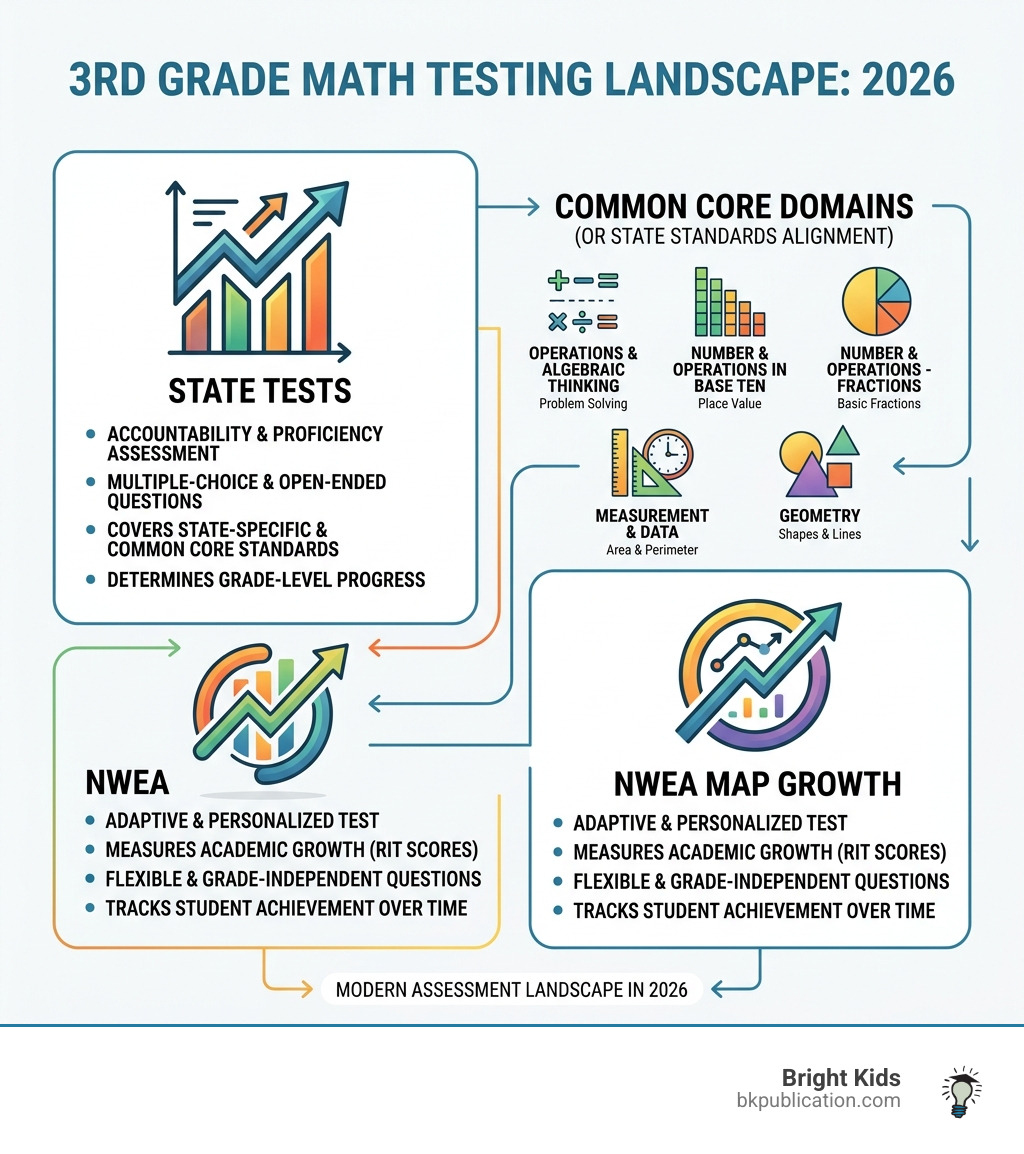
Essential Domains for 3rd Grade Admissions Math Practice
When we talk about 3rd grade admissions math practice, we aren't just talking about simple addition. By May 2026, the expectations for a rising fourth grader have become quite sophisticated. Most admissions tests and state assessments, like those in California, New York, and Texas, focus on five core "domains."

- Number Sense and Operations in Base Ten: This is the bread and butter of third grade. It includes rounding to the nearest 10 or 100, adding and subtracting within 1,000, and multiplying one-digit numbers by multiples of 10.
- Operations and Algebraic Thinking: This is where students start "thinking like mathematicians." They need to interpret products and quotients (e.g., knowing that 54 is 9 groups of 6) and solve two-step word problems using all four operations.
- Fractions: In third grade, fractions are no longer just "pizza slices." Students must understand fractions as numbers on a number line, identify equivalent fractions (like 1/2 and 2/4), and compare fractions with the same numerator or denominator.
- Measurement and Data: This domain covers telling time to the minute, measuring liquid volume and mass, and interpreting bar graphs and pictographs.
- Geometry: Students learn to categorize shapes based on their attributes (like quadrilaterals) and partition shapes into areas with equal parts.
Comparing State Standards for Practice
While we are based in NYC and serve students nationwide from San Francisco to Miami, looking at different state standards gives us a great "cheat sheet" for what is universally expected in 3rd grade admissions math practice.
| State/Test | Number of Questions | Key Focus Areas |
|---|---|---|
| Mississippi | 49 | Multiplication/Division (3.OA.1), Fractions, Area/Perimeter |
| Nebraska | 24 | Patterns, Measurement, Data Interpretation, Place Value |
| California | 65 | Number Sense (32 questions), Algebra, Statistics |
| MAP Growth | ~43 (Adaptive) | Computational Fluency, Algebraic Thinking, Geometry |
Common Core Alignment in 3rd Grade Admissions Math Practice
Most high-stakes tests, including the New York NYSTP Grade 3 Practice Test, are built on Common Core standards. If you see these codes on a practice test, here is what they mean:
- 3.OA (Operations & Algebraic Thinking): Solving multiplication and division word problems.
- 3.NBT (Number & Operations in Base Ten): Using place value to perform multi-digit arithmetic.
- 3.NF (Number & Operations—Fractions): Developing an understanding of fractions as numbers.
- 3.MD (Measurement & Data): Representing and interpreting data, and understanding concepts of area and perimeter.
- 3.G (Geometry): Reasoning with shapes and their attributes.
For a deeper dive into how these standards shape local curriculum, you can read more about Understanding 3rd Grade Math Standards and Curriculum.
Official State Practice Tests and Standards
One of the best ways to prepare for an admissions test is to use "released" state test questions. These are real questions used in previous years, which means they have been vetted by experts for fairness and accuracy.

Mississippi Academic Assessment Program (MAAP)
The Mississippi practice test is a fantastic resource because it includes 49 questions that mirror the difficulty of many private school admissions exams. It uses a mix of multiple-choice and "multiple-select" items (where a student must choose more than one correct answer).
Nebraska NeSA-M
The Nebraska practice test is shorter (24 questions) but excellent for testing "number patterns" and "data interpretation." For example, a typical question might ask a student to identify the missing number in a sequence like 88, __, 66, 55.
California Standards Test (CST)
If you are in Los Angeles or San Francisco, the California released questions are gold. They categorize questions into "reporting clusters." For instance, they might ask how "eight thousand, seventy-six" is written in standard form (8,076) or how many meters are in 5 kilometers (5,000).
Using these varied sources ensures your child isn't just memorizing one test format but is truly mastering the concepts. For more tips on this, check out our guide on Preparing for State-Level Math Assessments.
Sample Questions and Explanations
To give you a taste of 3rd grade admissions math practice, let's look at a few common problem types found in the Mississippi and California standards.
1. Multi-Digit Subtraction
- Question: Find the difference: $900 - $631.
- Explanation: This tests "regrouping" (or borrowing). Students must turn the 900 into 8 hundreds, 9 tens, and 10 ones.
- Answer: $269.
2. Equal Groups (Multiplication)
-
Question: Which groupings represent 36 apples placed equally into baskets? (Select two).
- A) 5 groups of 7
- B) 6 groups of 6
- C) 8 groups of 4
- D) 4 groups of 9
- Answer: B and D. This tests the understanding that multiplication is about equal groups.
3. Fraction Models
- Question: Which fraction is equivalent to 2/4?
- Answer: 1/2. Students should be able to visualize this using a number line or a shaded circle.
Common 3rd Grade Math Errors to Watch For:
- Rounding to the wrong place: Rounding 110 to 200 instead of 100 when asked for the nearest hundred.
- Confusing Area and Perimeter: Adding all sides (perimeter) when the question asks for the space inside (area).
- Misreading Graphs: Forgetting to check the "key" on a pictograph (e.g., where one picture of a book equals 5 books).
Navigating the MAP Growth Math Assessment
The NWEA MAP Growth test is a different beast entirely. Unlike the paper-and-pencil state tests, the MAP is adaptive. This means if your child gets a question right, the next one gets harder. If they get it wrong, it gets easier.
How the MAP Test Works
The test typically has about 43 questions and covers four main areas:
- Number Sense and Computation
- Algebraic Thinking
- Geometry and Measurement
- Data and Statistics
Because the test is untimed, it allows students to think through complex problems without the "ticking clock" anxiety. However, because it is adaptive, it can actually "level up" to 4th or 5th-grade questions if a student is doing exceptionally well. This makes it a popular tool for gifted and talented admissions.
For those looking for specific materials, we offer Bright Kids MAP Growth Practice Resources that mimic this digital, adaptive feel.
Interpreting MAP Math Scores
The MAP test uses a RIT scale (Rasch Unit). Think of it like a ruler that measures academic growth regardless of grade level.
- Average (50th Percentile): A typical 3rd-grade RIT score is around 184.
- High (95th Percentile): A score of 210 or higher is considered exceptional for a 3rd grader.
When you look at your child's score report, you’ll see "instructional domains." This tells you exactly where they are thriving and where they need more 3rd grade admissions math practice. If their "Geometry" score is lower than their "Operations" score, you know exactly what to focus on for the next few weeks.
If you are specifically preparing for private school entrance exams, you might also find our 3rd Grade ISEE Practice Book helpful, as it bridges the gap between state standards and independent school requirements.
Proven Strategies for Complex Problem Solving
In 3rd grade, the "word problem" becomes the ultimate test of math mastery. It’s no longer enough to just add numbers; students have to figure out which numbers to add and why.
The Multi-Step Challenge
A classic 3rd-grade problem looks like this: "Noah has 6 trays of 10 cookies. His mother baked 2 more trays of 10. How many cookies does Noah have now?"
To solve this, a student must:
- Multiply 6 x 10 (60).
- Multiply 2 x 10 (20).
- Add the results together (80).
Alternatively, they could recognize the pattern: (6 + 2) x 10 = 80.
Using Inverse Operations
We always teach our students to "check their work" using the opposite operation. If they solved a subtraction problem ($900 - $631 = $269), they should add $269 and $631 to see if they get back to $900. This is a formal self-check step that reduces careless errors.
Visual Models and Partitioning
For geometry and fractions, "drawing it out" is essential. When asked to find the area of a rectangle with a length of 7 and a width of 3, we encourage students to draw the grid. Seeing 21 individual squares makes the concept of "length times width" much more concrete than just memorizing a formula.
For more techniques, visit our article on Effective Math Problem-Solving Techniques.
Effective Strategies for 3rd Grade Admissions Math Practice
- Number Lines: Use them for everything! They are perfect for rounding, comparing fractions, and visualizing elapsed time.
- Unit Conversions: Memorize the basics early. Know that 1 meter = 100 centimeters and 1 kilometer = 1,000 meters.
- Estimation: Before solving a big problem, ask your child to "guess" the answer. If they are subtracting 631 from 900, they should know the answer will be somewhere near 300. If they get 500, they'll immediately know something went wrong.
The Bright Kids 4-Step Problem Solving Method:
- Read Together: Identify what the question is actually asking.
- Find the Rule: Determine which operations (multiplication, division, etc.) are needed.
- Apply the Rule: Do the math carefully.
- Check the Work: Use inverse operations or estimation to verify.
Frequently Asked Questions
What topics are most common in 3rd grade math admissions tests?
The most frequent flyers are multiplication and division facts (0-10), identifying fractions on a number line, calculating area and perimeter, and rounding to the nearest ten or hundred. You will also almost certainly see data interpretation questions involving bar graphs or "pictographs."
How long should a 3rd grader practice for math admissions tests?
We generally recommend a 4 to 8-week preparation window. Consistency is better than "cramming." Spending 20 minutes a day on 3rd grade admissions math practice is far more effective than a four-hour marathon on a Saturday. Start with a diagnostic test to see where the gaps are, then target those specific areas.
Where can I find full-length 3rd grade math practice tests?
You can find official released tests from state agencies like the Texas STAAR Released Test Questions. Additionally, while various digital portals offer free samples, for the most comprehensive, exam-aligned experience, our Bright Kids practice books are designed to mimic the exact format and difficulty of real admissions exams.
Conclusion
Preparing for 3rd grade admissions math practice doesn't have to be a stressful experience. By using official state resources, understanding the adaptive nature of the MAP test, and focusing on the core Common Core domains, you can give your child the tools they need to succeed.
At Bright Kids, we’ve spent 17 years perfecting the art of test prep. Our NYC-based team creates books that don't just teach the "how," but also the "why" behind every math concept. Whether you're looking for a comprehensive practice book or personalized tutoring to boost those RIT scores, we're here to help your child reach their full potential.
For more tips, tricks, and free resources, explore More info about 3rd grade admissions resources and let’s make this testing season a "successful journey" for your little mathematician!