

The Ultimate Guide to SSAT Exam Prep and Practice
Jun 08, 2026
Why the SSAT Practice Exam Is the Key to Private School Admissions
An SSAT Practice Exam is one of the most powerful tools a student can use to prepare for private school admissions — and knowing how to use it well makes all the difference.
Quick answers to what most families want to know:
- What is the SSAT? The Secondary School Admission Test (SSAT) is a standardized multiple-choice exam used by private, independent, and charter schools to evaluate applicants in grades 3–11.
- What does it test? Verbal reasoning, quantitative (math) reasoning, reading comprehension, and a writing sample.
- How many levels are there? Three — Elementary, Middle, and Upper — each designed for a specific grade range.
- Can students practice beforehand? Yes. Free and paid practice tests are widely available, both officially and through third-party providers.
- Does practice actually improve scores? Yes. Students regularly move from the 50th to the 85th percentile with consistent, structured practice.
Nearly 100,000 students take the SSAT or ISEE each year. The competition for seats at top private schools is real — and how well a student prepares often matters more than raw ability alone.
This guide walks you through everything: test levels, sections, scoring, strategies, and the best practice resources available in 2026.
I'm Bige Doruk, founder of Bright Kids and a Harvard MBA with nearly two decades of experience helping students navigate competitive admissions — including hands-on work with the SSAT Practice Exam across thousands of student cases. The strategies in this guide are grounded in real preparation experience, not guesswork.
Understanding the SSAT: Levels and Format
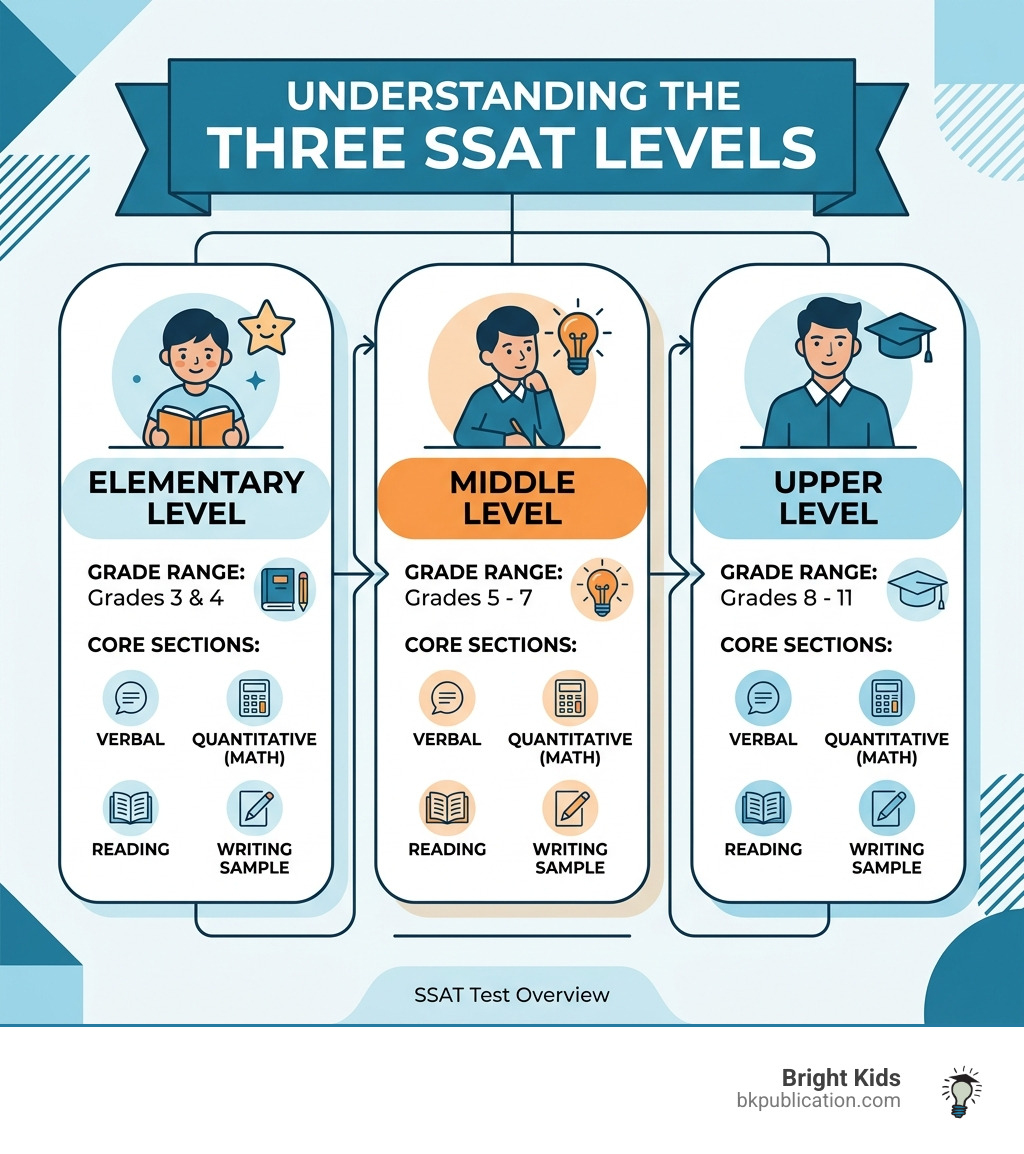
The SSAT is not a one-size-fits-all exam. It is carefully calibrated to match the developmental stage of the student. In our 17 years of experience at Bright Kids, we have found that the biggest mistake families make is using the wrong level of prep materials. As of May 2026, the test remains divided into three distinct levels based on the grade the student is currently in.
- Elementary Level: For students in grades 3 and 4 (applying for admission to grades 4 and 5).
- Middle Level: For students in grades 5, 6, and 7 (applying for admission to grades 6, 7, and 8).
- Upper Level: For students in grades 8, 9, 10, and 11 (applying for admission to grades 9 through PG).
Each level tests similar core competencies—Verbal, Quantitative, and Reading—but the complexity and time limits vary significantly. For a deeper dive into how these levels play into the broader admissions landscape, check out our Gifted Admissions SSAT Guide.
SSAT Structure Comparison Table
| Feature | Elementary Level | Middle Level | Upper Level |
|---|---|---|---|
| Total Questions | ~89-106 | 167 (including essay) | 167 (including essay) |
| Total Time | ~110 minutes | 3 hours, 10 minutes | 3 hours, 10 minutes |
| Quantitative | 1 section (30 min) | 2 sections (30 min each) | 2 sections (30 min each) |
| Verbal | 20 min | 30 min | 30 min |
| Reading | 30 min | 40 min | 40 min |
| Experimental | 15 min | 15 min | 15 min |
Choosing the Right SSAT Practice Exam for Your Grade
Selecting the correct SSAT Practice Exam is the first step in a successful study plan. If your child is in 5th grade, they should be taking the Middle Level practice test, even if they are exceptionally advanced. The SSAT is a "norm-referenced" test, meaning your child is compared to their peers in the same grade.
For those aiming for elite boarding schools or competitive day schools in New York or Los Angeles, the Upper Level exam (taken in 8th grade or later) is often the most critical hurdle. We recommend starting with a diagnostic test to see where your child sits relative to their grade-level expectations.
Mastering the Sections: Quantitative, Verbal, and Reading
The SSAT is designed to measure academic potential, not just memorized facts. Each section requires a different cognitive "muscle."
Strategies for the SSAT Practice Exam Quantitative Section
The Quantitative (Math) section is often the most intimidating for students because no calculators are allowed. This means mental math and scratchpad agility are paramount.
Key topics covered include:
- Number Sense: Fractions, decimals, percents, and basic operations.
- Algebra: Solving for 'x', linear equations, and inequalities.
- Geometry: Area, perimeter, volume, and properties of shapes.
- Data Analysis: Interpreting graphs, tables, and calculating averages.
One of our favorite strategies is the "Process of Elimination." Since there is a penalty for wrong answers (on Middle and Upper levels), we teach students to only guess if they can eliminate at least two of the five choices. If an exact calculation isn't listed, the SSAT may ask for the "closest" answer—always read the prompt carefully!
Improving Vocabulary and Logic for the Verbal Section
The Verbal section consists of 30 synonyms and 30 analogies, all to be completed in a lightning-fast 30 minutes. That is 30 seconds per question! To excel here, students must move beyond rote memorization. We focus on:
- Root Word Analysis: Understanding prefixes like "bene-" or "mal-" can help a student decode a word they’ve never seen before.
- Context Clues: Even in synonyms, thinking about how a word is used in a sentence can spark a connection.
- Logical Relationships: Analogies test the relationship between words (e.g., "Kitten is to Cat as Puppy is to Dog"). Identifying if the relationship is one of degree, part-to-whole, or synonym/antonym is key.
For more specific drills, see our SSAT Verbal Section Tips.
Reading Comprehension and the Unscored Essay
The Reading section provides 40 minutes for 40 questions based on passages of 250–350 words. These passages range from scientific reports on the water cycle to philosophical musings on non-conformity.
The Writing Sample is a unique beast. While it is unscored, a copy is sent directly to admission officers. Schools use this to see the "real" student—how they think and write under pressure without a tutor's help. Middle Level students often choose between a creative story and a personal essay, while Upper Level students typically choose between two essay prompts.
Scoring and Interpretation: What is a Good Score?
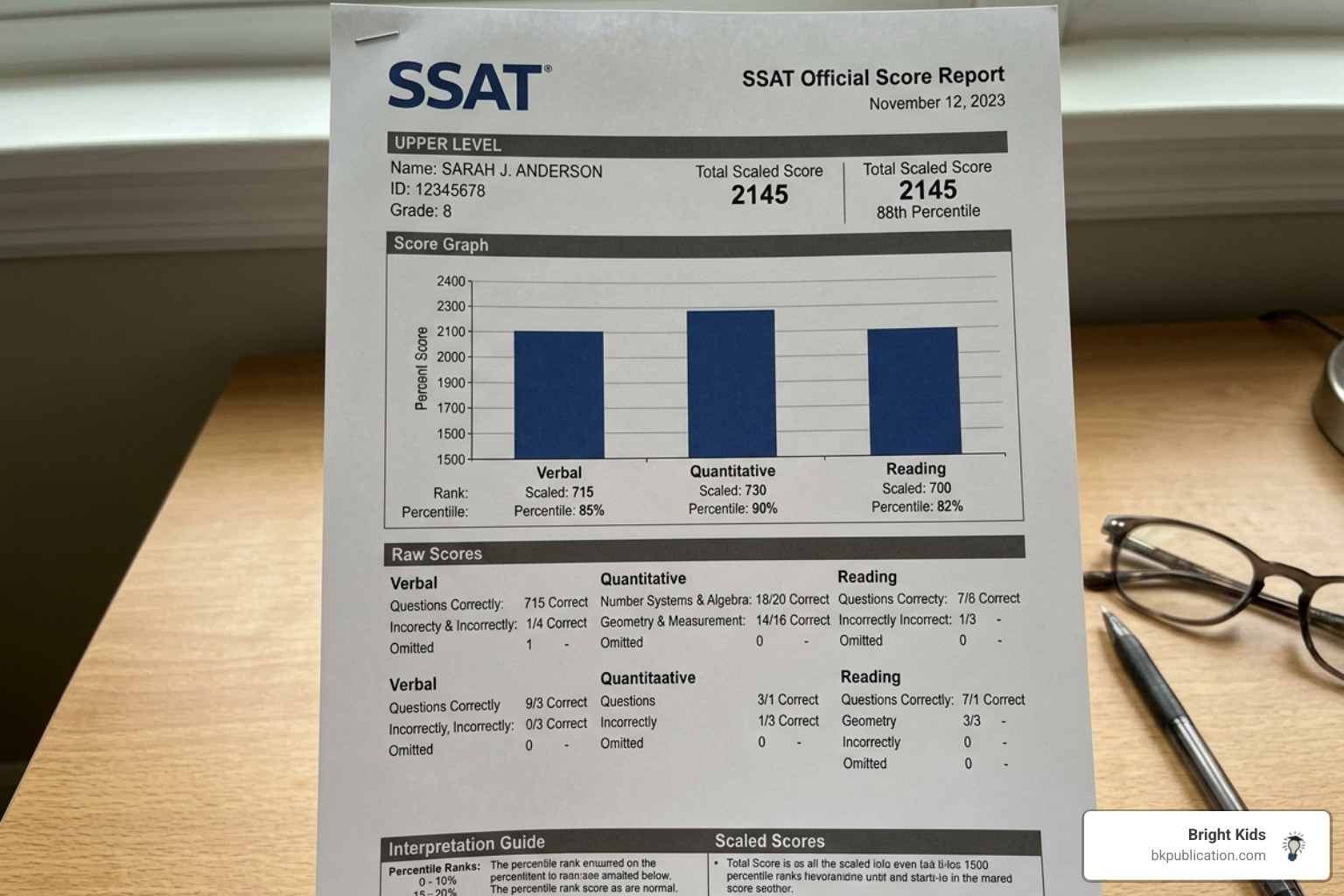
Understanding your score report can feel like decyphering a secret code. There are three main numbers you'll see:
- Raw Score: Points earned for correct answers minus a fraction for incorrect ones.
- Scaled Score: This accounts for the difficulty of the specific test version. For the Upper Level, this ranges from 1500 to 2400 (average is around 2000). For the Middle Level, the range is 1320 to 2310.
- Percentile Rank: This is the most important number. It compares your child to all other students of the same grade and gender who took the test in the last three years.
The "Wrong Answer Penalty": On the Middle and Upper levels, students earn 1 point for a correct answer and lose 1/4 point for an incorrect answer. Skipping a question results in 0 points. This makes the SSAT Practice Exam essential for learning when to guess and when to move on.
How an SSAT Practice Exam Predicts Your Percentile
Taking a realistic SSAT Practice Exam allows us to estimate a student's percentile before the stakes are high. If a student is scoring in the 60th percentile on practice tests but their dream school in San Francisco or Chicago typically accepts students in the 85th percentile, we know exactly where to focus our tutoring hours.
Effective Preparation with an SSAT Practice Exam
Preparation is a marathon, not a sprint. We’ve helped over half a million students through various platforms, and the data is clear: consistent, timed practice is the gold standard.

How to Use an SSAT Practice Exam for Diagnostic Growth
Don't just take a test and toss it aside. Use the results to build a roadmap:
- Initial Assessment: Take a full-length test to establish a baseline.
- Performance Analytics: Look for patterns. Is your child missing all the geometry questions? Are they running out of time on the Reading section?
- Targeted Practice: Use section-specific quizzes to bridge knowledge gaps. For example, if "synonyms" are the weak point, spend a week on root words.
Simulating Test Day with a Full-Length SSAT Practice Exam
To build testing stamina, students must practice in a distraction-free environment that mimics the 3-hour-plus ordeal of the actual exam.
- Time the sessions strictly.
- No phones or calculators.
- Take the scheduled 10-minute breaks.
- Practice on the medium you will use. If you are taking the "SSAT at Home," use a computer-based SSAT Practice Exam. If you are taking the paper-and-pencil version, use a printed PDF and a #2 pencil.
Registration, Costs, and Testing Options
In 2026, families have more flexibility than ever regarding how they take the test.
- Paper-and-Pencil: The traditional method, often held at local schools.
- SSAT at Home: A computer-based version with remote proctoring.
- Prometric Centers: Taken on a computer at a dedicated testing facility.
Typical Costs (2026 Estimates):
- Standard Paper/Pencil: ~$172
- SSAT at Home / Prometric: ~$242 - $258
- Late registration or "Flex" testing with a consultant can add $50 - $100 to these fees.
For official registration and a free mini-test to get started, visit the SSAT Online Practice Tests | Free Mini Practice Test page.
Frequently Asked Questions about the SSAT
Can students use calculators on the SSAT?
No. Calculators are strictly prohibited on all levels of the SSAT. This is why practicing mental math and long division is a core part of our curriculum at Bright Kids.
How many times can a student retake the SSAT?
Students can take the SSAT multiple times. There are several "Standard" dates per year, and students may also take one "Flex" test. Most schools will look at your best scores, but it is always wise to check the specific policy of the admissions office you are applying to.
What is the difference between the SSAT and the ISEE?
The SSAT and ISEE are very similar, but the SSAT includes a guessing penalty (on Middle/Upper levels) while the ISEE does not. Additionally, the SSAT Verbal section uses analogies, whereas the ISEE uses sentence completions. Many schools accept both, but some have a preference. We often recommend taking a practice version of both to see which format suits the student better.
Conclusion
The journey to a top-tier private school is demanding, but it doesn't have to be overwhelming. At Bright Kids, we have spent 17 years refining our approach to the SSAT Practice Exam, ensuring our materials mimic the real test experience with pinpoint accuracy.
Whether you are in New York, Chicago, or Los Angeles, the key to success is a blend of comprehensive practice and expert guidance. We've seen students raise their overall percentile by 14 points or more simply by identifying their weak spots and mastering test-taking endurance.
Ready to start your journey? Explore our comprehensive practice books and tutoring services to give your child the edge they need for the 2026-2027 admissions cycle. Together, we can turn test-day anxiety into a success story.