

Cracking the Code with Our Gifted Child SSAT Prep Manual
Apr 27, 2026
Why Every Gifted Family Needs a Clear SSAT Roadmap
A gifted admissions SSAT guide can be the difference between walking into test day with confidence and walking in unprepared against one of the most self-selecting student pools in standardized testing.
Here is a quick overview of what gifted families need to know:
| Topic | Key Takeaway |
|---|---|
| What is the SSAT? | A standardized aptitude test for private school admission, grades 3-11 |
| Who takes it? | Students applying to independent and selective private schools |
| How is it scored? | Scaled scores + percentiles compared to first-time test-takers in the same grade |
| What is a competitive score? | 75th percentile minimum; 80th-90th+ for elite or scholarship consideration |
| Is prep necessary? | Yes - the test-taker pool is highly prepared and self-selecting |
| Does it stand alone? | No - schools review it alongside essays, interviews, IQ tests, and recommendations |
| SSAT vs. ISEE? | Both are accepted by selective schools; each has different formats and scoring rules |
The SSAT is not your child's typical school test. It is an aptitude-based exam, designed to assess reasoning and problem-solving rather than curriculum mastery. That distinction matters enormously for how you prepare.
And the stakes feel real. Many of the most selective boarding and day schools expect scores at or above the 80th percentile. Some scholarship programs set the bar even higher, at the 90th percentile or above. Meanwhile, the students sitting in that same testing room have almost all prepared extensively.
Going in without a plan puts even the brightest kids at a disadvantage.
I'm Bige Doruk, founder of Bright Kids, and over nearly two decades I've helped more than 10,000 students navigate gifted admissions and standardized test preparation - including building structured resources specifically designed as a gifted admissions SSAT guide for families who want strategy, not just drilling. In this guide, I'll walk you through everything from understanding how scores work to building the complete application that selective schools are actually looking for.
Understanding the SSAT for Gifted Admissions
The Secondary School Admission Test (SSAT) is a cornerstone of the private school application process. Unlike state-mandated achievement tests that measure what a student has learned in class, the SSAT is designed to measure a student's ability to solve problems and think critically. For gifted students, this can be both a blessing and a challenge. While their natural reasoning skills are high, the format of the test—especially the analogies and the time pressure—can be unfamiliar.
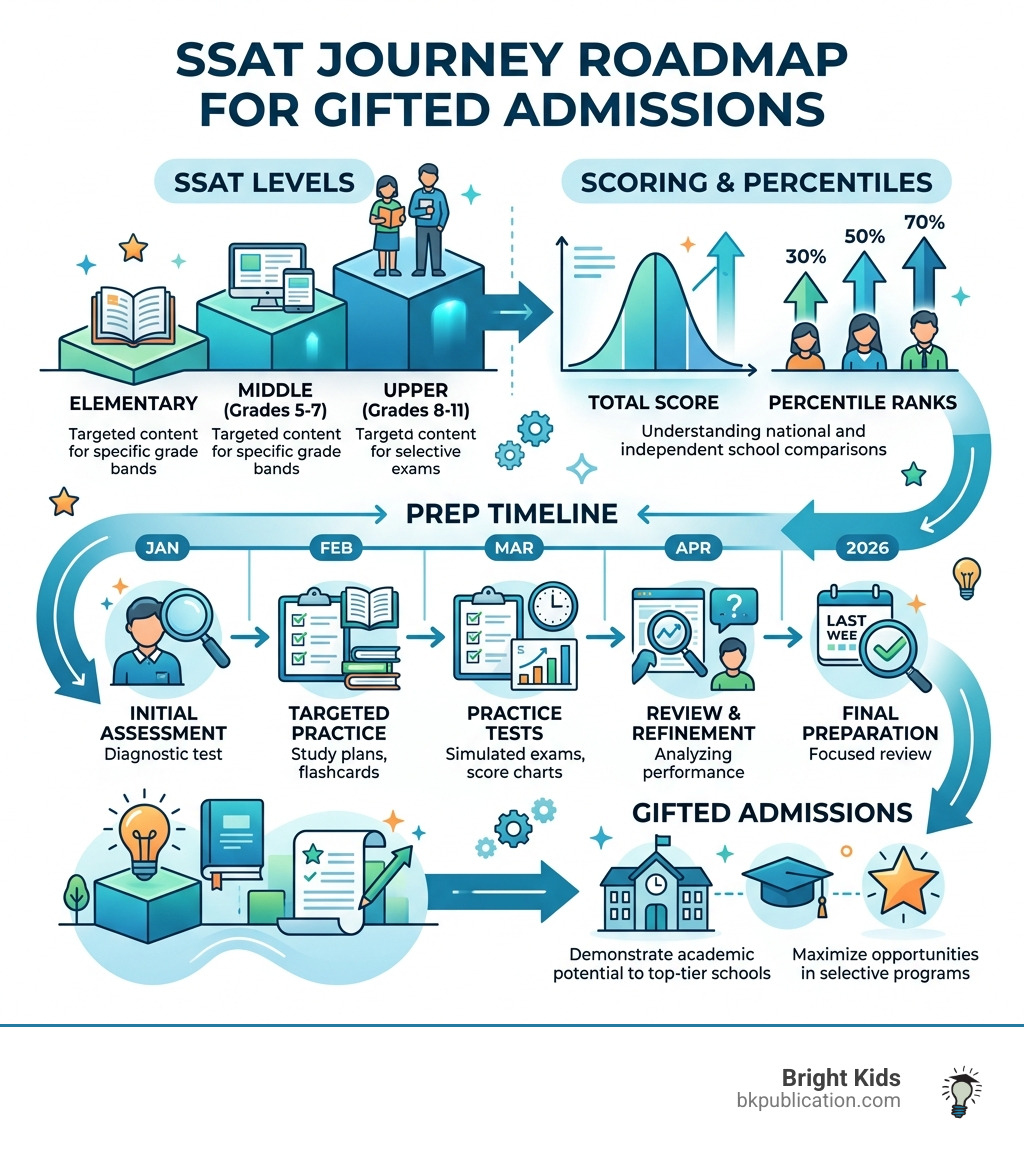
The SSAT is divided into three levels based on the grade a student is currently in:
- Elementary Level: For students in grades 3 and 4.
- Middle Level: For students in grades 5 through 7.
- Upper Level: For students in grades 8 through 11.
Each level includes sections on Quantitative (Math), Verbal (Synonyms and Analogies), and Reading Comprehension. There is also an unscored Writing Sample and an Experimental section. While the writing sample doesn't affect the numerical score, it is sent directly to admissions officers to help them evaluate a student's communication skills and "voice." For a deeper look at how these compare to other high-level tests, you might want to explore our ISEE Test Upper Level resources. Families should also visit SSAT for Families | Register for the SSAT to handle the logistics of test day.
Decoding the Gifted Admissions SSAT Guide Scoring
One of the most confusing aspects of the SSAT is the difference between scaled scores and percentiles.
Scaled Scores: These are consistent over time. A scaled score today means the same thing it did 15 years ago. They range differently by level:
- Elementary: 300-600 per section (900-1800 total)
- Middle: 440-710 per section (1320-2130 total)
- Upper: 500-800 per section (1500-2400 total)
Percentile Ranks: This is where the "gifted" aspect becomes tricky. SSAT percentiles compare your child only to other first-time test-takers in the same grade and gender over the last three years in the U.S. and Canada. Because the pool of students taking the SSAT is already high-achieving and often heavily tutored, a student who is in the 99th percentile at their local public school might find themselves in the 60th or 70th percentile on the SSAT.
The SSAT uses a process called equating to ensure that scores are comparable across different test forms, even if one version of the test was slightly harder than another. To help navigate this, we recommend using the SSAT Official Study Guide Books | Best SSAT Test Prep to see exactly how these scores are calculated.
Interpreting "Good" Scores for Selective Schools
What qualifies as a "good" score depends entirely on where you are applying. At highly selective "elite" schools, admissions officers often look for scores in the 80th percentile or higher. For families seeking merit-based scholarships at top boarding schools, scores at or above the 90th percentile are frequently expected.
However, a "good" score is also one that shows balance. Schools look for "spiky profiles" where a student might be a math genius but they also want to see that the verbal and reading scores are high enough to handle a rigorous prep school curriculum. It is worth noting that at some selective schools, up to 10% of the graduating class are National Merit Scholars—a testament to the high academic ceiling these institutions maintain.
Comparing the SSAT and ISEE for High-Achieving Students
Many private schools in cities like New York, Dallas, and San Francisco accept both the SSAT and the ISEE (Independent School Entrance Exam). Choosing between them is a strategic decision.
| Feature | SSAT | ISEE |
|---|---|---|
| Penalty | -1/4 point for wrong answers (Middle/Upper) | No penalty for guessing |
| Verbal Section | Synonyms and Analogies | Synonyms and Sentence Completion |
| Math Focus | Aptitude/Creative Problem Solving | Achievement/Curriculum-based |
| Essay | Creative or Expository (Unscored) | Expository (Unscored) |
| Flexibility | Multiple "Standard" dates + "Flex" test | Limited to once per testing window |
The guessing penalty on the SSAT is a major differentiator. Gifted students who are used to "powering through" tests need to learn when to skip a question to protect their score. Conversely, the ISEE is often seen as more of an achievement test. If your child excels in school math but struggles with abstract logic, the ISEE might feel more comfortable. You can compare these styles by looking at our ISEE Upper Level Practice Test.
Choosing the Right Test for Twice-Exceptional (2E) Learners
Twice-exceptional (2E) students—those who are gifted but also have a learning difference like ADHD or dyslexia—require a specialized approach to the gifted admissions SSAT guide.
These students often have "spiky" cognitive profiles, where their verbal reasoning might be in the 99th percentile, but their processing speed or working memory is much lower. For these families, the SSAT’s "Flex Test" (an individual or small group administration) can be a lifesaver. We often suggest ERB Upper Level Tutoring for those leaning toward the ISEE, but for the SSAT, the focus should be on securing accommodations such as extended time or laptop use for the writing sample.
Beyond the Score: Holistic Gifted Admissions Strategies

While the SSAT is important, it is just one piece of the puzzle. Selective schools use a holistic review process. They want to know who the child is beyond the numbers. This is where components like the Character Skills Snapshot come in. This online tool measures traits like resilience, open-mindedness, and social awareness.
IQ testing also plays a massive role in gifted identification. Many schools require or strongly recommend a formal cognitive assessment to confirm a student's high potential. If you are preparing for these early stages, our Gifted and Talented Practice Test can provide a helpful baseline.
Integrating IQ Testing into Your Gifted Admissions SSAT Guide
IQ tests like the WISC-V (for ages 6+) and the WPPSI-IV (for younger children) measure cognitive domains such as verbal comprehension, visual-spatial processing, and fluid reasoning.
- The 130 Cutoff: While 130 is often cited as the "gifted" threshold, many schools look for a full profile.
- NAGC Guidelines: The National Association for Gifted Children (NAGC) recommends using multiple measures for identification to ensure that "twice-exceptional" or underserved students aren't missed.
For students who excel in pattern recognition—a key part of many IQ tests—practicing with CoGAT Figure Matrices Exercises can help sharpen the specific visual-reasoning skills that admissions committees value.
Essential Application Components for Gifted Students
To truly stand out, a gifted student’s application should include:
- Admissions Essays: These should demonstrate intellectual curiosity. Schools don't just want to know what you did; they want to know why you care about it.
- Teacher Recommendations: These are vital for showing how a student contributes to a classroom discussion.
- Extracurricular Portfolios: For gifted kids with deep "passion projects" (like coding an app or writing a novella), a portfolio can be more impactful than a long list of clubs.
- Interview Preparation: Gifted students are often highly verbal, but they need to practice "translating" their complex thoughts into relatable, engaging conversation for an admissions officer.
Expert Preparation for the Gifted Admissions SSAT Guide
Preparation for the SSAT should be a marathon, not a sprint. Because the SSAT includes material that is often a grade level or two above what the student is currently learning in school, "going in cold" is rarely a good idea.
We recommend a three-to-six-month preparation window. This allows time for vocabulary building, which is essential for the verbal section’s analogies. Unlike the SAT, the SSAT still uses analogies, which require a specific type of logical mapping that most modern school curricula no longer teach. For families in New York looking at specialized high schools as well, our SHSAT Complete Guide offers a similar strategic roadmap.
Effective Test-Taking Strategies for High Percentiles
To reach the 90th percentile, students must master more than just content; they must master the "game" of the test.
- Time Management: On the Upper Level, students have only 30 minutes for 60 verbal questions. That’s 30 seconds per question.
- Strategic Skipping: Because of the 1/4 point penalty for wrong answers, if a student can't eliminate at least two wrong choices, they should usually skip the question.
- Dealing with Unfamiliar Material: The SSAT intentionally includes questions that are too hard for the average student in that grade. Gifted students, who are used to knowing all the answers, often panic when they hit a wall. Part of prep is learning that it’s okay to skip the "impossible" questions to focus on the ones they can solve.
Long-Term Skill Building vs. Short-Term Coaching
At Bright Kids, we believe in Aptitude Development. While short-term coaching can provide "tips and tricks," long-term skill building focuses on:
- Quantitative Reasoning: Learning to see the logic behind the math, not just memorizing formulas.
- Reading Comprehension: Moving beyond "finding the answer" to understanding tone, purpose, and inference.
- Problem-Solving: Developing the stamina to stay focused through a three-hour exam.
Frequently Asked Questions about Gifted SSAT Prep
What is a "good" SSAT score for elite private schools?
While there is no "hard" cutoff, most elite schools (the ones with single-digit acceptance rates) prefer to see percentiles in the 80th to 99th range. However, they also look at the "raw" scaled score to see how a student performed against the absolute difficulty of the test, not just the other test-takers.
How do schools use SSAT scores for course placement?
Many schools use the Quantitative (Math) scaled scores to determine if a student is ready for honors or accelerated math tracks. Similarly, a high Reading score might exempt a student from certain foundational English requirements or signal that they are ready for advanced humanities seminars.
When should my gifted child start preparing for the SSAT?
Ideally, a student should take a diagnostic test in the spring or early summer before the fall application season. This gives you enough time to identify gaps in vocabulary or math concepts without the stress of impending application deadlines.
Conclusion
Navigating private school admissions can feel like trying to crack a secret code. But with the right gifted admissions SSAT guide, it becomes a manageable, even rewarding, journey. While the SSAT is a vital benchmark, it is your child’s unique personality, their "spiky" intellectual passions, and their character that will ultimately win over an admissions committee.
At Bright Kids, we’ve spent 17 years helping families in NYC and across the country (from San Francisco to Dallas) master these exams. We know that gifted students don't just need more work—they need different work that challenges their reasoning and respects their intelligence.
If you're ready to take the next step in your child's journey, we're here to help. Whether it's through our comprehensive practice books or our expert tutoring, we can help your child show the world exactly what they're capable of. For more help on the final piece of the puzzle, check out our Private School Interview Preparation Guide. Let’s get started on opening those doors to your child's future!