

ISEE Test Upper Level: Your Ticket to the Big Leagues
Mar 26, 2026
What Is the ISEE Test Upper Level — and Who Needs to Take It?
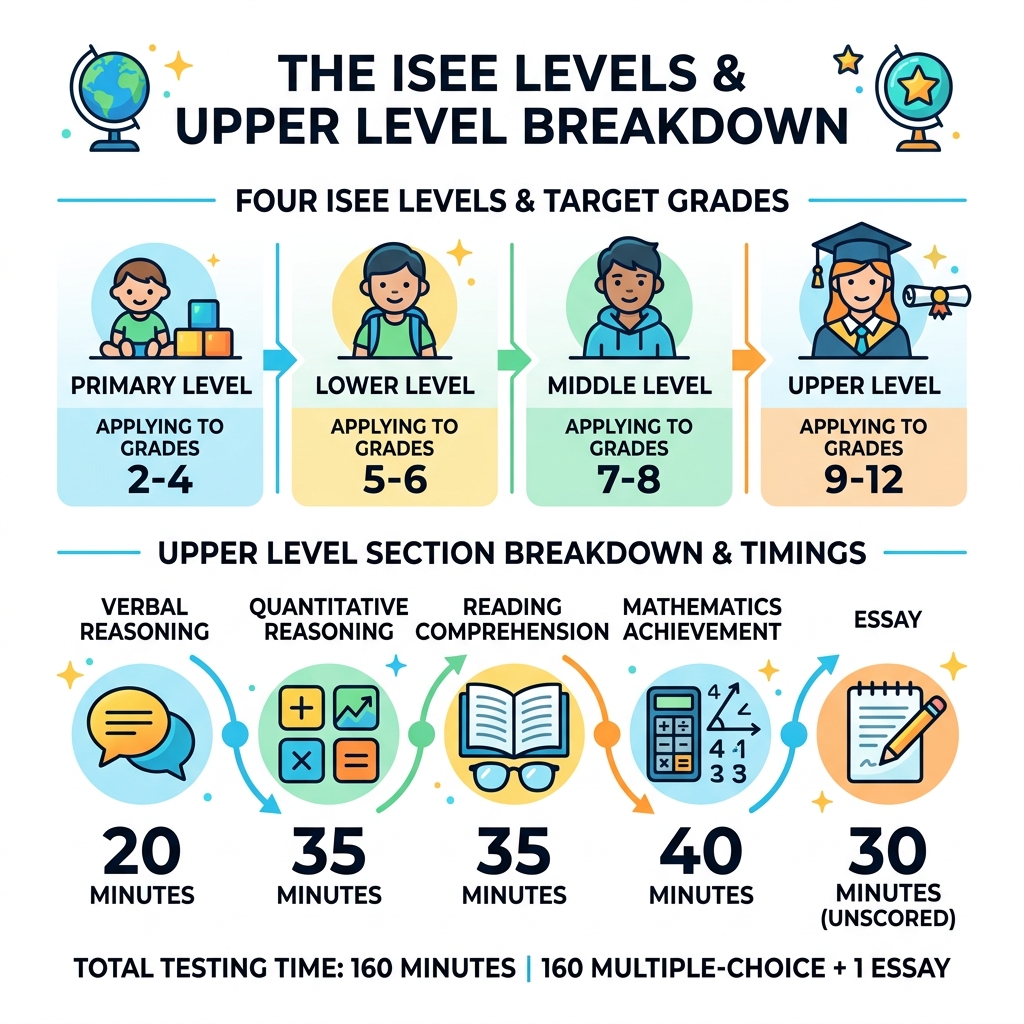
The ISEE test upper level is the standardized admissions exam used by over 1,200 private and independent schools to evaluate students evaluating students applying to grades 9 through 12.
Here's a quick snapshot of what the test looks like:
| Section | Questions | Time |
|---|---|---|
| Verbal Reasoning | 40 (35 scored) | 20 minutes |
| Quantitative Reasoning | 37 (32 scored) | 35 minutes |
| Reading Comprehension | 36 (30 scored) | 35 minutes |
| Mathematics Achievement | 47 (42 scored) | 40 minutes |
| Essay (unscored) | 1 prompt | 30 minutes |
| Total | 160 multiple-choice + 1 essay | 160 minutes |
The test is administered by the Educational Records Bureau (ERB) and is taken up to three times per year — once each in the Fall, Winter, and Spring/Summer testing seasons.
For ambitious students aiming at selective high schools, this exam is the gateway. Schools use ISEE scores alongside grades, recommendations, and interviews to make admissions decisions. Your score is compared only to other independent school applicants — not the general student population — which makes the competition more intense than many families expect.
This guide covers everything: structure, scoring, strategies, registration, and how to prepare with confidence.
Breaking Down the ISEE Test Upper Level Structure
Navigating the ISEE test upper level requires more than just subject knowledge; it requires stamina. The exam consists of 160 multiple-choice questions plus one unscored essay, totaling 160 minutes of testing time. One of the most important things to realize is that the test is designed to be difficult. Because it covers a range of grades (8th through 11th graders taking it for entry into 9th through 12th), some material may be beyond a student's current grade level.
Scored vs. Unscored Items
Every multiple-choice section contains "experimental" or unscored questions. These are questions the ERB is testing out for future exams. You won't know which ones they are, so we always tell our students to treat every question as if it counts.
- Verbal Reasoning: 35 scored, 5 unscored
- Quantitative Reasoning: 32 scored, 5 unscored
- Reading Comprehension: 30 scored, 6 unscored
- Mathematics Achievement: 42 scored, 5 unscored
Timing and Transitions
The total seat time is roughly three hours when you include the two scheduled 5-to-10-minute breaks. These breaks occur after the Quantitative Reasoning section and after the Mathematics Achievement section. Use this time to stretch and reset!
If you want to see exactly how these sections feel, you can Download a full ISEE Upper Level Practice Test to get started. Familiarizing yourself with the pacing is half the battle.
Verbal Reasoning and Reading Comprehension
The verbal side of the ISEE test upper level is a sprint. You have only 20 minutes to tackle 40 questions. This section measures vocabulary strength and the ability to understand relationships between words.
Synonyms (19 questions) These questions ask you to choose the word closest in meaning to the prompt word. The challenge here is the level of vocabulary; many words are pulled from high-level literature and academic texts. We recommend practicing with high-level vocabulary lists and academic texts to build a strong foundation.
Sentence Completions (21 questions) These require you to fill in the blank (or blanks) to make a sentence logically and grammatically correct. In the Upper Level, you will encounter two-blank sentence completions, which require a higher level of logic than the Lower or Middle levels.
Reading Comprehension This section gives you 35 minutes to read six passages and answer 36 questions (6 questions per passage). The passages cover a variety of topics, including:
- History and Social Sciences
- Science and Technology
- Arts and Humanities
- Contemporary Life
Questions will test your ability to identify the main idea, make inferences, define vocabulary in context, and determine the author's tone or purpose. For extra help, focus on mastering critical reading strategies that emphasize evidence-based answering and identifying the author's tone.
Math Sections on the ISEE Test Upper Level
There are two distinct math sections on the exam, and while they cover similar topics, they test different skills.
1. Quantitative Reasoning (QR) This section is all about mathematical thinking. You have 35 minutes for 37 questions. It includes:
- Word Problems: Standard math questions requiring logic.
- Quantitative Comparisons: You are given two quantities (Column A and Column B) and must determine if one is greater, if they are equal, or if there is not enough information to tell.
2. Mathematics Achievement (MA) This section focuses on actual computation and knowledge of mathematical terminology. You have 40 minutes for 47 questions. It aligns with the standards of the National Council of Teachers of Mathematics (NCTM).
Topics covered in both sections include:
- Numbers and Operations
- Algebraic Concepts (including equations and inequalities)
- Geometry
- Measurement
- Data Analysis and Probability
The Golden Rule of ISEE Math: No calculators permitted! Everything must be done by hand. This makes mental math and estimation skills incredibly valuable. You can sharpen your skills by mastering core algebraic concepts and practicing mental math techniques.
The Unscored Essay in the ISEE Test Upper Level
The final 30 minutes of the test are dedicated to the essay. Students are given a personal prompt—such as "Describe a person you admire"—and are asked to write an organized response.
Is it scored? No, the ERB does not provide a grade for the essay.
Then why take it? A copy of your handwritten essay is sent directly to the admissions committees of the schools you apply to. They use it to evaluate your writing style, organization, grammar, and personality. It’s a "writing sample" that proves you can produce quality work under pressure without the help of a tutor or AI. We suggest aiming for 3 to 5 well-developed paragraphs. You can practice with timed prompts to ensure you're ready to organize your thoughts and produce a polished writing sample under pressure.
Scoring Secrets: Stanines, Percentiles, and the Norm Group

Understanding your ISEE score report can feel like learning a second language. Here is the breakdown of the three main numbers you will see:
1. Scaled Scores For each section (except the essay), you receive a scaled score ranging from 760 to 940. This score accounts for the slight variations in difficulty between different versions of the test.
2. Percentile Ranks This is the most misunderstood part of the ISEE. If you get a 60th percentile, it does not mean you got 60% of the questions right. It means you scored better than 60% of the students in your "norm group."
3. Stanines The stanine scale is a 1–9 score that schools use to quickly categorize your performance:
- 1–3: Below Average
- 4–6: Average
- 7–9: Above Average
The "Norm Group" Factor
The ISEE norm group is unique. Unlike state tests where you are compared to every student in the state, the ISEE compares you only to other students applying to independent schools over the last three years. This is a highly motivated, high-achieving group. A student who is used to being in the 95th percentile at their current school might find themselves in the 50th or 60th percentile on the ISEE. Don't panic! Schools understand this and look at the whole picture.
For a deeper dive into how these numbers are calculated, refer to the Official ISEE Quick Facts Guide.
Registration, Fees, and Test Day Logistics
Registering for the ISEE test upper level is done through the ERB website. You have several options for where and how to take the test:
- Paper-Based Testing: Often held at member schools on specific Saturdays.
- Online Testing: Taken at a computer at a school or a specialized testing office.
- Prometric Centers: Professional testing centers available nationwide.
- At-Home Testing: A remote-proctored option using your own computer.
Fees and Seasons
Testing fees generally range from $165 to $255, depending on the location and how close to the test date you register.
Students can take the ISEE up to three times in a 12-month admission cycle, but only once per "season":
- Fall: August – November
- Winter: December – March
- Spring/Summer: April – July
Test Day Rules
- Identification: You must bring a verification letter and a form of identification.
- Materials: For paper tests, bring two #2 pencils and black-ink pens. No calculators, cell phones, or smartwatches are allowed.
- Accommodations: If your student has a documented disability, you can apply for accommodations (like extended time) through the ERB. This process should be started well in advance of your desired test date.
Proven Strategies for a Competitive Score
Preparing for the ISEE test upper level is a marathon, not a sprint. Here are the strategies we've seen work best for our students in NYC and beyond:
1. Master the Art of the Guess On the ISEE, there is no penalty for wrong answers. Never leave a bubble blank! If you are running out of time, pick a "letter of the day" and fill in the remaining circles.
2. Process of Elimination Even if you don't know the right answer, you can often spot two that are definitely wrong. Eliminating just one or two choices significantly increases your odds of guessing correctly.
3. Use Estimation in Math Since you can't use a calculator, don't get bogged down in long division if you don't have to. Often, looking at the answer choices and estimating the "ballpark" figure will lead you to the correct choice in half the time.
4. Active Reading For the Reading Comprehension section, don't just read the words—interact with them. Underline the main idea of each paragraph and circle transition words like "however" or "consequently." This makes finding the answers much faster.
5. Time Management The Verbal section gives you only 30 seconds per question. If a synonym word looks like Greek to you, don't stare at it. Guess, mark it in your booklet to return to later, and move on.
6. Use Quality Practice Materials Not all prep books are created equal. You want materials that mimic the actual difficulty of the exam. Bright Kids offers a range of comprehensive workbooks specifically designed to reflect the rigor of the Upper Level ISEE, ensuring students are prepared for the exact types of questions they will face on test day.
Frequently Asked Questions about the Upper Level ISEE
How many times can a student take the ISEE?
A student can take the ISEE up to three times in a 12-month admission cycle. However, you are limited to taking it only once per testing season (Fall, Winter, and Spring/Summer). Most families aim for a late Fall test with a Winter retake if necessary.
Are calculators allowed on the math sections?
No. Calculators are strictly prohibited on both the Quantitative Reasoning and Mathematics Achievement sections. Students are encouraged to use the blank space in their test booklets for scratch work and calculations.
What is considered a good stanine score for top schools?
While every school has different requirements, a stanine of 7, 8, or 9 is generally considered "above average" and competitive for the most selective independent schools. However, many schools accept students with scores in the 4 to 6 range (average) if the rest of their application—grades, interview, and extracurriculars—is exceptionally strong.
Conclusion
The ISEE test upper level is a challenging exam, but it is also an opportunity for your student to show off their hard work and thinking skills. At Bright Kids, we have spent 17 years helping families navigate the high-stakes world of school admissions led by our CEO Bige Doruk. Our NYC-based expertise has helped thousands of students master the nuances of the ISEE through comprehensive practice and targeted tutoring.
Success on the ISEE doesn't happen overnight. It comes from consistent practice, a solid understanding of the test's structure, and the confidence to handle the pressure of test day. Whether you are looking for the best prep books or expert one-on-one guidance, we are here to help your student reach the "Big Leagues."
For more resources and tips on mastering the admissions process, visit Bright Kids Tutoring and Publications.