

ISEE Upper Level Practice Test: Don't Let the Math Monster Win
Mar 27, 2026
What You Need to Know Before Taking the ISEE Upper Level Practice Test
The ISEE Upper Level practice test is the single most effective tool your child can use to prepare for private high school admissions — and this guide will show you exactly where to find the best ones.
Here's a quick snapshot of what the ISEE Upper Level is and what to expect:
| Detail | Info |
|---|---|
| Who it's for | Students applying to grades 9-12 |
| Administered by | Educational Records Bureau (ERB) |
| Total questions | 160 multiple-choice + 1 unscored essay |
| Total time | 160 minutes |
| Sections | Verbal Reasoning, Quantitative Reasoning, Reading Comprehension, Mathematics Achievement, Essay |
| Calculator allowed? | No |
| Scoring | Scaled scores (760-940) + Stanine (1-9) |
| Used by | 1,200+ private middle and high schools |
Over 1,200 private schools use the ISEE Upper Level to evaluate incoming students. The competition is real — and preparation matters more than most families realize.
Most students don't struggle because they're not smart enough. They struggle because the exam format is unfamiliar. The Verbal and Quantitative Reasoning sections in particular are designed to challenge students well beyond what they learn in a typical classroom. Strong grades alone won't carry a student through.
That's why realistic, timed practice under exam-like conditions is the single biggest lever families can pull before test day.
I'm Bige Doruk, founder of Bright Kids, and over nearly two decades I've helped more than 10,000 students navigate the ISEE upper level practice test and similar high-stakes admissions exams. In this guide, I'll walk you through everything — from exam structure and scoring to the best free and paid practice resources available today.
Understanding the ISEE Upper Level Exam Structure
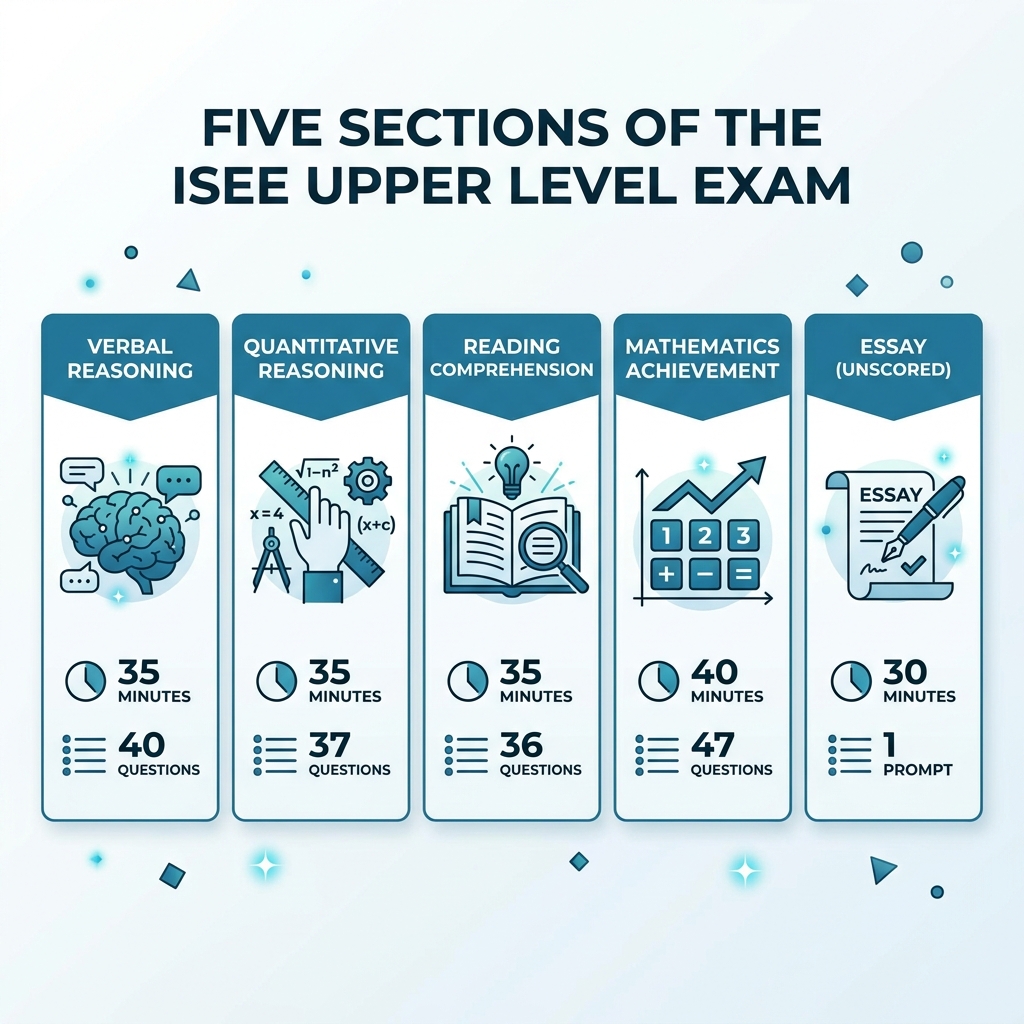
To conquer the "Math Monster" (and the Verbal one, too), we first need to understand the beast's anatomy. The ISEE Upper Level is a marathon, not a sprint. It consists of 160 multiple-choice questions plus one unscored essay, all packed into a 160-minute time limit.
The exam is divided into five distinct sections. For a deep dive into the official expectations, you can download the official What to Expect Guide provided by the ERB.
The Four Scored Sections
The core of the exam consists of four multiple-choice sections. Each section targets a specific cognitive or academic skill:
- Verbal Reasoning (40 questions, 20 minutes): This section moves lightning-fast. Students have only 30 seconds per question to tackle synonyms and sentence completions. It tests vocabulary depth and the ability to understand relationships between words.
- Quantitative Reasoning (37 questions, 35 minutes): This is the "logic" math section. It focuses on mathematical thinking and includes "quantitative comparisons," where students must determine which of two quantities is greater or if the relationship cannot be determined.
- Reading Comprehension (36 questions, 35 minutes): Students read six passages across various topics (history, science, literature) and answer six questions per passage. It tests the ability to find the main idea, identify supporting details, and infer meaning.
- Mathematics Achievement (47 questions, 40 minutes): Unlike Quantitative Reasoning, this section is more aligned with what students learn in school. It follows the National Council of Teachers of Mathematics (NCTM) standards, covering algebra, geometry, and data analysis.
The Essay Section
The final 30 minutes of the test are dedicated to the essay. Students receive a single prompt—usually a situational or personal question—and are asked to write a response.
While the essay is unscored, don't let your child think it doesn't matter! A copy of the essay is sent directly to the admissions offices of every school you apply to. Admissions officers use it to gauge a student's writing ability, personality, and ability to organize thoughts under pressure. We typically recommend a solid 3-5 paragraph structure to show maturity and clarity.
Scoring Secrets: Stanines, Scaled Scores, and Percentiles
The ISEE score report can look like a foreign language at first. Unlike a school test where a 90% is an "A," the ISEE uses a "norm-referenced" system. This means your child is compared to a highly competitive "norm group" of other students applying to independent schools over the last three years.
The most important numbers you'll see are the Scaled Scores (ranging from 760 to 940) and the Stanine Scores.
| Stanine Score | Percentile Rank | Performance Level |
|---|---|---|
| 9 | 96–99 | Superior |
| 8 | 89–95 | Above Average |
| 7 | 77–88 | Above Average |
| 4–6 | 23–76 | Average |
| 1–3 | 1–22 | Below Average |
What Defines a "Good" Score?
A "good" score is entirely dependent on the schools to which you are applying. For the most elite, academically rigorous private schools, admissions officers often look for stanines in the 7, 8, or 9 range. However, for many excellent schools, a stanine of 5 or 6 (which is perfectly average among this high-achieving peer group) is a very strong showing.
Since the ISEE is taken by a self-selected group of high achievers, even a "4" represents a student who is performing well compared to the general national population.
How Results are Delivered
If your child takes the isee upper level practice test format online at a testing center or at home, results are typically available on the ERB website within 24 to 48 hours. Paper-based tests take longer, usually around 10 to 14 days.
One major advantage for parents: you choose which scores to send. If your child takes the test multiple times, you can review the reports and only submit the best set of scores to your target schools.
How to Register and What to Expect on Test Day
Registration is handled through the ERB website. We recommend registering as early as possible—ideally several months in advance—to secure your preferred date and location.

Registration fees generally range from $160 to $250, depending on whether the test is taken at a school, a Prometric center, or at home. If the cost is a barrier, fee waivers are available through the ERB for families who qualify. You can register now for the ISEE to start the process.
Testing Locations and Formats
The ISEE offers significant flexibility in how it is taken:
- In-Person at Schools: Many private schools host testing days on weekends.
- Prometric Centers: These are professional testing sites that offer computer-based versions of the exam.
- At-Home Testing: Using secure online proctoring, students can take the exam from their own desks.
- Paper-Based: Some locations still offer the traditional "bubble sheet" format.
Strict Test Day Rules
ERB maintains very strict protocols to ensure fairness. Here are the "Golden Rules" for test day:
- No Calculators: This is the biggest shock for many students. All math must be done by hand on provided scratch paper.
- Electronics: Cell phones, smartwatches, and fitness trackers are strictly prohibited.
- Pencils: For paper tests, bring several sharpened #2 pencils. For computer tests, scratch paper and pencils are usually provided.
- Breaks: There are two scheduled 5-10 minute breaks. Use them to stretch and have a quick snack!
- ID: Don't forget your identification and your verification letter.
Proven Strategies for Your ISEE Upper Level Practice Test
Preparing for the ISEE isn't just about knowing math and vocabulary; it's about building stamina. Most students have never sat for a three-hour exam before.
We suggest a 30-40 hour study timeline spread over 2-3 months. The best way to start is with a diagnostic isee upper level practice test. This identifies your child's baseline and highlights exactly which "monsters" need the most attention.
Mastering Math in Your ISEE Upper Level Practice Test
Since calculators are banned, mental math and speed are your child's best friends.
- Quantitative Comparisons: Teach your child to look for relationships rather than doing long calculations. If Quantity A is $5 \times 125$ and Quantity B is $4 \times 125$, they shouldn't multiply; they should see that 5 of something is more than 4 of that same thing.
- NCTM Standards: Ensure they are comfortable with algebra basics, geometry formulas (area, perimeter, volume), and basic probability.
- Scratch Paper Hygiene: Encourage students to write clearly and organize their work. Many errors happen simply because a student misreads their own handwriting during a long division problem.
Verbal Tactics for the ISEE Upper Level Practice Test
The Verbal section is a race against the clock.
- Sentence Completion: Have your child cover the answer choices first. Read the sentence, "predict" a word that fits the blank, and then look for the choice that matches their prediction.
- Root Words: Since the ISEE uses high-level vocabulary, learning Greek and Latin roots (like bene, mal, chron) can help students decode words they've never seen before.
- Reading Passages: Don't just read; hunt for the "Main Idea." We teach students to quickly jot down a one-sentence summary of each paragraph to stay engaged and find answers faster.
Frequently Asked Questions about the ISEE Upper Level
How many times can a student take the ISEE?
A student can take the ISEE up to three times per year—once in each of the three "testing windows" (Fall, Winter, and Spring/Summer). Most families aim for a first attempt in the Fall/Winter window.
Is a calculator allowed on the math sections?
No. There is a strict prohibition on calculators for all levels of the ISEE. Students must be comfortable with manual calculations.
How long should a student prepare before the exam?
While every student is different, we find that 8 to 12 weeks of consistent practice is the "sweet spot." This allows enough time to take several full-length simulations without causing "test burnout."
Conclusion: Partnering for Success
At Bright Kids, we know that the ISEE can feel like a daunting hurdle between your child and their dream school. But with 17 years of expertise and a deep understanding of the NYC and nationwide private school landscape, we've turned the "Math Monster" into a manageable challenge for thousands of families.
Our comprehensive practice books are designed to mimic the actual exam interface and question style exactly, ensuring there are no surprises on test day. Whether you are looking for self-study materials or personalized tutoring at our New York City locations (or nationwide via Zoom), we are here to help your child shine.
Ready to start your journey? Explore our ISEE prep collections and give your child the tools they need to succeed.