

SHSAT: An Essential Guide to the Exam
Apr 03, 2026
What the SHSAT Is and Why It Matters for Your Child
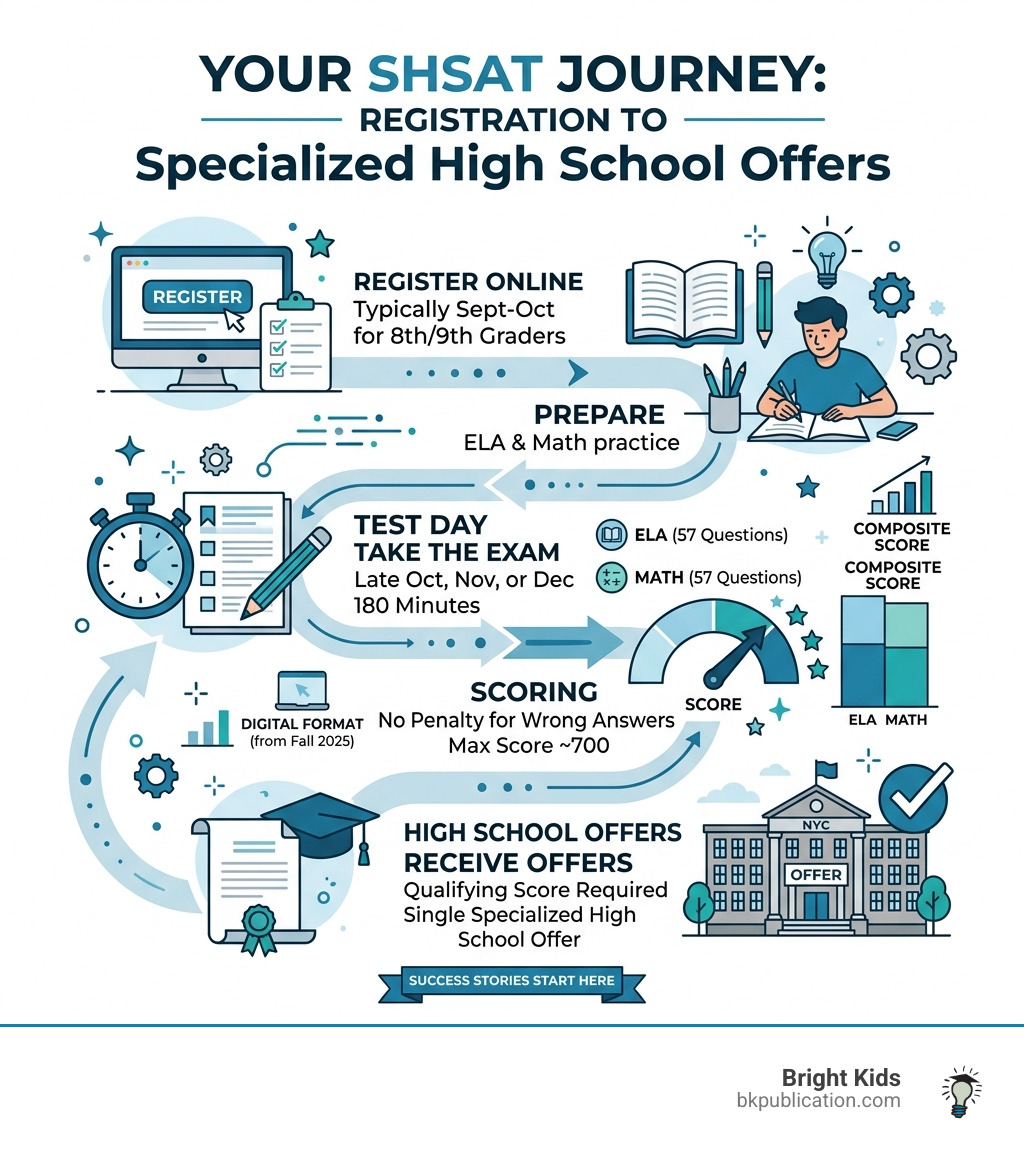
The SHSAT (Specialized High Schools Admissions Test) is the single exam that determines admission to eight of New York City's most competitive public high schools. Here's what you need to know at a glance:
| Key Detail | Info |
|---|---|
| Who takes it | NYC residents in 8th grade or first-time 9th grade |
| When it's given | Late October, mid-November, early December |
| Sections | ELA (57 questions) + Math (57 questions) |
| Total time | 180 minutes |
| Max score | ~700 composite |
| Cost | Free |
| Scoring | No penalty for wrong answers |
| Going digital | Fall 2025 (digital), Fall 2026 (adaptive) |
This is a high-stakes, one-shot exam. Your child's score — and nothing else — determines whether they get a seat at schools like Stuyvesant, Bronx Science, or Brooklyn Tech.
In 2024, 25,678 students took the SHSAT. Only 4,072 of them — about 1 in 6 — received a qualifying score. That gap between hopeful and admitted makes preparation critical.
This guide walks you through everything: the format, the scoring, the cutoff scores, the upcoming digital changes, and how to give your child the best shot at success.
I'm Bige Doruk, founder of Bright Kids, and over nearly two decades I've helped more than 10,000 students prepare for competitive exams including the SHSAT, distributing over 200,000 workbooks and practice tests along the way. Read on for the complete, practical breakdown your family needs to approach this exam with confidence.
What is the SHSAT and Who Can Take It?
The SHSAT stands for the Specialized High Schools Admissions Test. It is the mandatory competitive exam for any New York City student wishing to enter the city’s elite Specialized High Schools. Unlike other high schools in the city that might look at grades, attendance, or interviews, the testing schools use the SHSAT as their sole criterion for admission.
To be eligible to take the test, a student must be a current resident of New York City. The exam is primarily designed for 8th graders who are applying for a seat in 9th grade. However, first-time 9th graders can also take the test to apply for a very limited number of seats in the 10th grade. It is important to note that the 9th-grade version of the test is significantly more difficult and the competition for those few 10th-grade seats is incredibly fierce.
Whether your child attends a public, private, or parochial school, they are eligible as long as they live within the five boroughs. You can find more official details on eligibility and registration on the Specialized High School Admissions Test page or read about the history of the exam on the Specialized High Schools Admissions Test - Wikipedia entry.
The Eight Testing Schools vs. LaGuardia
There are nine Specialized High Schools in total, but only eight of them require the SHSAT. These "Testing Schools" are:
- Stuyvesant High School (Manhattan)
- The Bronx High School of Science (Bronx)
- Brooklyn Technical High School (Brooklyn)
- The High School for Mathematics, Science and Engineering at City College (Manhattan)
- The High School of American Studies at Lehman College (Bronx)
- The Brooklyn Latin School (Brooklyn)
- Queens High School for the Sciences at York College (Queens)
- Staten Island Technical High School (Staten Island)
The ninth school, Fiorello H. LaGuardia High School of Music & Art and Performing Arts, does things differently. Instead of the SHSAT, LaGuardia requires an audition and a review of the student's academic record. Students can apply to one or more of its six studios: Dance, Drama, Instrumental Music, Technical Theater, Visual Arts, and Vocal Music. Because the processes are separate, a student could potentially receive an offer from one of the eight testing schools and an offer from one (or more) studios at LaGuardia!
Understanding the shsat Format and Structure

The SHSAT is a marathon, not a sprint. Students are given 180 minutes (3 hours) to complete the entire test. One of the unique aspects of this exam is that students can choose how to allocate their time. There is no proctor telling them when to move from English to Math; they can start with whichever section they prefer and switch back and forth as needed.
The test consists of 114 total questions, split evenly between two sections. However, not every question is scored. In each section, 47 questions are "scored" and 10 questions are "experimental" items used by the test makers for future exams. Since students don't know which is which, they must treat every question as if it counts!
| Section | Question Count | Format |
|---|---|---|
| English Language Arts (ELA) | 57 Items | Revising/Editing & Reading Comprehension |
| Mathematics | 57 Items | 5 Grid-ins & 52 Multiple Choice |
ELA and Math Topics on the SHSAT
The SHSAT is designed to align with the New York State Learning Standards, but it often pushes students beyond what they see in their daily classroom.
English Language Arts (ELA): This section is divided into two parts.
- Revising/Editing: This tests the "mechanics" of writing. Part A focuses on individual sentences (grammar, punctuation, sentence structure), while Part B asks students to improve a larger passage by fixing flow, clarity, and organization.
- Reading Comprehension: Students will encounter 6 passages. These typically include 3-4 informational texts, 1-2 literary prose pieces, and one poem. The questions ask about the central idea, tone, specific details, and the author’s intent.
Mathematics: The math section covers arithmetic, algebra, geometry, and data analysis.
- Grid-in Questions: The first five questions are not multiple choice. Students must calculate the answer and bubble it into a grid. This prevents "guessing" and ensures students actually know the computation.
- Multiple Choice: The remaining 52 questions cover word problems and computational tasks. Topics include fractions, decimals, statistics, probability, and basic coordinate geometry.
For a deeper dive into specific question types, we recommend checking out the Test Content and Other Information | NYSHSAT resource.
Scoring, Cutoff Scores, and the Admissions Process
The way the SHSAT is scored can be a bit of a mystery to many families. It isn't as simple as "getting 80% right."
First, a raw score is calculated based on the number of correct answers (out of 47 scored questions per section). There is no penalty for wrong answers, so we always tell our students: never leave a bubble blank!
Then, through a complex process of calibration and normalization, the raw score is converted into a scaled score. This process ensures that the difficulty of different test versions is accounted for. The maximum scaled score for each section is usually around 350, leading to a maximum composite score of approximately 700.
One interesting "quirk" of the SHSAT scoring is that it rewards "spiky" profiles. Because of the way the scaling works, a student who scores exceptionally high in one section and average in the other might actually end up with a higher composite score than a student who is "pretty good" at both.
Recent Cutoff Scores for Top Schools
Offers are made in a very specific way: the student with the highest score in the city gets their first-choice school. Then the second-highest scorer gets their first choice, and so on. This continues until a school's seats are completely filled. The score of the last student to get into a school becomes that year's "cutoff score."
Based on recent data for 2026 admissions, here were the cutoff scores for some of the most popular schools:
- Stuyvesant High School: 561
- The Bronx High School of Science: 525
- HSMSE at City College: 539
- The High School of American Studies at Lehman: 507
- Brooklyn Technical High School: 506
- The Brooklyn Latin School: 495
These numbers change every year based on how well the students perform and which schools are the most popular choices that season.
The Future of the Exam: Digital and Adaptive Testing
The SHSAT is entering a new era. For decades, it was a pencil-and-paper exam. However, in Fall 2025, the SHSAT moved to a digital format.
This initial digital transition included "tech-enhanced items" (TEI). Instead of just bubbling in a circle, students might have to drag and drop items or select multiple correct answers. To help students get used to this, the NYC DOE has launched the Home | NYC SHSAT portal, which includes a Student Readiness Tool. This tool allows kids to practice with the digital interface, using features like highlighters, notes, and zoom.
Computer-Adaptive Testing (CAT) in 2026
The biggest change comes in Fall 2026, when the test is scheduled to become a Computer-Adaptive Test (CAT).
In a CAT, the test "learns" from the student. If a student answers a question correctly, the next question might be slightly harder. If they get it wrong, the next one might be easier. This allows the test to find the student's true ability level more quickly. While this can feel intimidating, it also means the test can be more precise. Digital navigation will still allow for embedded supports like glossaries for certain students. You can keep an eye on updates and find Practice Tests | NYC SHSAT as they become available on the official portal.
Support Systems: Accommodations, DREAM, and Discovery
New York City aims to make the SHSAT accessible to all students. There are several programs and accommodations in place to ensure a level playing field.
Accommodations: Students with disabilities who have an IEP or 504 plan may be eligible for accommodations such as double time (360 minutes instead of 180), a separate testing room, or Text-to-Speech software. English Language Learners (ELLs) and eligible former ELLs also receive double time and are provided with bilingual math and ELA glossaries in several languages. You can find more on these policies at the Specialized High School Admissions Test - Schools.nyc.gov website.
The DREAM and Discovery Programs
To increase diversity at these elite schools, the city utilizes two main programs:
- DREAM Program: This is an intensive, free after-school and summer prep program for 6th and 7th graders from underrepresented backgrounds or low-income neighborhoods. It aims to prepare them for the SHSAT long before test day arrives.
- Discovery Program: This program is for students who scored just below the cutoff score and attend a school with a high Economic Need Index. If these students are recommended for the program and successfully complete a rigorous summer enrichment course, they can earn a seat at a Specialized High School. Currently, the Discovery program fills about 20% of the seats at each school.
Frequently Asked Questions about the SHSAT
When and where is the test administered?
The shsat is typically held over several weeks in late autumn.
- October: Many 8th graders in NYC public schools take the test during a "School Day" administration at their own middle school.
- November: Weekend testing is usually held at designated "Testing Centers" for students who attend private/parochial schools or those who missed the school day test.
- December: This is typically when 9th graders take their version of the exam.
How many questions are actually scored?
As mentioned earlier, there are 57 questions per section, but only 47 are scored. The other 10 are experimental. These experimental questions are used by the Department of Education to "field test" items for future years to ensure they are fair and valid. Because you cannot distinguish between a scored and an unscored question, your strategy should be to give 100% effort to all 114 items.
Preparing for the shsat with Practice Resources
Preparation is the key to managing the stress of this exam. We always recommend starting with a diagnostic test to see where your child's strengths and weaknesses lie.
- Timed Practice: Since the test is 180 minutes, students need to build "test stamina." Taking full-length practice tests is essential.
- Error Analysis: Don't just look at the score. Look at why a question was missed. Was it a calculation error? A misunderstanding of the passage?
- Official Handbooks: The NYC DOE releases an official handbook every year. You can find the NYC Guide to the SHSAT online, which includes two full-length practice tests (Form A and Form B).
Conclusion
The journey to a Specialized High School is a challenging one, but it is also an incredible opportunity for your child to join a community of motivated, high-achieving peers. At Bright Kids, we have spent 17 years perfecting the art of test preparation. We believe that the best results come from a combination of high-quality materials and expert guidance.
Our test prep books are designed to mimic the actual SHSAT as closely as possible, helping students feel like test day is just another day at their desk. When you pair our comprehensive workbooks with our personalized tutoring, you give your child the tools they need to master the content and the strategies required to succeed.
If you're ready to start your journey, you can Prepare for success with SHSAT collections through our online shop. We are here to support NYC families every step of the way, from the first practice question to the day those results finally arrive in the MySchools portal. Good luck!