

Don't Panic! Your Child's Guide to Otis Lennon Test Sample Questions
Apr 28, 2026
What Are OLSAT Test Sample Questions — and Where Can You Find Them?
OLSAT test sample questions are practice problems designed to mirror the real Otis-Lennon School Ability Test, which schools use to identify students for gifted and talented programs from Pre-K through 12th grade.
Here is a quick look at the main question types your child will encounter:
| Section | Question Types | Who It's For |
|---|---|---|
| Verbal Comprehension | Following Directions, Antonyms, Sentence Completion | All levels |
| Verbal Reasoning | Analogies, Logical Selection, Aural Reasoning | All levels |
| Pictorial Reasoning | Picture Classification, Picture Analogies, Picture Series | Younger grades |
| Figural Reasoning | Figural Analogies, Pattern Matrices, Figural Classification | All levels |
| Quantitative Reasoning | Number Series, Number Matrix, Numeric Inference | All levels |
A few key facts to know right away:
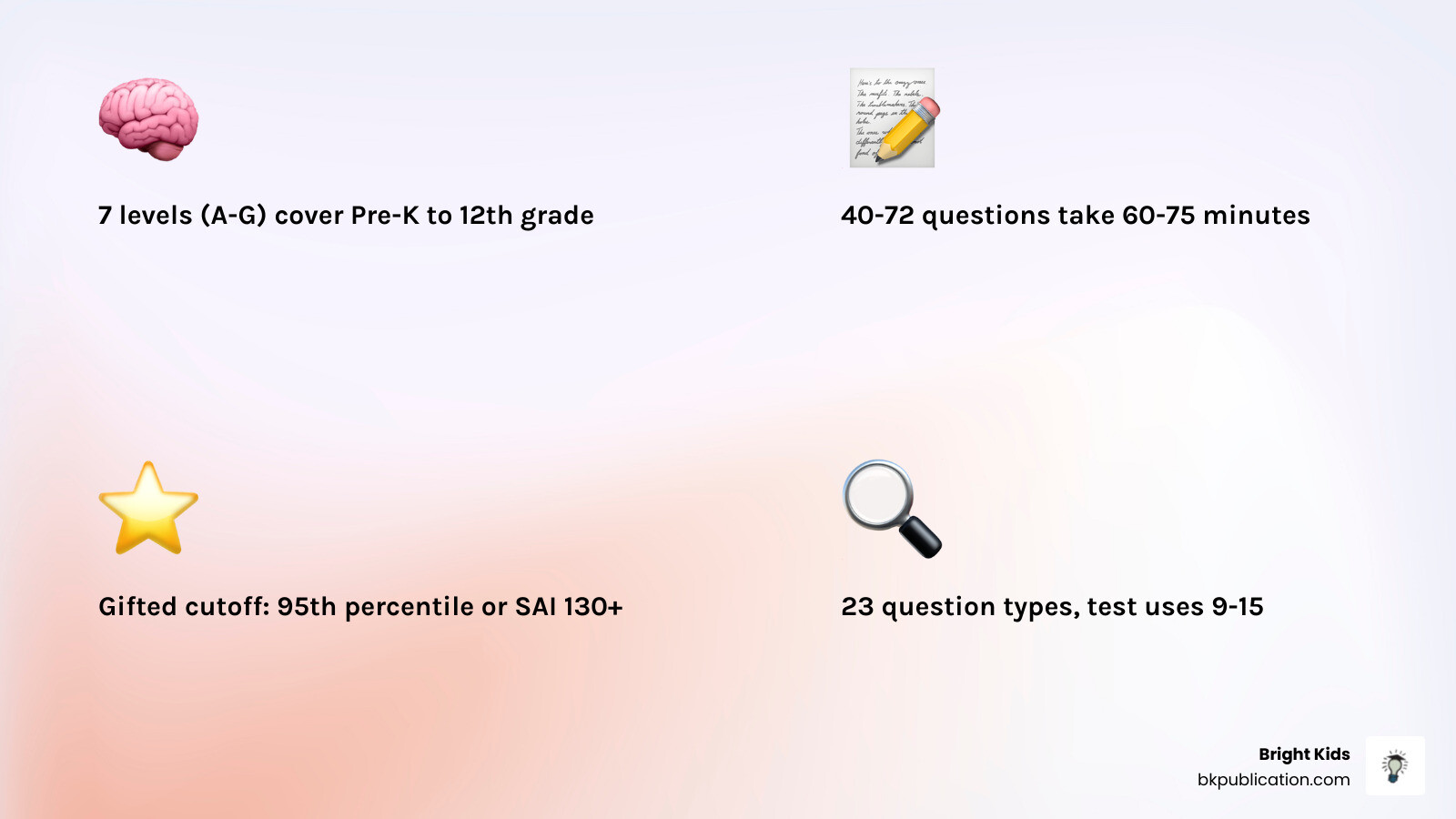
- The OLSAT has 7 levels (A through G), covering Pre-K to 12th grade
- Tests range from 40 to 72 questions and take 60 to 75 minutes
- Gifted programs typically require a 95th percentile score or an SAI of 130+
- There are 23 different question types across all levels — but any single test uses only 9 to 15 of them
This guide walks you through real sample questions by section and grade level, explains the reasoning behind each question type, and gives you practical strategies to help your child prepare with confidence — not anxiety.
I'm Bige Doruk, founder of Bright Kids and a Harvard MBA with nearly two decades of experience helping over 10,000 students navigate gifted testing, including working with OLSAT test sample questions across every grade level. Our team has helped families go from confused to confident — and this guide reflects everything we've learned along the way.
Understanding the OLSAT Structure and Scoring
When we talk about the OLSAT, we aren't talking about a math or spelling bee. The Otis-Lennon School Ability Test is a "school ability" test, meaning it measures how well a child can think, reason, and solve problems they haven't seen in a textbook. Because a kindergartner thinks very differently than an eighth grader, the test is broken down into seven distinct levels.
Understanding these levels is the first step in finding the right olsat test sample questions for your child. If you give a 2nd grader a Level G test meant for high schoolers, you’ll both end up in tears!
| OLSAT Level | Grade Level | Number of Items | Verbal/Nonverbal Split |
|---|---|---|---|
| Level A | Pre-K | 40 | 16 Verbal / 24 Nonverbal |
| Level B | Kindergarten | 60 | 30 Verbal / 30 Nonverbal |
| Level C | 1st Grade | 72 | 36 Verbal / 36 Nonverbal |
| Level D | 2nd Grade | 72 | 36 Verbal / 36 Nonverbal |
| Level E | 3rd Grade | 72 | 36 Verbal / 36 Nonverbal |
| Level F | 4th - 5th Grade | 72 | 36 Verbal / 36 Nonverbal |
| Level G | 6th - 12th Grade | 72 | 36 Verbal / 36 Nonverbal |
Deciphering the Scores: SAI and Percentiles
When the results come back, you won't see a "70% correct." Instead, you’ll see the School Ability Index (SAI) and a Percentile Rank.
The SAI is a normalized score where 100 is exactly average. Most students fall between 85 and 115. However, for highly competitive gifted programs in cities like New York or Chicago, schools often look for an SAI of 130 or higher. The Percentile Rank compares your child to other children in the same age group across the country. A 95th percentile rank means your child scored better than 95% of their peers.
If you are just starting this journey, we recommend looking at a Gifted and Talented Practice Test to see how the OLSAT compares to other common assessments like the CogAT or NNAT.
Verbal Reasoning and Comprehension OLSAT Test Sample Questions
The Verbal sections of the OLSAT measure how well a child understands language and uses it to solve problems. This isn't just about vocabulary; it’s about "logical listening" and "word math."
For the youngest learners (Levels A-C), these questions are often read aloud by the test administrator. This is known as Aural Reasoning or Following Directions. For example: "Mark the picture that shows a spaceship first, an alien second, and an astronaut last."
The child must process that specific sequence and choose the correct image from a row of options. As children get older, they move into more complex areas like Verbal Classification and Logical Selection.

If you’re preparing a student in a competitive district, you might also be looking at CTP Test Prep NYC, as many private schools use a combination of these verbal reasoning metrics.
Verbal Analogies and Word Classification
Verbal analogies ask a child to find a relationship between two words and apply that same relationship to a new pair.
Sample Question (Level E/F): Baker is to bread as florist is to ___________. A) Garden B) Bouquet C) Petals D) Water
The Reasoning: A baker creates or provides bread. A florist creates or provides a bouquet. While a florist works with petals and water, the "creator-to-product" relationship points directly to "Bouquet."
Word Classification (Odd-One-Out): Which word does not belong? A) Trumpet B) Guitar C) Flute D) Piano E) Violin
The Reasoning: This is a classic OLSAT "trick." All are instruments. However, the Trumpet, Guitar, Flute, and Violin are all portable and typically held while playing. The Piano is a large, stationary piece of furniture. Therefore, the Piano is the outlier.
Sentence Completion and Arrangement olsat test sample questions
These questions test a child's "syntactic sense"—their ability to understand how a sentence should logically flow.
Sentence Completion Sample: The magician pulled a rabbit out of his hat, leaving the audience in _______ and _______. (A) shock..laughter (B) anger..boredom (C) sleep..tears
The child must use context clues. Magicians usually elicit surprise (shock) or joy (laughter), making "A" the only logical choice.
Sentence Arrangement Sample: If the words below were arranged to make the best sentence, what letter would the last word begin with? trees / early / morning / birds / sang / in / the / loudly / the
The Reasoning: The child must mentally build the sentence: "The birds sang loudly from the trees early in the morning." The last word is "morning," so the answer is "M." This requires significant working memory! If your child is older, practicing with an ISEE Upper Level Practice Test can also help sharpen these sentence-building skills.
Mastering Non-Verbal and Quantitative Reasoning
The Non-Verbal sections are often where children have the most fun—but also where they face the most "alien" concepts. These questions use shapes, patterns, and numbers instead of words.
Figural Reasoning and Pattern Matrices olsat test sample questions
Figural reasoning involves looking at geometric shapes and figuring out how they change. Do they rotate? Do they change color? Do they flip?
Figural Analogy Sample: Imagine a large square with a small circle inside. In the next box, the circle has moved outside the square. Now, you are shown a large triangle with a small star inside. What comes next? The Reasoning: The rule is "move the inner shape to the outside." The correct answer would be a large triangle with a star outside of it.
Pattern Matrix Sample: In a 3x3 grid, the first row has 8 lines, the second has 6 lines, and the third has 4 lines. The Reasoning: The pattern is "subtract 2 lines." The child must identify this mathematical relationship hidden within a visual puzzle. For more practice in this specific area, check out CoGAT Figure Matrices Exercises, which use very similar logic.
We often tell parents to treat these like puzzles. If you can make it a game, the child will be much more engaged. You can even find Practice ITBS Test Free Online materials that offer similar spatial reasoning challenges.
Quantitative Reasoning and Number Matrices
Quantitative reasoning isn't about long division; it’s about seeing the "rhythm" in numbers.
Number Series Sample: 0, 1, 2, 5, 6, 7, 10, 11, 12, ? The Reasoning: Look at the gaps. +1, +1, +3. Then +1, +1, +3. The last number was 12 (the end of a +1 sequence), so the next jump is +3. The answer is 15.
Number Matrix Sample: A grid shows numbers that increase by 11 in one direction and decrease by 49 in another. The child must solve for the missing "X" by identifying the horizontal and vertical rules simultaneously. This is advanced logic that is also a staple of the SHSAT Complete Guide for older students.
Effective Strategies for OLSAT Preparation
Preparing for the OLSAT is a marathon, not a sprint. Here are our top "Bright Kids Approved" strategies:
- Don't Just Practice—Explain: When your child gets a question right, ask them why. If they can explain the "rule" (e.g., "The shape rotated 90 degrees"), they have truly mastered the concept.
- The "Power of the Guess": On the OLSAT, there is no penalty for wrong answers. Teach your child to never leave a bubble blank. If they are stuck, they should eliminate the "silly" answers and take their best shot.
- Visualization: For inference questions (e.g., "If Stewart is taller than Bobby..."), teach your child to draw "height lines" on scratch paper. Visualizing the data makes it much harder to get confused.
- Manage the Clock: The OLSAT is timed. During your final week of prep, do at least one full-length, timed simulation. This builds the "test stamina" needed to stay focused for 60+ minutes.
- Environment Matters: Practice in a quiet space without snacks or screens. This mimics the real testing environment in schools across our locations, from NYC to Los Angeles.
If you feel your child needs more personalized support, ERB Upper Level Tutoring or specialized ISEE Test Upper Level coaching can provide the structured environment some students need to thrive.
Frequently Asked Questions about the OLSAT
What is a qualifying score for gifted and talented programs?
While every school district is different, the "gold standard" for many elite programs is the 95th percentile. In terms of the SAI (School Ability Index), a score of 130 or higher is typically considered the threshold for "Highly Gifted" status. Some programs may accept scores as low as the 90th percentile if other factors (like grades or teacher recommendations) are strong.
How many questions are on the OLSAT for each grade level?
- Pre-K (Level A): 40 questions
- Kindergarten (Level B): 60 questions
- 1st Grade through 12th Grade (Levels C-G): 72 questions The administration time usually stays between 60 and 75 minutes, though younger children may take longer due to the verbal instructions being read aloud.
How does the OLSAT differ from the CogAT or NNAT?
The NNAT (Naglieri Nonverbal Ability Test) is 100% non-verbal—it uses only shapes and colors. The CogAT is similar to the OLSAT but often focuses more heavily on "multilevel" reasoning. The OLSAT is unique because it has a very heavy emphasis on verbal reasoning and "aural" (listening) skills in the younger years, making it a very well-rounded measure of overall school ability.
Conclusion
The OLSAT doesn't have to be a source of stress for your family. By breaking down the test into its 23 question types and practicing with high-quality olsat test sample questions, you can help your child walk into the testing room feeling prepared and capable.
At Bright Kids, we’ve spent 17 years perfecting the art of test prep. From our home base in NYC to our offices in Miami, Chicago, and San Francisco, we provide the books and tutoring that families trust. Our practice materials are designed to mimic the real exam as closely as possible, ensuring there are no "scary surprises" on test day.
Ready to give your child the edge they deserve? Explore our full range of OLSAT prep services and practice books and let’s get started on the path to academic success together!