

The Word Nerd’s Guide: Top SSAT Verbal Section Tips
May 01, 2026
Understanding the Format: 60 Questions in 30 Minutes
The SSAT Verbal section is a high-speed chase. You are presented with 60 multiple-choice questions: 30 Synonyms followed by 30 Analogies. You have exactly 30 minutes to complete them. If you do the math, that averages out to just 30 seconds per question.
One of the most important SSAT verbal section tips to remember is that within each sub-section (Synonyms and Analogies), the questions generally progress from easiest to hardest. However, every question is worth exactly one raw point. There are no "bonus points" for cracking a level-5 difficulty analogy.
In terms of scoring, your raw score (the number of correct answers minus a penalty for wrong ones) is converted into a scaled score. For the Upper Level SSAT, this range is typically 500-800. Because the Verbal section is the fourth section of the test, students are often fatigued by the time they reach it. Understanding this structure helps us stay mentally sharp and strategically focused.
Pacing and the 30-Second Rule
Effective time management is the difference between a 600 and a 750. Since you have 30 seconds per question, you cannot afford to "marry" a single difficult word. If you don't recognize a synonym or can't find the relationship in an analogy within 15-20 seconds, mark it in your test booklet and move on.
We recommend a "Two-Pass" strategy:
- The First Pass: Go through the entire section and answer every question that feels "easy" or "medium." These are your "banked" points.
- The Second Pass: Return to the questions you skipped. Now that the pressure of finishing is off, you can use your remaining minutes to apply logic to the tougher vocabulary.
The goal isn't necessarily to finish every single question—it's to get as many correct as possible while minimizing errors.
Essential SSAT Verbal Section Tips for Pacing and Scoring
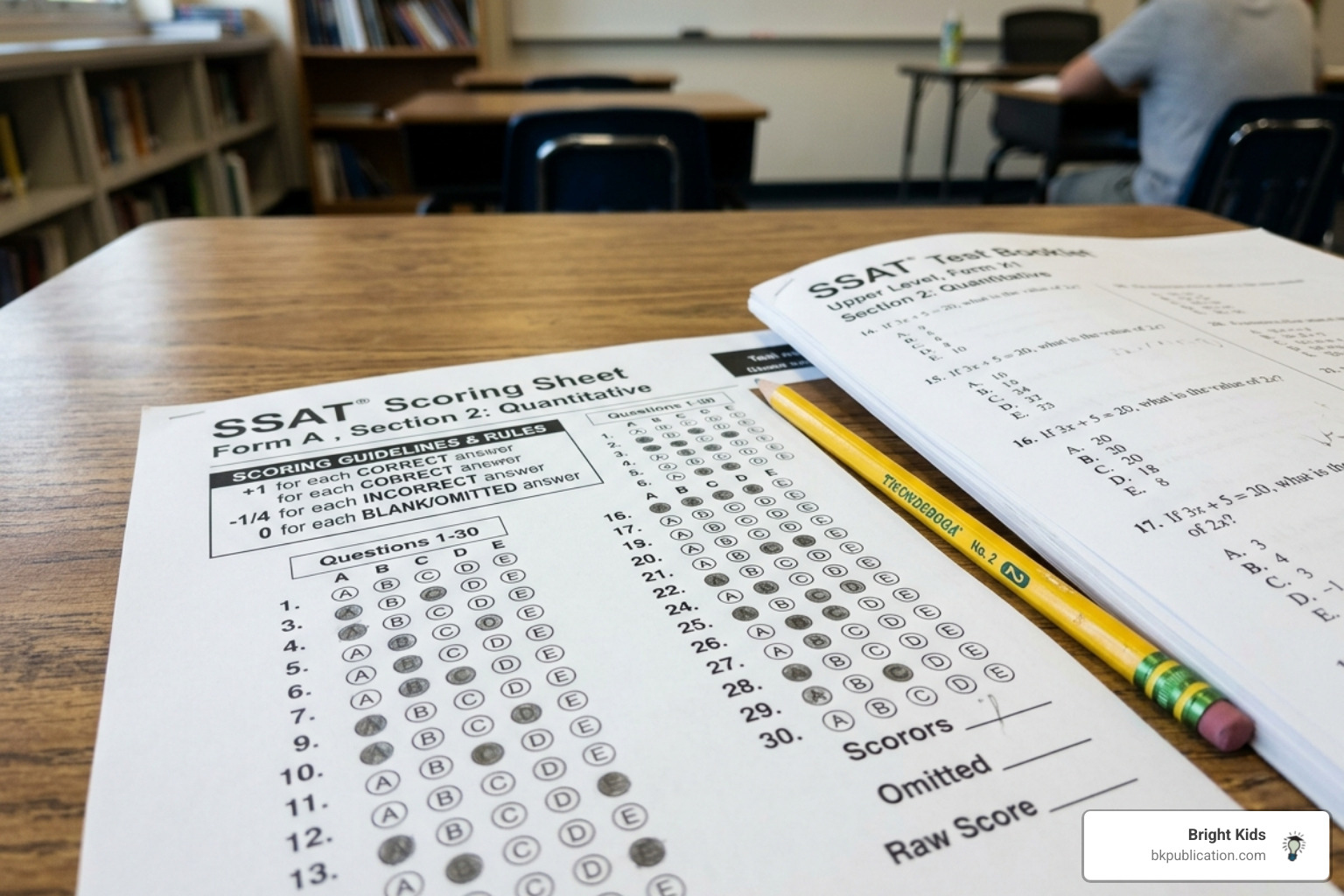
The SSAT uses a "guessing penalty," which is a fancy way of saying they want to discourage blind luck.
- Correct Answer: +1 point
- Incorrect Answer: -1/4 point
- Blank Answer: 0 points
This means that if you guess randomly on four questions and get them all wrong, you lose a full point from your raw score. However, if you leave them blank, your score remains unchanged. This makes the SSAT very different from many state-level tests where you should always bubble something in.
When to Guess and When to Skip
Strategic guessing is a skill. You should only guess if you can use the process of elimination to cross out at least one (and ideally two or more) answer choices.
- If you can't eliminate any choices: Leave it blank. The probability of getting it right (20%) isn't worth the 1/4 point risk.
- If you can eliminate one choice: It’s a toss-up, but generally safer to skip if you are aiming for a high percentile.
- If you can eliminate two or more choices: The odds are now in your favor. This is an "educated guess," and statistically, these will help your score over the course of the 60 questions.
Always prioritize accuracy over speed. It is better to answer 45 questions correctly and leave 15 blank than to answer all 60 but get 25 of them wrong.
Mastering Synonyms with Context and Word Parts
Synonyms test your "dictionary" knowledge, but you don't need to have memorized the entire Merriam-Webster to succeed. When you see a word you don't know, look for its "DNA"—the roots, prefixes, and suffixes.
For example, if you see the word "malevolent," you might recognize the prefix "mal-," which means "bad" or "evil." Even if you don't know the full definition, you can eliminate any answer choices with a positive "charge," like "kind" or "generous."
Decoding Unfamiliar Words: SSAT Verbal Section Tips
To improve your performance, use the "Sentence Method." Put the stem word into a simple sentence that captures its meaning. If the word is "Abbreviate," your sentence might be "I need to abbreviate this long story." Then, test the answer choices in that same sentence. "I need to shorten this long story." It fits!
Another powerful tool is the use of bizarre mnemonics. Our brains remember the strange and the funny much better than the mundane. For the word "Abase" (to humiliate), imagine a baseball player tripping over a base and embarrassing himself in front of the whole stadium.
| Root/Prefix/Suffix | Meaning | SSAT Example Word |
|---|---|---|
| Mal- | Bad | Malice, Malign |
| Bene- | Good | Benefactor, Benevolent |
| Anthro- | Human | Anthropology, Philanthropy |
| Chron- | Time | Chronological, Chronic |
| Contra- | Against | Contradict, Controversy |
| Cred- | Believe | Incredible, Credibility |
| Dict- | Speak | Dictate, Prediction |
| Fract- | Break | Fracture, Fraction |
| Ject- | Throw | Eject, Interject |
| Magn- | Large | Magnify, Magnitude |
| Omni- | All | Omniscient, Omnipotent |
| Path- | Feeling | Empathy, Apathy |
| Phil- | Love | Philosophy, Bibliophile |
| Port- | Carry | Portable, Transport |
| Scrib- | Write | Inscribe, Scribble |
| Spec- | Look | Spectator, Inspect |
| Struct- | Build | Construct, Structure |
| Tract- | Pull | Extract, Retract |
| Vis- | See | Visual, Vision |
| Voc- | Voice | Vocal, Advocate |
| Anti- | Against | Antiseptic, Antisocial |
| De- | Down/Away | Descend, Deposit |
| Dis- | Not/Apart | Distant, Disconnect |
| Inter- | Between | Intermediate, Intervene |
| Pre- | Before | Precede, Prepare |
| Re- | Again | Return, Review |
| Un- | Not | Unhappy, Unseen |
| -ology | Study of | Biology, Psychology |
Cracking the Code of SSAT Analogies
Analogies aren't just about vocabulary; they are about logic. An analogy asks you to find the relationship between two words and then find a second pair of words that shares that exact same relationship.
The golden rule for analogies is to create a Bridge Sentence. If the question is "KITTEN : CAT," your bridge sentence is: "A kitten is a baby cat." Then, apply that sentence to the answer choices. "A puppy is a baby dog." Perfect.
Identifying Relationships: SSAT Verbal Section Tips
If your bridge sentence is too simple, you might find two "correct" answers. For example, if the pair is "HAMMER : TOOL," don't just say "A hammer is a tool." Be more specific: "A hammer is a type of tool used for hitting." This specificity helps you eliminate "attractor" answers that are close but not quite right.
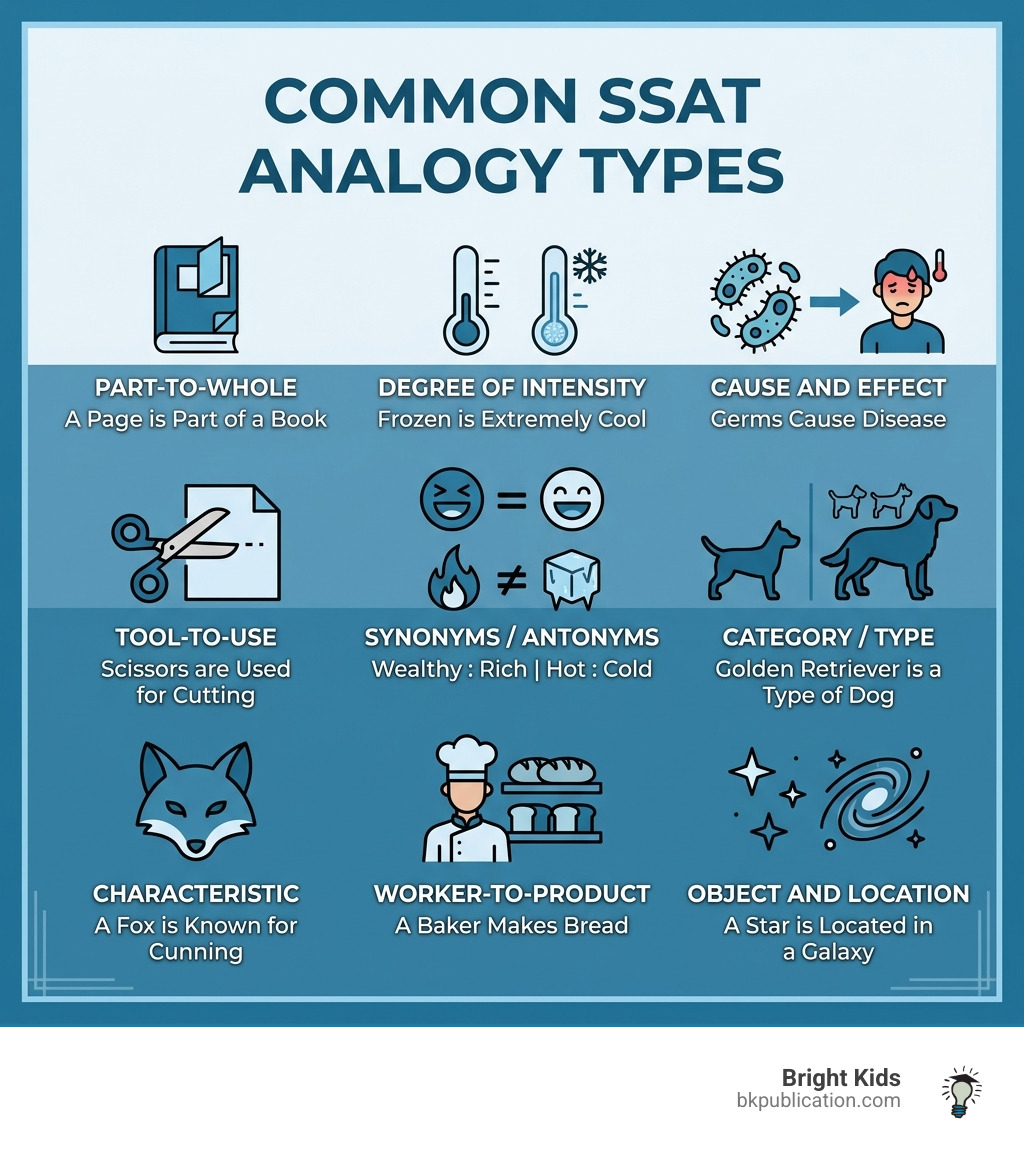
Here are 9 common analogy types found on the SSAT:
- Part to Whole: Page : Book (A page is a part of a book).
- Degree of Intensity: Cool : Frozen (Frozen is an extreme version of cool).
- Cause and Effect: Germs : Disease (Germs cause disease).
- Tool and Use: Scissors : Cut (Scissors are used to cut).
- Synonyms/Antonyms: Wealthy : Rich or Hot : Cold.
- Category/Type: Golden Retriever : Dog (A Golden Retriever is a type of dog).
- Characteristic: Fox : Cunning (A fox is known for being cunning).
- Worker and Product: Baker : Bread (A baker makes bread).
- Object and Location: Star : Galaxy (A star is located in a galaxy).
Long-Term Vocabulary Building and Practice
You cannot cram for the SSAT Verbal section. Vocabulary is like a piggy bank; you have to make small, daily deposits over months to see a big return. We recommend a 3-6 month preparation window.
One of the most effective SSAT verbal section tips is to move beyond rote memorization. Instead of just reading a list, engage your senses.
- Handwrite your lists: Research shows that writing by hand reinforces memory better than typing.
- Use them in conversation: If you learn the word "truculent," try to use it twice in a conversation during the week. "The bus driver was feeling a bit truculent this morning!" Once you use a word in context, you own it forever.
- Active Reading: Read articles from The New York Times or The Economist. When you hit a word you don't know, look it up and add it to your personal "Hit List."
Simulating Real Test Conditions
As you get closer to test day, you must practice under pressure. A student might be a vocabulary genius at the kitchen table but freeze up when the 30-minute timer starts.
Take full-length practice sections. Use a bubble sheet. Silence your phone. After each practice session, perform an Error Analysis. Don't just look at what you got wrong—look at why. Did you miss a "not" in the question? Did you fall for a secondary definition? Did you spend two minutes on a hard analogy and run out of time for three easy ones at the end? Learning from your mistakes is the fastest way to raise your score.
Frequently Asked Questions about the SSAT Verbal Section
Should I try to answer every question on the Verbal section?
In most cases, no. Unless you are scoring in the 95th percentile and above, trying to answer all 60 questions often leads to "careless" errors and rushing. It is better to focus on the 45-50 questions you feel confident about and leave the "impossible" ones blank to avoid the 1/4 point penalty.
How many vocabulary words should I learn each week?
We recommend 15 to 20 new words per week, but the key is retention. It's better to truly learn 10 words (meaning you can use them in a sentence and identify their roots) than to skim 50 words and forget them by Sunday.
Is the SSAT Verbal section harder than the Reading section?
They test different skills. The Reading section tests your ability to synthesize information and find evidence in a text. The Verbal section is more about "raw" word knowledge and quick logic. Many students find the Verbal section more intimidating because of the strict time limit, but it is often the section where scores improve the most with dedicated practice.
Conclusion
Mastering the SSAT Verbal section is a marathon, not a sprint. By combining a strong foundation in word roots with savvy test-taking strategies like the "Two-Pass" method and strategic skipping, you can significantly boost your scaled score.
At Bright Kids, we’ve spent 17 years perfecting the art of admissions prep. Our publications are designed to mimic the actual exam as closely as possible, ensuring there are no surprises on test day. Whether you are in New York, Chicago, or Los Angeles, our goal is to give you the tools to walk into that testing center with total confidence.
Ready to take your prep to the next level? More info about SSAT prep resources is available on our blog, where we share deep dives into every section of the test. Happy studying, you word nerds!