

Level Up Your Child's NNAT Reasoning by Analogy Skills
Jun 24, 2026
What Is NNAT Analogy Reasoning for Kids — and Why It Matters
NNAT analogy reasoning for kids is one of the most important — and often most challenging — question types on the Naglieri Nonverbal Ability Test (NNAT3), the widely used assessment that helps schools identify students for gifted and talented programs across the United States.
Here's a quick overview of what you need to know:
| Question | Quick Answer |
|---|---|
| What is Reasoning by Analogy? | A question type where kids identify how shapes relate in a matrix and find the missing piece |
| Which grades see these questions? | Kindergarten through Grade 4 (NNAT Levels A–D) |
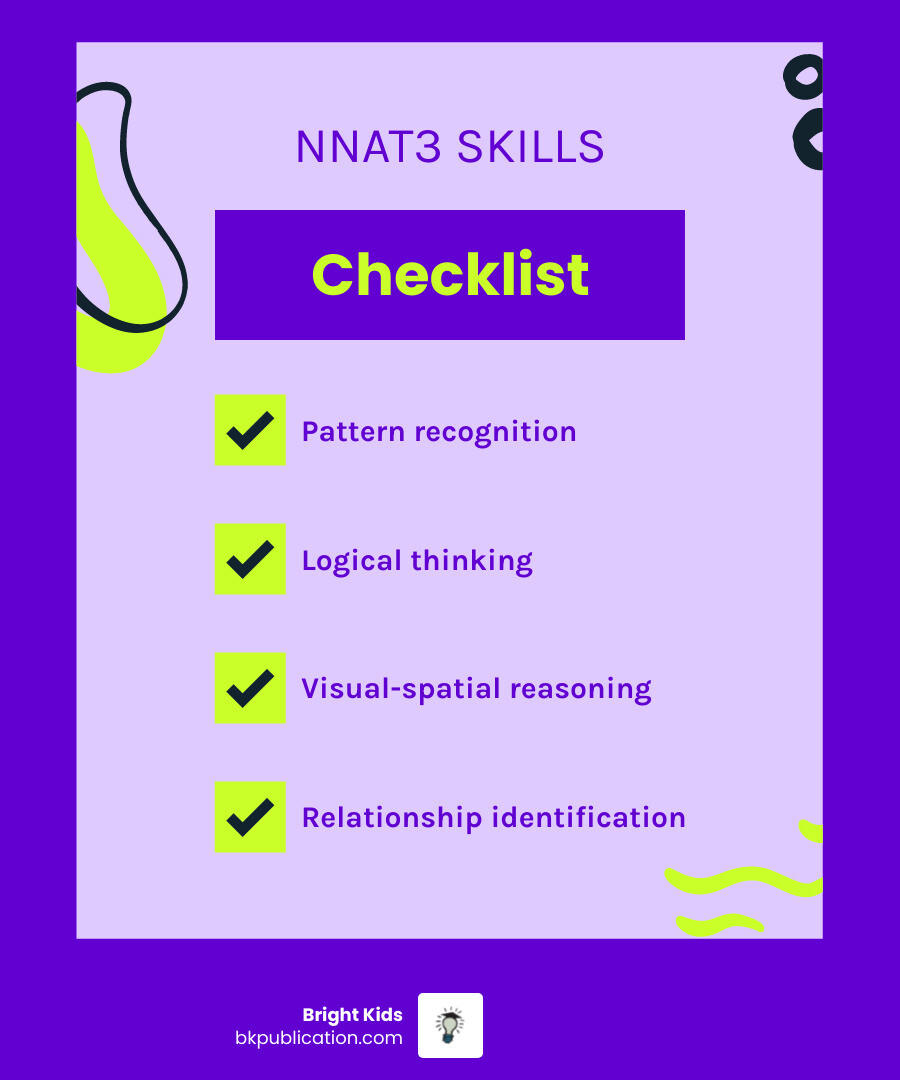
| What skills does it test? | Pattern recognition, logical thinking, visual-spatial reasoning |
| How many questions total on the NNAT3? | 48 questions in 30 minutes |
| What's a gifted-level score? | Generally an NAI score of 130+ (top 5%) |
Unlike reading or math tests, the NNAT uses only shapes and visual patterns — no words, no numbers. That makes Reasoning by Analogy questions feel unfamiliar to many children, even very bright ones. The good news? With the right strategies and practice, these skills are absolutely teachable.
I'm Bige Doruk, founder of Bright Kids, and over nearly two decades I've helped more than 10,000 students build the visual reasoning skills needed to excel at NNAT analogy reasoning for kids and similar nonverbal assessments. In the guide below, I'll walk you through exactly how these questions work — and how to prepare your child to tackle them with confidence.
The NNAT Nonverbal Reasoning Test is specifically designed to be fair to children from all backgrounds, as it doesn't rely on English language proficiency or school-taught knowledge. Instead, it looks at how a child thinks.
Understanding NNAT Analogy Reasoning for Kids
When we talk about nnat analogy reasoning kids usually encounter, we are looking at a very specific type of visual logic. In these questions, a child is presented with a 2x2 matrix (a square divided into four boxes). Three of the boxes contain geometric shapes, and one box is empty. The child’s job is to figure out the relationship between the shapes in the top row and then apply that same logic to the bottom row to find the missing piece.
These questions appear in NNAT3 Levels A through D, which covers students from kindergarten through the 4th grade. At the kindergarten level (Level A) and 1st grade level (Level B), Reasoning by Analogy is a cornerstone of the test. As children move into 3rd and 4th grade (Level D), the transformations become more complex, involving multiple changes at once, such as shifting colors while simultaneously flipping the shape.
At its heart, NNAT Reasoning by Analogy is about relationship recognition. It asks the child, "If this happens to the first shape to turn it into the second shape, what must happen to the third shape to turn it into the fourth?"
Why NNAT Analogy Reasoning for Kids Is Essential for Gifted Testing
School districts in major hubs like New York City, Chicago, and Houston use the NNAT to identify "high potential" students. But why use analogies instead of just asking hard math questions?
The answer lies in cognitive potential. Educators want to find children who can think abstractly and solve problems they haven't seen before. Because the test is nonverbal, it offers cultural neutrality. A child who just moved to Miami or San Francisco and is still learning English can perform just as well as a native speaker because the logic is purely visual.
Success on these questions contributes to the Naglieri Ability Index (NAI) score. This score, which ranges from 40 to 160, compares a child to their peers within a three-month age window. Most gifted programs look for a "Gifted" designation (NAI 130-144) or "Exceptional" (NAI 145-160). By practicing with a Gifted and Talented Practice Test, children become familiar with the "language" of these shapes.
Identifying Patterns in NNAT Analogy Reasoning for Kids
To excel at nnat analogy reasoning kids must develop three core abilities:
- Visual-Spatial Reasoning: Understanding how shapes look when they move or change.
- Pattern Recognition: Seeing the "rule" that governs a change.
- Abstract Thinking: Moving beyond what the shape is (e.g., a blue square) to what it represents in the logic of the puzzle.
By working through Bright Kids NNAT Preparation Resources, students learn to stop guessing and start analyzing. Instead of seeing a jumble of shapes, they begin to see a system of rules.
How Reasoning by Analogy Questions Work
To solve these puzzles, children must look at the matrix systematically. The NNAT3 is a 30-minute test with 48 questions, which means kids have less than a minute per question. Efficiency is key!
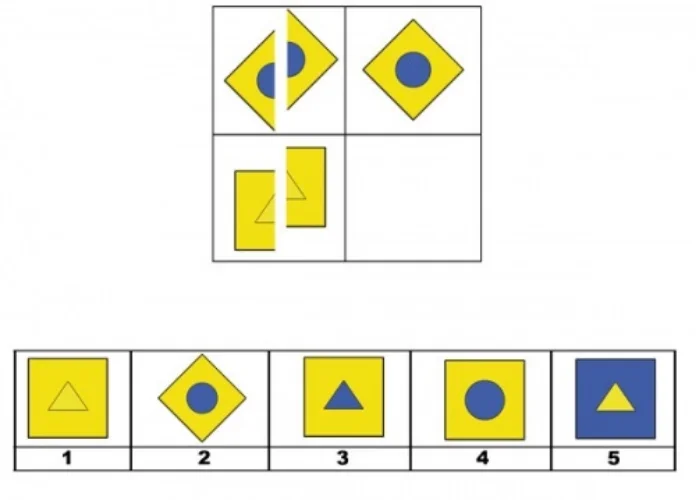
In a typical matrix, the child must examine the relationship across the row (left to right) and down the column (top to bottom). Usually, the rule that applies horizontally will also be supported by the vertical logic. For example, if a shape turns from blue to yellow in the top row, the shape in the bottom row should also turn from blue to yellow.
Common Visual Transformations
What exactly "happens" to these shapes? In our 17 years of experience at Bright Kids, we've identified several recurring transformations that appear in nnat analogy reasoning kids tests.
- Mirror Images: A shape is reflected across a central axis (horizontal or vertical).
- Shape Rotation: A shape turns 90 or 180 degrees.
- Color Switching: A blue shape becomes yellow, or a shaded area becomes white.
- Shading Changes: The internal pattern (like stripes or dots) moves or disappears.
| Feature | Level A (Kindergarten) | Level D (Grades 3-4) |
|---|---|---|
| Matrix Size | Simple 2x2 | Complex 2x2 or 3x3 |
| Number of Changes | Usually 1 (e.g., just color) | Often 2-3 (e.g., size + color + flip) |
| Distractors | Clearly different shapes | Shapes that look almost identical to the answer |
| Logic | Direct "copy" or "change" | Complex spatial rotations |
Working with Multiple Dimensions
As children progress through the levels, the questions start requiring them to track multiple dimensions simultaneously. A Level D question might involve:
- Shape Orientation: The triangle points up in box A but down in box B.
- Size Progression: The shape gets smaller as it moves across the row.
- Object Count: One circle becomes two circles.
This is where many kids get tripped up. They might notice the color change but forget to check if the shape also flipped. Using resources like Practice Tests 1 and 2: NNAT3 Grade 3 Level D helps older students build the mental stamina to check every detail before bubbling in their answer.
Step-by-Step Strategies to Solve Analogy Questions
At Bright Kids, we don't believe in "tricks." We believe in systems. When a child has a step-by-step method, test anxiety melts away because they know exactly what to do when they see a hard problem.
The Bridge Sentence Technique
One of the most effective ways to teach nnat analogy reasoning kids is through "bridge sentences." Even though the test is nonverbal, verbalizing the logic in their heads helps children lock in the relationship.
The format is: "A is to B as C is to D."
For example: "The Big Blue Square (A) is to the Small Blue Square (B) as the Big Red Circle (C) is to the..." The child naturally finishes the sentence with: "...Small Red Circle (D)."
By using this technique, the child identifies the specific transformation (size change) and applies it to the second pair. This "pair-based thinking" is the secret to Mastering NNAT Logic. It forces them to look at the relationship rather than just looking for a shape that "looks nice."
Elimination and Verification
The NNAT is a multiple-choice test, and the "distractor" choices are designed to look very similar to the correct answer. We teach students to be "detectives."
- Predict the answer first: Before looking at the choices, have the child describe or draw what they think belongs in the empty box. This prevents them from being confused by tricky distractors.
- Eliminate the "Impossible": Cross out any answers that are the wrong color or the wrong shape entirely.
- Track the details: If the top row shows a 90-degree turn, eliminate any choices that show a 180-degree turn.
- Verify both ways: Check if the answer works both across the row and down the column.
This systematic checking is a core part of our Gifted Child Test Prep philosophy. It’s not just about being smart; it’s about being careful.
Frequently Asked Questions about NNAT Analogies
What is a good NAI score for gifted programs?
The Naglieri Ability Index (NAI) is the standard score used for the NNAT. While every school district (from NYC to Los Angeles) has its own cutoff, a score of 130 or higher is generally considered the threshold for "Gifted" identification. This usually places a child in the 90th percentile or higher, meaning they performed better than 90% of students their age.
How many analogy questions are on the NNAT3?
The NNAT3 contains 48 questions in total, and students have 30 minutes to finish. In Levels A and B (Kindergarten and 1st Grade), Reasoning by Analogy makes up a large portion of the test alongside Pattern Completion. In Levels C and D, the test introduces Serial Reasoning and Spatial Visualization, but Analogy questions remain a critical component for scoring well.
What are common mistakes children make on these questions?
Even the brightest kids can make simple errors. The most common mistakes include:
- Ignoring the details: Noticing the shape change but missing a small shading difference.
- Focusing on only one dimension: Seeing that a shape turned blue but failing to see that it also rotated.
- Rushing: With only 30 minutes for 48 questions, some kids panic and pick the first answer that looks "okay."
- Overthinking: Trying to find a "secret" rule when the transformation is actually a simple flip.
To avoid these, we recommend short, consistent practice sessions. Practicing 20 minutes a day, three times a week, is far more effective than a four-hour "cram session" the weekend before the test.
Conclusion
Preparing for nnat analogy reasoning kids sections doesn't have to be a stressful experience. At Bright Kids, we’ve found that when children view these questions as puzzles or games, they actually enjoy the challenge.
Our NYC-based team has spent 17 years perfecting test prep books and tutoring services that mimic the real exam environment. We don't just want your child to pass a test; we want them to develop long-term cognitive skills—like logical deduction and spatial awareness—that will serve them in math, science, and beyond.
Whether you are in Connecticut, Dallas, or anywhere Nationwide, you can Level Up Your Prep with our comprehensive materials. Every child has potential; sometimes they just need the right tools to show the world how they think. Happy puzzling!