

Common Core Math Instructional Strategies That Actually Work (Without the Headache)
Jun 23, 2026
Why Common Core Math Instructional Strategies Matter for Your Child's Academic Success
Common Core math instructional strategies have changed how millions of students learn math — and if your child is heading toward a gifted program, private school admissions test, or any standardized assessment, understanding these strategies is a real advantage.
Here is a quick look at the most effective approaches:
| Strategy | What It Does |
|---|---|
| Differentiated Instruction | Meets students at their level while keeping grade-level rigor |
| Small-Group Guided Math | Targeted support for 2-6 students based on skill gaps |
| Number Line Representations | Builds mental models, especially powerful for fractions |
| Math Language Routines | Develops reasoning and mathematical communication |
| Gamified Learning | Increases engagement through points, quests, and avatars |
| Student Discourse | Exposes misconceptions and deepens understanding |
| Choice Boards | Gives students agency while practicing the same standard |
| Productive Struggle | Builds perseverance and problem-solving confidence |
These strategies are not just classroom theory. According to research cited by Harvard's Center for Education Policy Research, 82% of math teachers are now changing more than half of their instructional materials to align with the new standards — and 73% have embraced those standards fully or quite a bit. That is a significant shift in how math is being taught, and it affects what your child experiences every day in school.
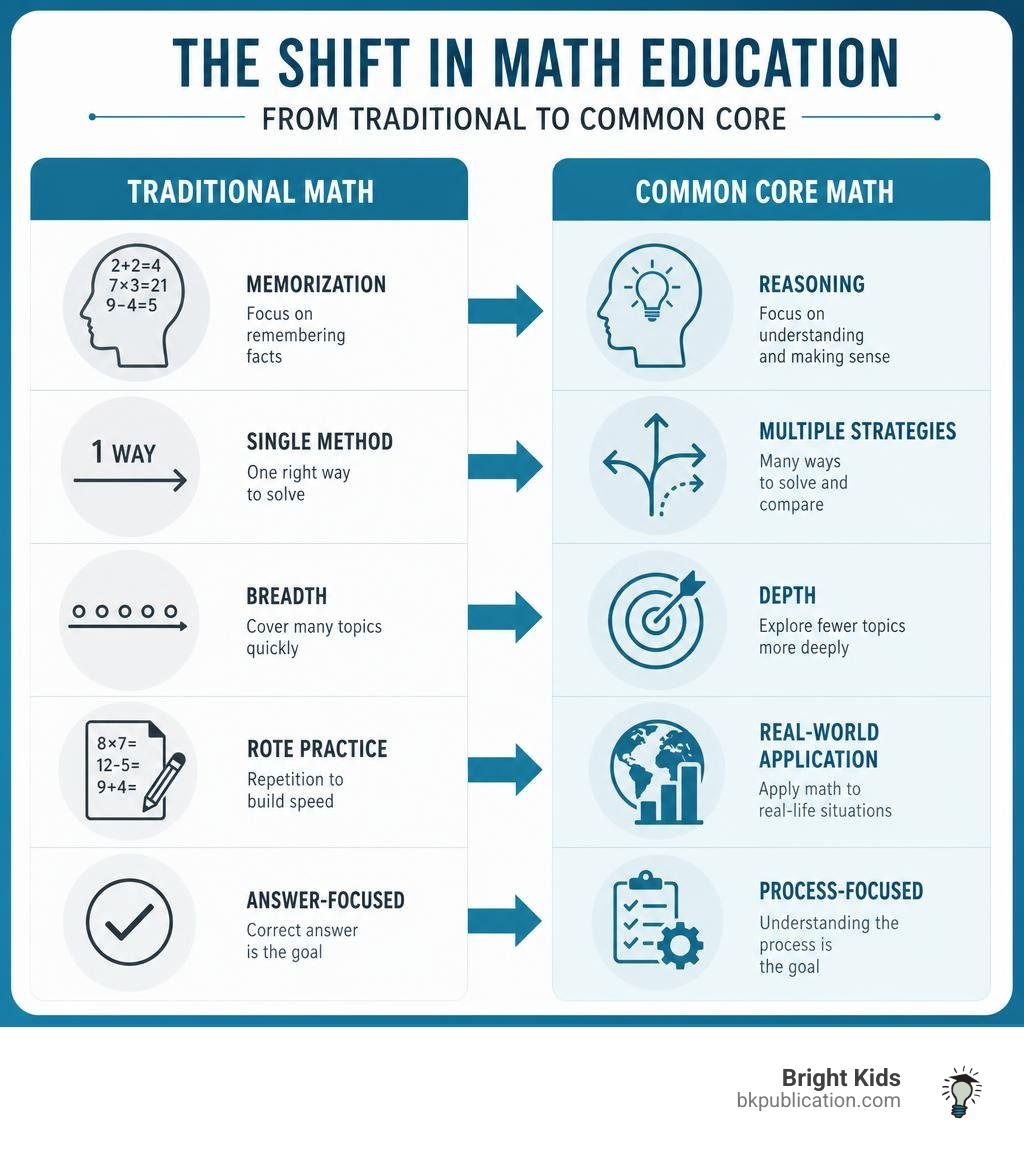
The move from traditional math — focused on memorization and single correct methods — to Common Core is not just a curriculum change. It is a shift in how students are expected to think. Problems now require reasoning, explanation, and real-world application. That can feel overwhelming for students (and parents) who were raised on drills and worksheets.
The good news: the right tools and strategies make this shift manageable — and even exciting.
I'm Bige Doruk, founder of Bright Kids, and over nearly two decades of supporting more than 10,000 students through gifted programs and competitive school admissions, I've seen how fluency with common core math instructional strategies directly shapes performance on high-stakes assessments like the ISEE, SSAT, and SHSAT. Below, I'll walk you through the strategies, tools, and resources that actually move the needle.
Understanding the 8 Standards for Mathematical Practice
The foundation of the Common Core State Standards (CCSS) for mathematics is built on two pillars: Content Standards (what students should know at each grade level) and the eight Standards for Mathematical Practice (SMPs) (how students develop deep mathematical expertise).
Traditional math instruction heavily favored procedural memorization: memorize the formula, complete 50 identical practice problems, and move on. Under frameworks like the [PDF] New York State Next Generation Mathematics Learning Standards, the goal is a balanced approach that pairs procedural fluency with conceptual understanding and real-world application. We want students to know not just how to do a calculation, but why the method works and when to apply it.
Making Sense of Problems and Persevering (SMP 1)
The very first standard is all about building academic resilience. Instead of giving up when a formula isn't immediately obvious, students are taught to engage in productive struggle.
When presented with complex word problems, students learn to:
- Analyze the given information, constraints, relationships, and goals.
- Map out a entry point or pathway to a solution rather than guessing a random operation.
- Monitor their own progress and change course if their current method isn't working.
For example, rather than simply asking students to multiply two numbers in a word problem, we might present them with a real-world scenario—like planning a school fundraiser budget—where they must first identify which mathematical operations are necessary. This builds the mental stamina required for rigorous standardized testing.
Reasoning, Modeling, and Precision (SMP 2-6)
These middle standards bridge the gap between abstract numbers and tangible realities.
- SMP 2 (Reason abstractly and quantitatively): Students learn to decontextualize a problem (representing a real-world situation with symbols) and contextualize it (understanding what those symbols mean in real life).
- SMP 4 (Model with mathematics): This involves applying math to solve everyday problems. Whether it's using colored blocks to model negative numbers or drawing diagrams to represent ratio relationships, modeling makes abstract concepts visible.
- SMP 6 (Attend to precision): Precision isn't just about getting the right answer. It means communicating mathematical ideas clearly, using correct symbols, labeling units of measure accurately, and explaining reasoning with precise vocabulary.
Developing these skills helps students transition from seeing math as a series of isolated tricks to recognizing it as a cohesive language. To foster these habits, resources like the Stanford Youcubed Mathematical Mindsets program highlight the importance of visual math and open-ended inquiry in building mathematical confidence.
Structure and Repeated Reasoning (SMP 7-8)
The final standards focus on patterns.
- SMP 7 (Look for and make use of structure): Students learn to see complicated mathematical expressions as single objects or as being composed of several objects. For instance, understanding how fact families work allows a student to see that subtraction is simply the inverse of addition, or that algebraic expressions follow the same structural rules as basic arithmetic.
- SMP 8 (Look for and express regularity in repeated reasoning): This involves noticing if calculations are repeated, and looking both for general methods and for shortcuts. When students notice that multiplying a number by 10 always shifts its place value, they are practicing repeated reasoning.
Core Common Core Math Instructional Strategies for the Classroom

Implementing these standards successfully requires shifting from a teacher-centered lecture model to a student-centered, active learning environment. To achieve this, we rely on evidence-based instructional strategies that balance classroom management with personalized learning outcomes.
Differentiated Instruction and Small-Group Guided Math
No two students enter a classroom with the exact same mathematical foundation. Differentiated instruction allows us to provide multiple entry points to on-grade-level content, ensuring that struggling students receive scaffolding while advanced learners are appropriately challenged.
One of the most effective ways to manage this is through small-group guided math (typically involving 2 to 6 students). While the rest of the class works on independent practice, math centers, or digital learning tools, the teacher meets with a small group to provide targeted Tier 2 support or enrichment.
According to the Understanding/Implementing CT Core Standards in the Classroom guide, organizing these groups with clear, time-saving routines is essential for effective classroom management.
In a guided math framework, a typical workshop session might look like this:
- Whole-Group Mini-Lesson (10–15 mins): Introduce the core concept or standard.
-
Rotations/Centers (20–30 mins):
- Group A (with teacher): Guided practice with targeted scaffolding or extension.
- Group B (independent): Hands-on activities, math journaling, or choice boards.
- Group C (digital): Adaptive learning software that adjusts to the student's proficiency.
- Whole-Group Reflection (5 mins): Summarize learning and address common misconceptions.
Gamified Learning and Student Discourse
Keeping students engaged in math requires more than just worksheets. Gamified instruction—incorporating game elements like points, quests, avatars, and friendly leaderboards—has been shown to significantly boost student motivation. A 2023 meta-analysis across dozens of studies and thousands of students confirmed that gamified math elements lead to a large, statistically significant positive effect on learning outcomes.
In addition to gamification, we must prioritize student discourse. Math shouldn't be silent. We want classrooms filled with active "math talk" where students share their reasoning, critique their peers' approaches, and defend their solutions.
To facilitate this, teachers can use techniques such as:
- Turn and Talk: Prompting students to explain their partner's strategy in their own words.
- Revoicing: Repeating a student's statement and asking them to confirm if the interpretation is correct.
- Adding On: Encouraging other students to build upon a classmate's initial reasoning.
Essential Tools and Resources for Common Core Math Mastery
To support these common core math instructional strategies, educators use specific tools that move students through the Concrete-Representational-Abstract (CRA) instructional model. This model starts with physical manipulatives (concrete), transitions to drawings and visual models (representational), and ends with numbers and mathematical symbols (abstract).
| Tool / Resource | Target Concept | Instructional Purpose |
|---|---|---|
| Number Lines | Fractions, Integers, Operations | Visualizes numerical relationships, intervals, and relative values. |
| Frayer Models | Math Vocabulary & Terms | Deepens conceptual understanding by defining terms, characteristics, examples, and non-examples. |
| Choice Boards | Standard-Aligned Practice | Boosts student agency by allowing them to choose how they demonstrate mastery. |
| Math Language Routines | Word Problems & Reasoning | Scaffolds language acquisition and breaks down complex word problems for all learners. |
Number Lines and Visual Representations
Number lines are incredibly versatile tools that support mathematical reasoning across all grade levels. They are especially powerful for teaching fractions, decimals, and negative numbers, which are notoriously difficult for students to conceptualize.
Instead of teaching students to simply memorize fraction rules, a number line helps them visualize where a fraction sits relative to zero and one. This builds a strong mental map of numerical value.
For students needing extra support, the Scaffolding Instruction for All Students: A Resource Guide for Mathematics Grade 6 illustrates how visual models—such as ratio tables, colored blocks, and tape diagrams—allow diverse learners, including English Language Learners and students with special needs, to access rigorous grade-level content without lowering expectations.
Math Language Routines and Choice Boards
Developed by Stanford University's SCALE Initiative, Math Language Routines (MLRs) are structured classroom activities that help students read, write, and speak mathematically.
Two highly effective MLRs are:
-
The Three Reads Routine: Students read a word problem three distinct times with a different focus each time:
- First Read: Focus on the context (What is the story about?).
- Second Read: Focus on the quantities (What are the numbers and what do they represent?).
- Third Read: Focus on the mathematical questions (What are we trying to solve?).
- Information Gap: Students are paired up; Partner A has the problem but lacks the necessary data, while Partner B has the data but doesn't know the problem. To solve it, they must ask precise mathematical questions, forcing them to communicate clearly.
To complement these routines, choice boards offer students a menu of standard-aligned activities. For example, a student learning geometry might choose to write a math journal entry explaining a shape's attributes, draw a scale model, or complete a digital challenge. This flexibility keeps students motivated and in control of their learning pace.
How to Assess Progress and Ensure Visibility of Standards
Effective assessment under Common Core goes beyond grading Friday quizzes. We need to continuously monitor student progress toward the Standards for Mathematical Practice using both formative and summative measures.
To help educators plan and assess these shifts, the CCSS INSTRUCTIONAL Practice Guide outlines concrete "Core Actions" that should be visible in daily math lessons.
Using the Core Actions Framework for Assessment
The Core Actions framework breaks down high-quality math instruction into three clear areas:
- Core Action 1: Align with the Standards. The lesson must focus on grade-level standards, connect new concepts to prior knowledge, and target the specific aspect of rigor (conceptual understanding, procedural skill, or application) called for by the standard.
- Core Action 2: Make the Mathematics Explicit. The teacher must use clear explanations, multiple representations, and checks for understanding throughout the lesson.
- Core Action 3: Provide Practice Opportunities. Students must be given time to work with on-grade-level problems, engage in productive struggle, and explain their thinking to peers.
By focusing on these observable behaviors, administrators and coaches can provide targeted feedback to teachers, ensuring that the mathematical practices are truly alive in the classroom.
Tracking Student Growth in Common Core Math Instructional Strategies
To measure individual student progress, we use a comprehensive proficiency matrix. This matrix tracks student development from an initial level (relying on heavy scaffolding) to an intermediate level, and finally to an advanced level (where they can independently select tools, justify their reasoning, and solve novel problems).
For a deep dive into implementing these observational tools, the TEACHER SELF-LEARNING SERIES (specifically Module 6) provides teachers with structured guides on what "look-fors" to monitor. This resource helps teachers identify whether students are simply following steps or genuinely showing mathematical proficiency.
Bridging the Gap: Communicating Common Core to Parents

One of the greatest challenges of the Common Core era has been parent anxiety. Many parents feel discouraged when they look at their child's homework and realize they don't understand the methods being taught. It’s common to hear, "Why can't they just carry the one the way we used to?"
Explaining the "Why" Behind Common Core Math Instructional Strategies
To ease this tension, we must maintain an open dialogue and explain the "why" behind these modern methods.
When communicating with parents, we emphasize that:
- The standard algorithm is still taught. We haven't thrown out traditional methods. Instead, we teach the conceptual framework first so that when students learn the standard algorithm, they actually understand what the numbers represent.
- Multiple strategies build flexibility. Teaching multiple ways to solve a problem (such as using an open number line or area models for multiplication) ensures that students who struggle with abstract formulas have visual, reliable alternatives.
- We are building a growth mindset. We want children to see math as a dynamic puzzle to be solved, not a set of rigid rules to be memorized.
Schools can support parents by sending home clear information sheets, hosting math nights where parents can try the visual tools themselves, and encouraging parents to model a positive attitude toward math at home.
Frequently Asked Questions about Common Core Math
What is the main difference between Common Core and traditional math?
Traditional math instruction focused heavily on memorization, procedural drills, and finding a single correct answer using a single taught method. Common Core math prioritizes deep conceptual understanding, mathematical reasoning, and the ability to solve real-world problems using multiple flexible strategies.
How do I handle student frustration during productive struggle?
Frustration is a natural part of learning. To keep productive struggle from turning into destructive frustration, teachers can use strategic scaffolding. This means asking open-ended guiding questions (e.g., "What do you notice about this problem?" or "What tool could we use to draw this out?") rather than simply giving the student the answer. Celebrating effort and highlighting mistakes as learning opportunities also helps build a growth mindset.
What are the best resources for aligned math practice?
High-quality, aligned math practice requires resources that mimic the rigor and format of modern assessments. Look for curriculum guides from state education departments, structured scaffolding resources, and specialized practice books that focus on multi-step problem solving and conceptual reasoning.
Conclusion
Mastering common core math instructional strategies is not just about passing the next end-of-unit test. It is about equipping our children with the critical thinking, reasoning, and problem-solving skills they need to navigate an increasingly complex world.
At Bright Kids, we have spent 17 years helping families navigate high-stakes academic transitions. We know that when students are armed with deep conceptual understanding and the confidence to persevere through challenging problems, they excel—not just in school, but on competitive admissions tests and beyond.
If you want to give your child a competitive edge and build their mathematical fluency, explore our comprehensive prep resources, including the Best ISEE Math Book, designed to align with rigorous modern standards and set your child up for long-term academic success.