

Mastering the Screening with Stanford Binet Prep for Success
Jun 19, 2026
Why Stanford-Binet Exam Prep Can Make a Real Difference for Your Child
Stanford-Binet exam prep is one of the most effective ways to help your child perform at their best on one of the most widely used intelligence assessments in gifted and school admissions testing.
Here is a quick overview of what effective preparation looks like:
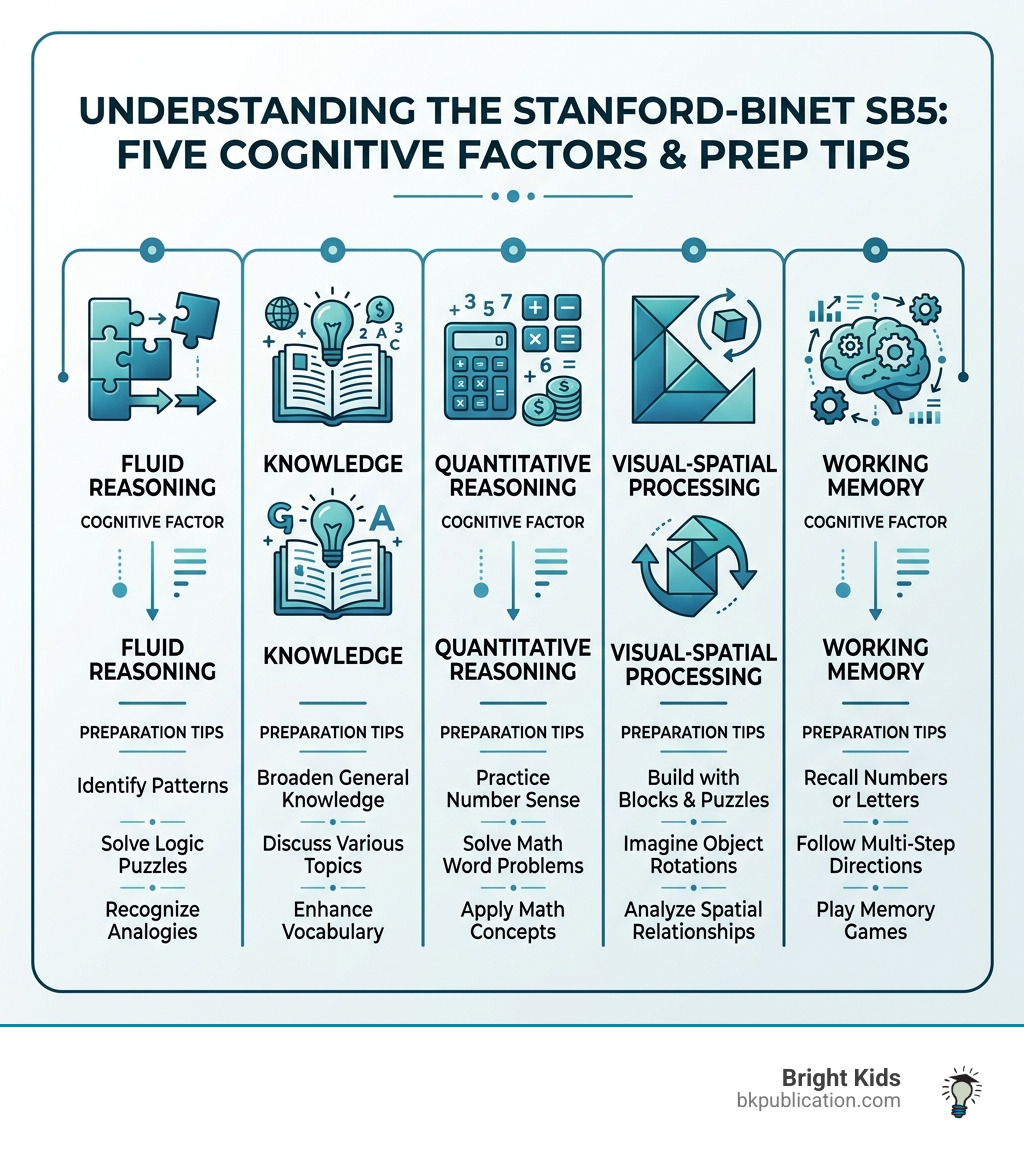
- Familiarize your child with the five cognitive domains tested: Fluid Reasoning, Knowledge, Quantitative Reasoning, Visual-Spatial Processing, and Working Memory
- Build behavioral skills — for young children, sitting still, pointing correctly, and listening carefully are just as important as knowing the answers
- Use "brain game" framing — avoid the words "test" or "exam" to keep anxiety low and engagement high
- Practice with realistic materials — use question types that mirror the actual test format, including both verbal and nonverbal tasks
- Optimize test-day readiness — prioritize sleep, a healthy meal, and a calm morning routine
The stakes can be high. At programs like Hunter College Elementary School in New York City, nearly 1,000 children compete for just 50 spots — and a single point difference in score can determine admission.
You cannot change a child's innate intelligence. But you can make sure that intelligence shows up fully on the day of the test.
I'm Bige Doruk, founder of Bright Kids, and over nearly two decades I've guided thousands of families through Stanford-Binet exam prep — helping children from early childhood through competitive admissions reach their full potential. Let's walk through exactly how to prepare your child, step by step.
Understanding the Stanford-Binet Intelligence Scales (SB5)
The Stanford-Binet Intelligence Scales, currently in its Fifth Edition (SB5), is one of the oldest and most respected psychological assessments in the world. Originally developed by Alfred Binet and Theodore Simon in France, it was later adapted by Lewis Terman at Stanford University in 1916. Today, it remains a gold standard for identifying giftedness and assessing cognitive development in individuals from age 2 to over 85.
In our work across major cities like New York, Chicago, and Los Angeles, we often see the SB5 used as a primary gateway for elite educational opportunities. For many families, the Stanford binet test is their first encounter with formal "IQ testing."
What makes the SB5 unique is its range. Because it can be administered to a two-year-old using toys and play-based cues, or to a high-achieving adult using complex logic puzzles, it is incredibly versatile. In the context of school admissions, particularly for kindergarten entry at institutions like Hunter College Elementary School (HCES), the test serves as a rigorous "Round 1" screen.
When we talk about stanford binet exam prep, we aren't talking about "teaching to the test" in a way that memorizes answers—that’s impossible, as the actual test questions are protected. Instead, we focus on developing the underlying cognitive skills and the "test-taking stamina" required to handle a one-on-one evaluation with a psychologist. For more detailed insights into the history and utility of this assessment, you can explore our Stanford-Binet Exam Prep Resources.
The Five Pillars of Cognitive Assessment
The SB5 is structured around five specific cognitive factors. To provide a truly comprehensive assessment, the test evaluates each of these factors through both verbal and nonverbal domains. This means there are actually 10 subtests in total.
Understanding these pillars is essential for effective stanford binet exam prep:
- Fluid Reasoning: This is the ability to solve new problems that don't depend on past knowledge. It involves seeing patterns and relationships. For a child, this might look like completing a matrix or identifying a logical sequence of shapes.
- Knowledge (Crystallized Intelligence): This measures the information a child has acquired from their environment, school, and home life. It includes vocabulary and "procedural knowledge"—knowing how or why things work.
- Quantitative Reasoning: This isn't just "math." It’s the ability to understand numerical concepts, patterns, and word problems. In younger children, this might involve basic counting or understanding "more" versus "less."
- Visual-Spatial Processing: This measures the ability to see patterns, solve puzzles, and understand how objects fit together in space. We often use tangrams and blocks to help children develop these skills.
- Working Memory: This is the "scratchpad" of the brain. It measures how much information a child can hold in their mind while performing a task, such as repeating a sequence of numbers or following multi-step directions.
The test is "adaptive," meaning it uses "routing subtests" (usually Vocabulary and Object Series) to determine the starting point for the rest of the exam. If a child performs well early on, the test becomes more challenging to find their "ceiling." If they struggle, it adjusts to find their "floor." This ensures the child is always being tested at an appropriate level of difficulty.
| Factor | Nonverbal Domain | Verbal Domain |
|---|---|---|
| Fluid Reasoning | Object Series / Matrices | Absurdities / Analogies |
| Knowledge | Procedural Action | Vocabulary |
| Quantitative Reasoning | Nonverbal Math | Verbal Math Problems |
| Visual-Spatial Processing | Form Board / Puzzles | Position and Direction |
| Working Memory | Delayed Response | Block Span / Sentence Memory |
Effective Stanford Binet Exam Prep Strategies
When we begin stanford binet exam prep with a young child, we don't start with a stopwatch and a desk. We start with play. For a four-year-old, the biggest hurdle isn't always the logic—it's the behavior. Sitting in a room with a stranger (the psychologist) for 45 to 90 minutes is a massive "ask" for a preschooler.
Behavioral Skills and "Pointing Accuracy"
One of the most overlooked aspects of stanford binet exam prep is physical precision. On the SB5, many answers are given by pointing to a picture. If a child points "somewhere in the middle" of two choices, the psychologist cannot guess what they meant. We teach children to point clearly and hold their finger still until the "puzzle teacher" acknowledges them.
We also practice "waiting for the go signal." Children are naturally impulsive; they want to answer before the question is finished. Learning to listen to the entire prompt is often the difference between a correct answer and a "silly" mistake.
Psychological Framing: The "Puzzle Teacher"
We never tell a child they are going to take an "IQ test" or an "exam." That is a recipe for anxiety. Instead, we frame the experience as going to play games with a "puzzle teacher." We use names like "Smart Kids Say" or "Brain Teasers" to keep the atmosphere light. This psychological framing ensures the child enters the room with curiosity rather than fear.
Building Knowledge Through Daily Life
To boost the "Knowledge" and "Vocabulary" factors, we encourage parents to expand their daily interactions:
- Non-fiction reading: While storybooks are great, non-fiction books about animals, space, or how things are made build the informational "Knowledge" base tested in the SB5.
- "Why" Questions: Instead of just giving directions, ask your child "Why do we brush our teeth?" or "What would happen if it never rained?" This builds verbal reasoning and procedural knowledge.
- Directional Vocabulary: Use words like "beneath," "adjacent," "column," and "row" during play so these terms aren't foreign when heard during the test.
For a deeper dive into these techniques, check out our guide on Stanford-Binet Intelligence Prep.
Essential Materials for Stanford Binet Exam Prep
You cannot effectively prepare for the SB5 with just a screen. Because the actual test involves physical objects, your stanford binet exam prep should too.
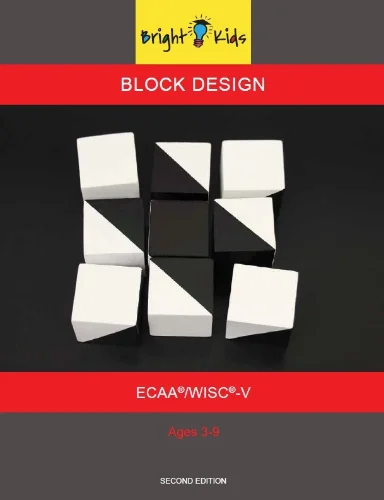
At Bright Kids, we’ve developed specialized materials that mimic the "look and feel" of the exam without using the actual protected questions. Our Stanford-Binet Practice Book includes over 500 items designed to sharpen the five cognitive factors.
Key materials we recommend including in your home practice:
- Tangrams and Pattern Blocks: These are essential for the Visual-Spatial Processing subtests. Children need to learn how to rotate shapes in their minds to fit a design.
- Figural Classification Cards: These help children practice "Fluid Reasoning" by identifying which object doesn't belong in a group or finding the commonality between different images.
- Physical Manipulatives: Using actual blocks to build structures based on a picture helps bridge the gap between abstract thought and physical execution.
By using these tools, you ensure your child is comfortable with the format of the tasks. When the psychologist pulls out a set of blocks, your child won't be intimidated—they’ll be excited because they’ve seen "games" like this before. For families in the New York area looking for specific local guidance, we offer More info about Stanford Binet IQ Test Prep for Child in NYC.
Reducing Anxiety During Stanford Binet Exam Prep
Test anxiety can significantly deflate a child's score, making them appear less capable than they actually are. Our goal in stanford binet exam prep is to build "test-taking confidence."
- Routine Maintenance: In the week leading up to the test, keep everything as normal as possible. This is not the time to introduce a new bedtime or a high-pressure study schedule.
- Sleep Hygiene: For children aged 4-6, we recommend 10-12 hours of sleep. A tired brain cannot access its full "Working Memory" capacity.
- The "Puzzle Teacher" Talk: About a week before the test, mention that they will be meeting a new friend who has some fun puzzles to solve. Explain that you will be waiting right outside the door.
- Avoid Pressure: Praise the effort and the focus, not the "smartness." If a child feels like their worth is tied to the score, they will freeze.
Our Bright Kids Test Prep Strategies emphasize that a happy, relaxed child is a child who can think clearly. If your child has separation anxiety, inform the psychologist ahead of time so they can spend a few extra minutes building rapport before the formal assessment begins.
Navigating the Testing Process and Scoring
The administration of the SB5 is a one-on-one process between your child and a licensed psychologist. It typically takes between 45 and 90 minutes, though it can go longer for older children or those who are scoring in the very high ranges.
Understanding the Scores
When the test is finished, the psychologist will calculate several scores:
- Full Scale IQ (FSIQ): This is the "big number" that combines all 10 subtests.
- Factor Index Scores: These show how your child performed in each of the five pillars (e.g., a "Working Memory Index").
- Percentile Ranks: This tells you how your child performed compared to a national sample of children their exact age. A 95th percentile rank means they scored higher than 95% of their peers.
The Importance of Age Bands
The SB5 is extremely precise with age. For children under five, the "age bands" are calculated in one-month increments. This means a child who is 4 years and 2 months old is compared only to other children who are 4 years and 2 months old. Once a child hits age five, the bands expand to four-month increments. This precision ensures that a child isn't penalized just because they have a late birthday.
For competitive programs like Hunter College Elementary, the scoring requirements are incredibly high. In recent years, a child typically needed a score of at least 148 to even be considered for the second round of admissions. This puts them in the "Highly Gifted" range (145-160+). To better understand how these numbers translate to school placement, see our article on Understanding IQ Scores and Percentiles.
Frequently Asked Questions about Stanford-Binet Testing
Can you really prepare for an IQ test?
This is the most common question we hear. While you cannot "cram" to increase innate intelligence, you can absolutely prepare to ensure that a child's true ability is accurately measured. Stanford binet exam prep removes the "fear of the unknown." If a child understands the types of questions being asked and has the behavioral stamina to stay focused, their score will reflect their actual potential rather than their confusion or boredom.
How does the SB5 compare to the WISC or WPPSI?
The WISC-V and WPPSI-IV are other common IQ tests. However, many schools (like HCES) specifically prefer the SB5 because of its non-linear structure. The SB5 "skips around" between different types of questions, which measures a child's "cognitive flexibility"—their ability to switch gears from a math problem to a vocabulary question quickly. The SB5 also has a higher "ceiling," making it better for identifying children in the "profoundly gifted" range.
What is the highest possible score on the Stanford-Binet?
While the standard "Highly Gifted" range starts at 145, the test can measure much higher. Historically, the highest recorded score on a Stanford-Binet test was 328, though modern versions (SB5) are generally capped around 160 for standard reporting. Most gifted programs look for scores in the 130+ (Moderately Gifted) or 145+ (Highly Gifted) range.
Conclusion
Preparing for the Stanford-Binet is about more than just a number; it’s about giving your child the tools to walk into a high-stakes environment with a smile on their face and the confidence to say, "I can do this."
At Bright Kids, we believe that every child has unique cognitive strengths. Our goal is to help those strengths shine through comprehensive practice, expert tutoring, and a deep understanding of the admissions landscape in cities like New York and Chicago. Whether you are aiming for a top-tier gifted program or simply want a clearer picture of your child's development, the right preparation makes all the difference.
Ready to take the next step? Master your child's preparation today with our proven resources and expert guidance.