

How to Prep for the Stanford Binet Without Losing Your Mind
Apr 22, 2026
Understanding the Stanford-Binet (SB5) and the Five Cognitive Factors
Stanford-Binet intelligence prep is something almost every parent of a gifted child will search for at some point — and the good news is that smart, targeted preparation does make a difference.
Here's a quick answer to what effective prep actually looks like:
| Prep Strategy | Does It Help? |
|---|---|
| Familiarizing your child with question formats | Yes — reduces anxiety and builds confidence |
| Practicing the five cognitive factor areas | Yes — especially Knowledge and Quantitative Reasoning |
| Memorizing exact test questions or answers | No — can invalidate results |
| Using "brain games" framing instead of "test prep" | Yes — psychologists prefer children aren't aware they're being coached |
| Optimizing sleep, nutrition, and routine before test day | Yes — physical state meaningfully impacts performance |
| Relying on "IQ boosting" programs | No — these lack scientific backing |
The stakes can be high. At Hunter College Elementary School (HCES) in NYC, nearly 1,000 children compete for just 50 spots — a 5% acceptance rate. For families in that situation, knowing how to prepare (and what to avoid) isn't just helpful. It's essential.
But preparation looks very different for a four-year-old than it does for an adult. And it looks very different when done well versus when it's done in ways that stress kids out or skew their results.
I'm Bige Doruk, founder of Bright Kids, and over nearly two decades I've guided thousands of families through Stanford-Binet intelligence prep — from early childhood enrichment to competitive gifted admissions. In this guide, I'll walk you through exactly what works, what doesn't, and how to keep the whole process manageable for you and your child.
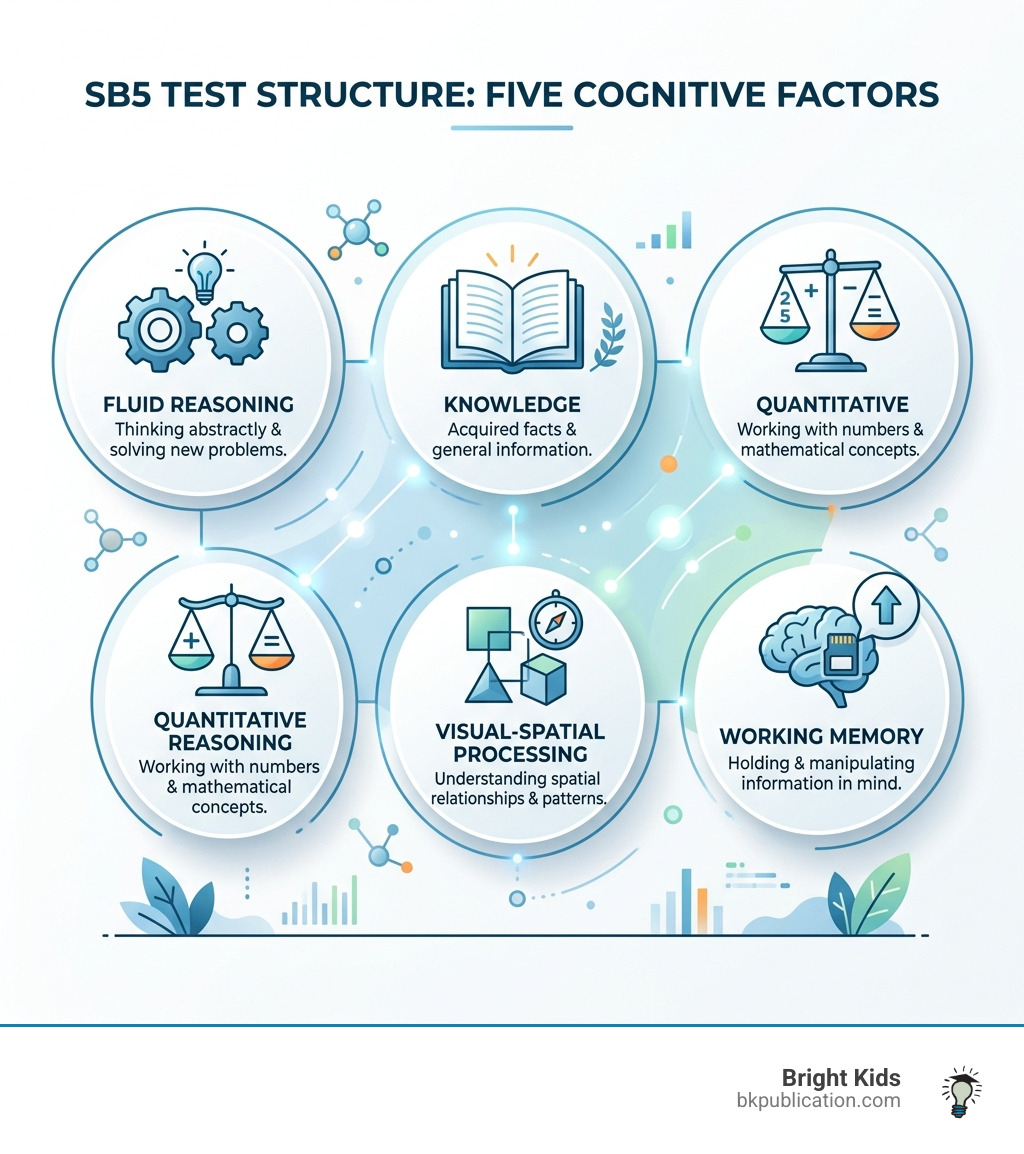
To understand how to approach stanford binet intelligence prep, we first have to look at what the test actually is. The Stanford-Binet Intelligence Scales, Fifth Edition (SB5), is the modern evolution of the very first intelligence test developed by Alfred Binet and Theodore Simon in France. It was later refined at Stanford University by Lewis Terman. Today, it is one of the most respected standardized assessments used to measure cognitive ability in individuals from age 2 to 85+.
The SB5 doesn't just give one "IQ number." It provides a Full Scale IQ, along with a Verbal IQ and a Nonverbal IQ. This distinction is crucial because it helps identify children who might have incredible spatial reasoning but struggle with language-based instructions, or vice versa.
The test is built around five specific cognitive factors. We focus our stanford binet intelligence prep on these core areas:
- Fluid Reasoning: The ability to solve novel problems where prior knowledge doesn't help much. This involves seeing patterns and relationships.
- Knowledge: This is "crystallized intelligence"—things your child has learned from their environment, like vocabulary or social norms.
- Quantitative Reasoning: This isn't just "math"; it's the ability to understand numerical relationships and solve logic-based word problems.
- Visual-Spatial Processing: This involves seeing how parts fit into a whole, rotating objects in the mind, and identifying patterns in shapes.
- Working Memory: The ability to hold information in the mind while performing a task with it (like repeating a sequence of words or numbers).
Verbal vs. Non-Verbal Subtests
The SB5 is unique because it tests each of these five factors in both a verbal and non-verbal format. Here is how those activities typically differ:
| Cognitive Factor | Non-Verbal Activity | Verbal Activity |
|---|---|---|
| Fluid Reasoning | Object series / Matrices | Verbal absurdities / Analogies |
| Knowledge | Procedural knowledge | Vocabulary / Defining words |
| Quantitative Reasoning | Non-verbal math puzzles | Verbal math word problems |
| Visual-Spatial | Form board / Tangrams | Position and direction tasks |
| Working Memory | Delayed response tasks | Memory for sentences/digits |
The test typically takes between 45 and 90 minutes. It uses "adaptive testing," meaning the psychologist starts with "routing tests" to find the right entry point for your child’s ability level. This ensures the child isn't bored by easy questions or overwhelmed by impossible ones.
Effective Stanford Binet Intelligence Prep: Myth vs. Reality
There is a long-standing myth that you cannot—and should not—prepare for an IQ test. The argument is that intelligence is "innate" and preparation will "fake" the results. At Bright Kids, we believe in a more nuanced reality.
While you cannot fundamentally change a person's innate "fluid intelligence" (their raw processing power) overnight, you can absolutely help them perform to their true potential. Stanford binet intelligence prep is about removing the obstacles that prevent a child from showing what they can do.
Common IQ Testing Myths
-
Myth: IQ is fixed at birth and never changes.
- Reality: While cognitive potential is innate, scores can fluctuate based on education, environment, and physical health.
-
Myth: Preparing will "invalidate" the test.
- Reality: Familiarizing a child with the format of the test (like how to use tangrams or how to answer an analogy) reduces "test anxiety," which is the #1 cause of score deflation.
-
Myth: You should tell your child they are taking an "IQ test."
- Reality: This creates immense pressure. Psychologists actually prefer that children haven't been "coached" on specific answers, as it makes the administration more authentic.
The goal of ethical stanford binet intelligence prep is familiarity, not memorization. If a child has never seen a matrix puzzle before, they might spend three minutes just trying to figure out what they are supposed to do. If they’ve practiced similar puzzles, they can get straight to the "thinking" part.
Strategic Approaches for Young Children and HCES Admissions
In the New York City area, the Stanford-Binet is most famous for its role in the Hunter College Elementary School (HCES) admissions process. The competition is legendary: nearly 1,000 gifted students apply, but only the top 50 (25 girls and 25 boys) are admitted. That is a 5% acceptance rate—stiffer than many Ivy League universities.
For HCES, Round I is the Stanford-Binet V. It’s administered one-on-one by a psychologist and lasts about an hour. If your child scores in the top tier, they move to Round II, which is a 90-minute playgroup observation.
Because HCES uses age-adjusted scoring (comparing children in precise two-month "age bands"), every point matters. For the youngest children (ages 2:0 to 4:11), the norms are even tighter, calculated in one-month increments.
To help families navigate this, our Stanford-Binet Preparation Guide includes over 500 practice items specifically designed for children ages 4 to 8. We don't just use paper and pencil; we use physical manipulatives like:
- Mini figural classification cards
- Puzzles and tangrams
- Counting blocks
By using these physical tools, children get used to the "hands-on" nature of the actual test. You can also supplement this with a Gifted and Talented Practice Test to see how your child handles different logic formats.
Stealth Strategies for Stanford Binet Intelligence Prep
The "secret sauce" to preparing a four or five-year-old is to make sure they have no idea they are "preparing." Psychologists are trained to look for signs of over-coaching. If a child says, "My mom told me the answer to this one is the triangle," the test results could be flagged.
Instead, use these "stealth" methods:
- The "Brain Games" Frame: Never call it "test prep." Call it "Smart Kids Games" or "Brain Teasers."
- Absurdity Detection: The SB5 often asks children to identify what is "silly" or "impossible" in a picture (like a car with square wheels). Play this game at the park or while looking at picture books.
- Non-Fiction Reading: Because the "Knowledge" factor tests real-world information, read non-fiction books about animals, space, or how things work.
- Pattern Matching: Use everyday objects like socks or cereal to create patterns and ask your child to "complete the sequence."
Physical and Mental Optimization for Test Day
You could do all the stanford binet intelligence prep in the world, but if your child arrives at the psychologist's office hungry, tired, or terrified, their score will not reflect their true ability.
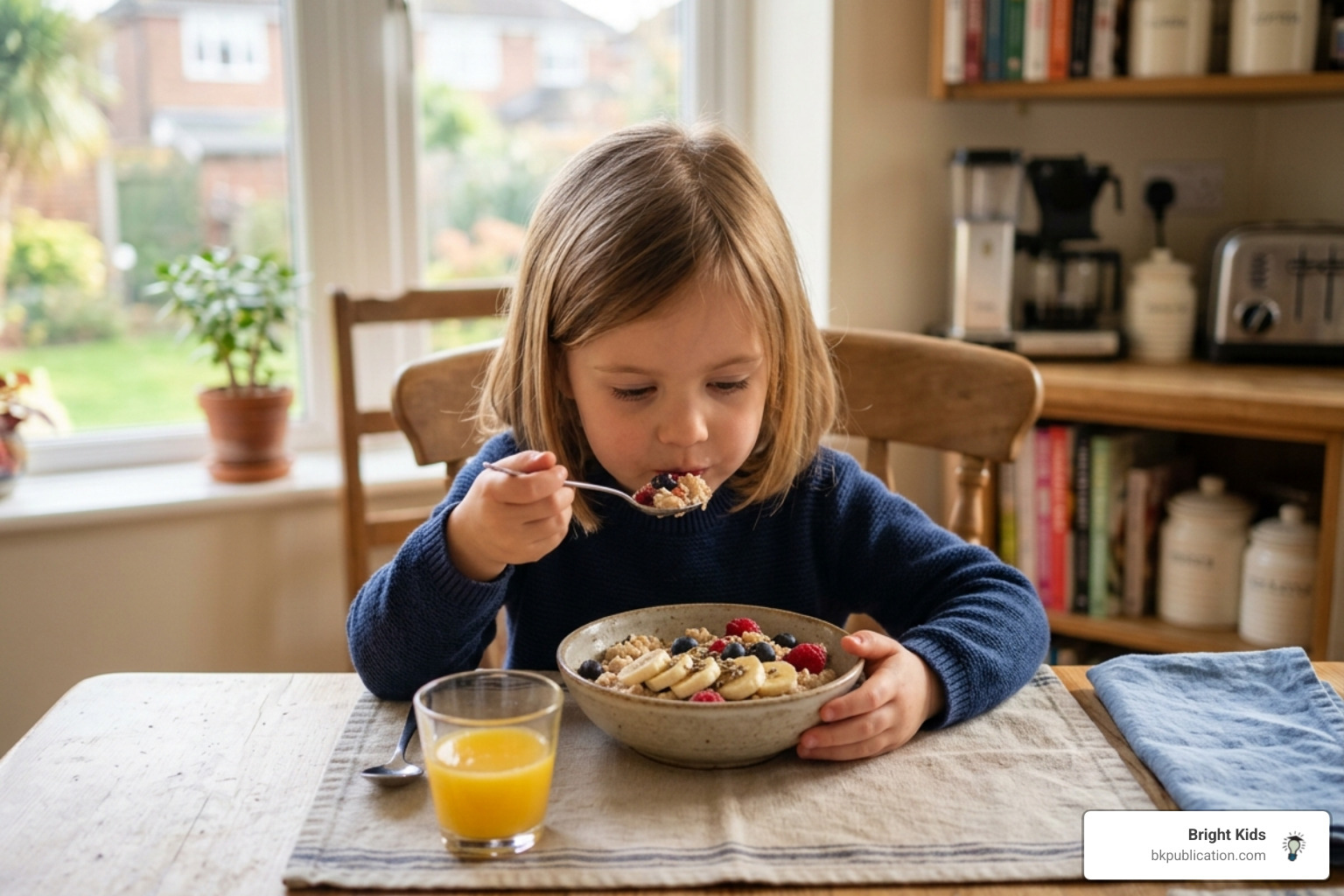
The Pre-Test Checklist
- Sleep: Ensure 7–9 hours of quality sleep for several nights leading up to the test. Cognitive function drops significantly with even mild sleep deprivation.
- Nutrition: On the morning of the test, serve a breakfast with complex carbohydrates and protein (like oatmeal and eggs). Avoid high-sugar cereals that lead to a "crash" mid-test.
- Hydration: Even slight dehydration can cause brain fog and reduced focus.
- Anxiety Reduction: Keep the morning routine calm. Arrive at the location 15 minutes early so your child can acclimate to the environment without feeling rushed.
- Movement: A little light physical activity—like a walk to the office or some stretching—can improve mental alertness.
During the test, encourage your child to "trust their instincts." In many SB5 subtests, the simplest answer is often the correct one. If they get stuck, teach them that it’s okay to guess and move on. Since wrong answers don't usually penalize the score more than an omitted answer, guessing is a valid strategy. You can practice these logic flows with CoGAT Figure Matrices Exercises to build their confidence in visual problem-solving.
Frequently Asked Questions
How is the Stanford-Binet scored and what do the ranges mean?
The SB5 uses a standard scoring system where the mean (average) is 100 and the standard deviation is 15. This means about 68% of the population scores between 85 and 115.
- 130–144: Gifted (Top 2% of the population)
- 145+: Very Gifted or Highly Gifted (Top 0.1%)
- Highest Score Ever: The highest recorded score on a Stanford-Binet was 328, though modern versions are generally capped around 160 for standard reporting.
For HCES admissions, scores are not typically shared with parents anymore. You are simply notified if your child has qualified for the next round.
What should parents avoid doing during the preparation process?
- Don't over-practice: If your child starts getting frustrated or bored, stop. You want them to enter the test feeling "sharp" and curious, not "burned out."
- Don't use the actual test name: Avoid saying "Stanford-Binet" or "IQ test" around the child.
- Don't pressure the outcome: Avoid telling the child how important the test is for their school future. This creates "choking" under pressure.
- Don't cram: Cognitive skills take time to build. Start your stanford binet intelligence prep a few months in advance with short, 15-minute "game sessions."
Where can I find reliable Stanford Binet Intelligence Prep?
Reliable prep focuses on the types of questions asked, not the exact questions themselves. Look for resources that include:
- Practice for all five cognitive factors.
- Both verbal and non-verbal exercises.
- Physical manipulatives for younger children.
- Age-appropriate difficulty levels.
At Bright Kids, we provide specialized publications and tutoring services tailored to these exact requirements, ensuring your child is familiar with the challenges they will face.
Conclusion
Preparing for the Stanford-Binet doesn't have to be a high-stress ordeal. When approached as a series of engaging "brain games" and cognitive puzzles, stanford binet intelligence prep can actually be a bonding experience that builds your child's confidence and curiosity.
By focusing on the five cognitive factors—Fluid Reasoning, Knowledge, Quantitative Reasoning, Visual-Spatial Processing, and Working Memory—and optimizing your child's physical and mental state, you give them the best possible chance to shine. Whether you are aiming for the top 50 spots at Hunter College Elementary School or simply want to understand your child's learning profile, we are here to help.
Bright Kids has been the most trusted name in gifted and talented admissions for 17 years. Our NYC-based team offers comprehensive practice materials that mimic real exams, paired with expert tutoring to deliver superior results.
Ready to start? More insights on gifted and talented testing are available on our blog, or you can explore our full range of prep guides and manipulatives to give your child the Bright Kids advantage.