

How to Prepare Prives School Visit Playdates in 5 Simple Steps
Apr 22, 2026
Why Prives School Visit Playdates Matter for Admissions Readiness
Prives School Visit Playdates: How do you prepare is one of the most practical questions families ask as April 2026 admissions decisions approach. Here is a quick answer:
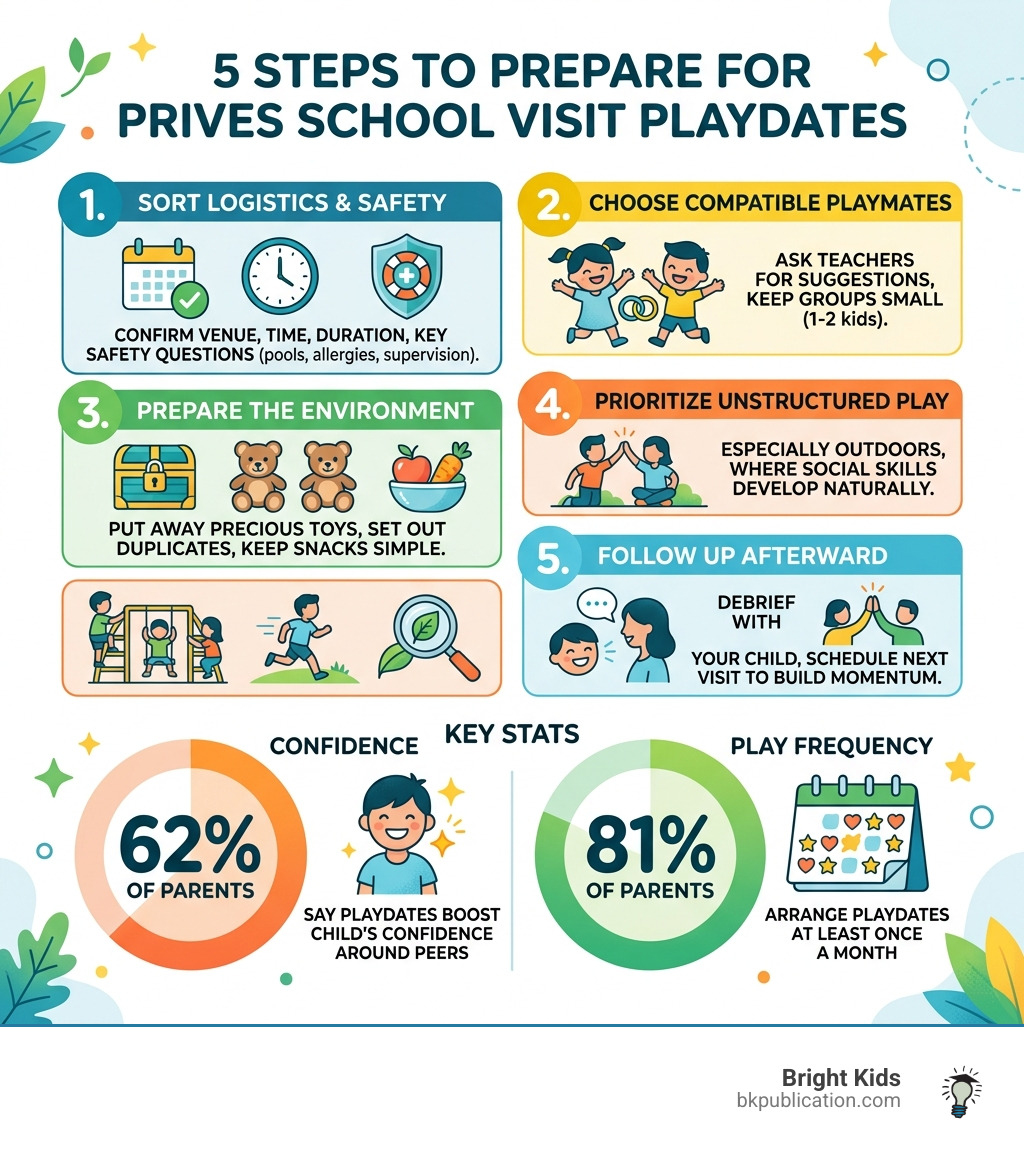
- Sort the logistics first — confirm venue, timing, duration, and key safety questions (pools, allergies, supervision).
- Choose compatible playmates — ask teachers for suggestions and keep groups small (one or two kids).
- Prepare the environment — put away precious toys, set out duplicates, and keep snacks simple.
- Prioritize unstructured play — especially outdoors, where social skills develop most naturally.
- Follow up afterward — debrief with your child and schedule the next visit to build momentum.
Research backs this up. A recent parent poll found that 81% of parents arrange playdates at least once a month, and 62% say playdates directly boost their child's confidence around peers. For families targeting selective schools like Prives, that confidence is not a nice-to-have — it shows up in assessments, interviews, and classroom interactions.
Playdates are not just social events. They are low-pressure rehearsals for the exact skills private school admissions teams look for: turn-taking, empathy, problem-solving, and independent play.
I'm Bige Doruk, founder of Bright Kids, and over nearly two decades I have helped more than 10,000 families navigate private school admissions — including the social-emotional preparation that makes Prives School Visit Playdates: How do you prepare such a critical piece of the puzzle. In the five steps ahead, I'll walk you through exactly what works.
Step 1: Master the Logistics and Safety Protocols
When we think about Prives School Visit Playdates: How do you prepare, our minds often jump to what the children will do. However, the success of a playdate is often determined before the first guest even arrives. Logistics and safety are the foundation of a stress-free experience.
One of the biggest hurdles we face is timing. According to research, 42% of parents cite clashing schedules as the primary challenge to arranging playdates. To combat this, we recommend scheduling at least two weeks in advance, especially during the busy April 2026 admissions season. Aim for a "sweet spot" in the day — usually after a nap or lunch when energy levels are high but before the late-afternoon "witching hour."
Choosing the Venue: Home vs. Neutral Ground
Deciding where to host is the first logistical hurdle. While your home offers a controlled environment, a local park in NYC, Chicago, or San Francisco can reduce the "possessiveness" that often leads to toy-related conflicts.
| Feature | Home Playdate | Neutral Park Venue |
|---|---|---|
| Comfort Level | High (familiar environment) | Moderate (new surroundings) |
| Sharing Issues | Frequent (territorial over toys) | Low (shared public equipment) |
| Cleanup | Required by host | Minimal |
| Safety Control | High (baby-proofed) | Variable (public space) |
| Space | Limited to room size | Expansive for outdoor play |
The "Awkward" Safety Questions
We cannot stress this enough: safety questions are non-negotiable. It can feel uncomfortable to ask another parent about their home, but as experts at Preschool Playdate | Key Questions to Ask Beforehand suggest, a brief moment of awkwardness is worth a lifetime of safety.
When preparing for a visit, we should always ask:
- Pools and Water: Do you have a pool or hot tub? If so, is it gated and what is the supervision plan?
- Firearms: Are there guns in the home, and are they locked away separately from ammunition?
- Allergies: We must exchange detailed allergy information. Even if your child doesn't have an allergy, the guest might.
- Supervision: Who else will be in the home? Are there older siblings or pets that might overwhelm a younger child?
Always exchange emergency contact information and clarify the duration. For a first-time playdate, 1.5 to 2 hours is the ideal window. It’s long enough to build a connection but short enough to end while everyone is still having fun.
Step 2: Select Compatible Playmates for Prives School Readiness
Not every child is a perfect match for a playdate, and that is okay. When we consider Prives School Visit Playdates: How do you prepare, we should look for playmates who complement our child’s temperament.
The Role of Teacher Input
If your child is currently in daycare or preschool, their teacher is your best resource. Teachers see social dynamics that parents don't. We suggest asking, "Who does my child naturally gravitate toward during free play?" or "Which child has a similar maturity level?" Matching children with similar energy levels often leads to more harmonious play.
Small Group Dynamics
For Prives School readiness, bigger is not better. We recommend starting with one-on-one playdates. This allows children to focus on deep social skills like empathy and collaborative problem-solving without the distraction of a large group. Research shows that 62% of parents believe playdates help their child feel more confident, and this confidence is built most effectively in small, intimate settings.
According to 10 playdate tips when you have a preschooler, it is also helpful to pick a playmate who shares a specific interest, such as building blocks or imaginative role-play. This "common ground" acts as a social bridge, making the initial transition easier for both children.

Step 3: Prives School Visit Playdates: How do you prepare the Environment?
A cluttered environment leads to a cluttered play experience. When we prepare our homes for a Prives School visit playdate, we should adopt a minimalist mindset.
The "Precious Toy" Strategy
Before the guest arrives, sit down with your child and identify their "precious" items — the toys they absolutely cannot bear to share. We recommend putting these away in a closet or high shelf. This isn't "hiding" toys; it's setting your child up for success by removing potential triggers for conflict.
As noted in Do this quick prep for a peaceful playdate, providing "duplicates" can also be a lifesaver. If both children love trains, having two engines prevents the "it's my turn" battle before it even starts.
Minimalist Hosting and BYOS
You don't need a Pinterest-perfect setup. In fact, elaborate setups can actually increase stress for the children. Keep the play space open and clear of unnecessary clutter.
For snacks, we love the BYOS (Bring Your Own Snacks) approach. This ensures that every child has something they like and are safe to eat, which is especially important for managing allergies. If you do provide snacks, keep them simple: sliced fruit, crackers, or water. Avoid high-sugar treats that can lead to energy crashes and overstimulation.
This preparation is a key part of Winning Million Dollar Kindergarten Spot: Essential Steps, as it teaches your child how to be a gracious host while maintaining a calm, orderly environment — a trait highly valued in private school settings.
Essential Supplies for Prives School Visit Playdates: How do you prepare
While unstructured play is the goal, having a few "backup" activities is wise if the energy starts to dip.
- Craft Kits: Statistics show 64% of parents favor simple crafts like drawing or stickers.
- Playdough: This is an excellent sensory activity that encourages parallel play (playing side-by-side) before moving into cooperative play.
- Sensory Bins: A simple bin filled with rice, beans, or water and small scoops can keep preschoolers engaged for surprisingly long periods.
Step 4: Focus on Social Skills and Unstructured Play
The most important part of Prives School Visit Playdates: How do you prepare is actually the "play" itself. While we might be tempted to organize a series of games, the real magic happens during unstructured time.
The Power of the Outdoors
If the weather in your city allows, take the playdate outside. 77% of parents say free outdoor play is key to a successful playdate. Whether it's a backyard or a local park, the outdoors provides a "nature’s playground" where children can run, jump, and negotiate space more freely than they can indoors. Outdoor play reduces stress and allows for more imaginative, expansive games.
Building Social "Muscles"
Playdates are the gym where children work out their social muscles. We should look for opportunities to support:
- Turn-taking: Gently reminding children that "first it's your turn, then it's your friend's turn."
- Empathy: If a child looks sad because a toy was taken, we can point out their facial expression: "Look at your friend's face; they look a bit sad. How can we help?"
- Problem-solving: Instead of jumping in to solve every conflict, we can ask, "You both want the blue truck. What's a fair way to decide who uses it first?"
Being a Gracious Playdate Guest is a skill that must be practiced. We should remind our children to greet the host, use "please" and "thank you," and help with the "two-minute cleanup" at the end.
Navigating Challenges in Prives School Visit Playdates: How do you prepare
Even with the best preparation, challenges will arise. Tears, tantrums, and boredom are all part of the learning process.
- Conflict Management: If a disagreement gets heated, use redirection. "It looks like we're having a hard time with the blocks. Let's try some playdough for a few minutes."
- Boredom: Sometimes kids just "click out." This is when your backup craft kit comes in handy.
- Overstimulation: If the noise level gets too high, suggest a "quiet break" with a book or a puzzle.
39% of parents say the most important part of a playdate is simply seeing their child have fun. Don't get so caught up in the "admissions" aspect that you forget to let them be kids.
Step 5: Post-Playdate Follow-up and Building Community
The playdate doesn't end when the guest leaves. The "after-action" steps are what turn a one-time meeting into a lasting friendship and a stronger school community.
Debriefing with Your Child
Once the guest has departed, take five minutes to talk to your child. Ask them:
- "What was your favorite thing you did today?"
- "Was there a time when you felt happy/sad?"
- "What would you like to do differently next time?"
This helps children process their emotions and reinforces the social lessons they learned. It’s also a great time to praise them for specific positive behaviors: "I was so proud of how you shared your favorite dinosaur!"
Building the Parent Network
Playdates are just as much for the adults as they are for the kids. In fact, 39% of parents say playdates have helped them build new friendships with other adults. In the competitive world of private school admissions, having a supportive network of fellow parents is invaluable.
Send a quick text or thank-you note to the other parent. Something simple like, "Thanks so much for coming over! The kids had a blast with the blocks. Let's do it again soon!" goes a long way.
If the playdate happened as part of a school visit or tour, you might even find yourself comparing notes. When you are Touring a Preschool, these parent connections can provide "insider" insights into the school's culture and facilities that you won't find in a brochure.
Frequently Asked Questions about Prives School Visit Playdates: How do you prepare
What is the ideal duration for a first-time school playdate?
We generally recommend 60 to 90 minutes for a first-time encounter, and never more than 2 hours. It is always better to end a playdate while the children are still getting along and having fun. This leaves them wanting more and ensures a positive "memory" of the event. We also suggest giving a "10-minute warning" and a "2-minute warning" before it's time to clean up, which helps children transition without a meltdown.
What questions should I ask Prives School staff about their facilities?
If the playdate is taking place on school grounds or as part of a visit, ask about:
- Supervision Ratios: How many adults are present during free play?
- Safety Protocols: What are the procedures for playground injuries or visitors?
- Indoor vs. Outdoor: How much time is spent in each environment, and what are the backup plans for inclement weather?
How do I handle a playdate where the children are not getting along?
Don't panic! Conflict is a natural part of social development. If the children are struggling, try to shift from cooperative play (working together) to parallel play (playing near each other with separate toys). If that doesn't work, introduce a structured activity like a snack or a short story. If the friction continues, it is perfectly okay to end the playdate early. Simply say, "It looks like we're all a bit tired today, let's try again another time when we're more rested."
Conclusion
Preparing for Prives School Visit Playdates: How do you prepare doesn't have to be a source of anxiety. By focusing on simple logistics, choosing the right companions, and fostering a minimalist, play-focused environment, we set our children up for social-emotional success that will serve them long after the admissions process is over.
At Bright Kids, we know that getting into a top-tier school like Prives requires a balance of academic readiness and social confidence. Our NYC-based team has spent 17 years perfecting the art of test prep and admissions guidance, ensuring that your child is ready for every aspect of the journey.
Ready to take the next step in your child's education? Prepare for your interview with our comprehensive guide and give your child the edge they need for the April 2026 admissions season. Together, we can turn a simple playdate into a cornerstone of your child's future success.