

ISEE Prep for Private Schools and How to Survive the NYC Race
Jun 26, 2026
Why ISEE Prep for Private Schools Feels So High-Stakes — and What to Do About It
ISEE prep for private schools starts with understanding what you're actually dealing with: a reasoning-based exam that determines which students get a seat at New York City's most competitive independent schools.
Here is what most families need to know right away:
| Question | Quick Answer |
|---|---|
| What is the ISEE? | A standardized admissions test for private and independent schools, administered by the ERB |
| Who takes it? | Students applying to grades 2–12 at independent schools |
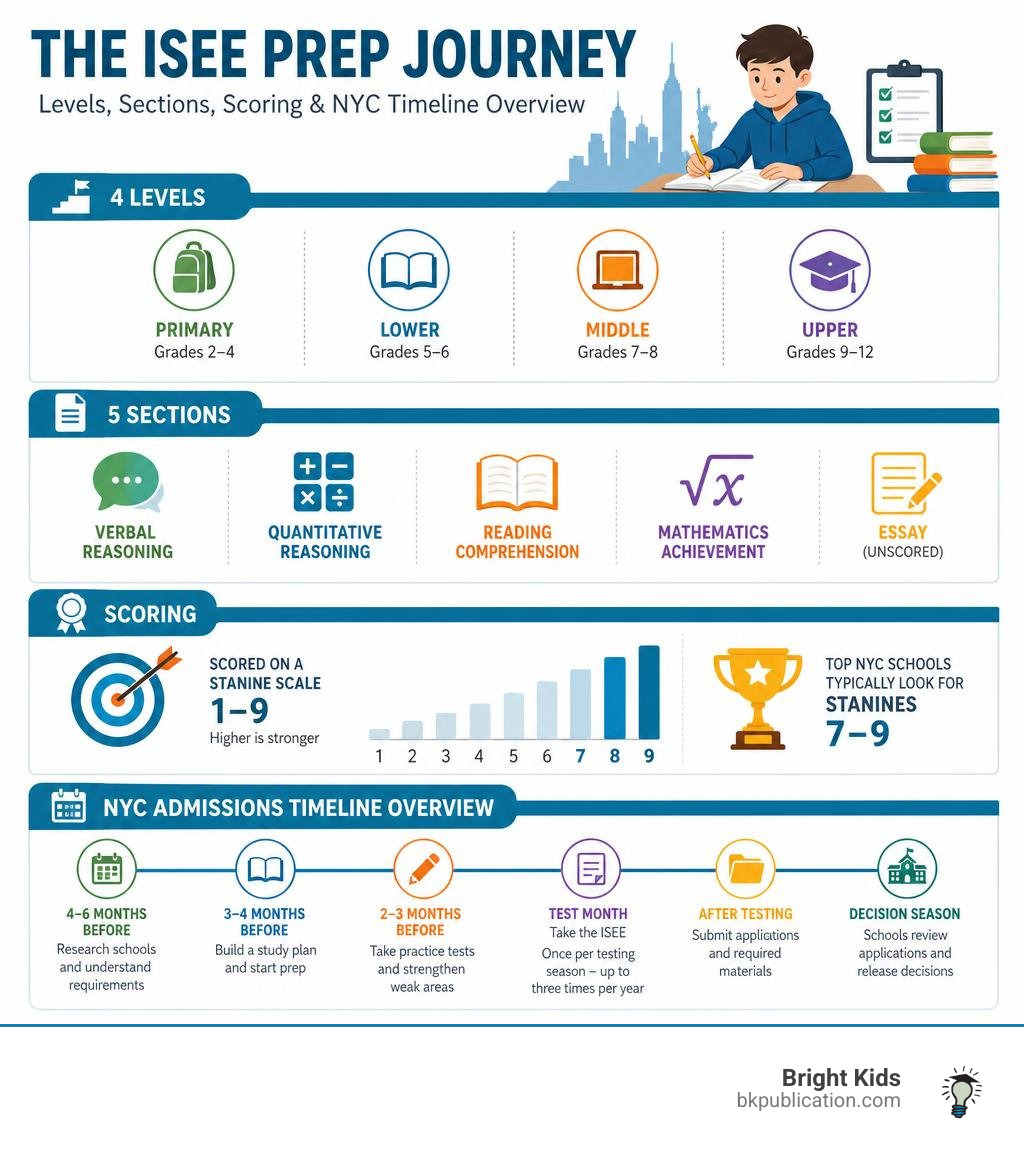
| How many levels? | Four: Primary, Lower, Middle, and Upper |
| What sections are on it? | Verbal Reasoning, Quantitative Reasoning, Reading Comprehension, Mathematics Achievement, and an unscored essay |
| How is it scored? | Stanines (1–9); top NYC schools typically look for stanines of 7–9 |
| How many times can you take it? | Once per testing season — up to three times per year |
| How long should you prep? | 12–16 weeks is typical; start earlier for the most competitive schools |
| Is there a guessing penalty? | No — always answer every question |
The ISEE is accepted by over 1,200 independent schools worldwide. In New York City, schools like Dalton, Horace Mann, Trinity, Brearley, and Fieldston all rely on it. Acceptance rates at the most selective NYC private schools can fall into the single digits. That makes your child's ISEE score one of the most important factors in the entire application.
But here is something many NYC parents get wrong: the ISEE is not a curriculum test. It does not simply reflect what your child has been taught in school. It measures how they think — their reasoning, vocabulary, and ability to work through unfamiliar problems under time pressure. A student who excels in class can still find the ISEE surprisingly challenging on a first practice test.
That gap between classroom performance and test performance is exactly why preparation matters — and why the right preparation looks very different from regular homework.
I'm Bige Doruk, founder of Bright Kids, and over nearly two decades I've helped more than 10,000 students navigate ISEE prep for private schools through structured, skill-based programs that build real competence rather than test-taking anxiety. This guide draws on that experience to walk you through everything — from understanding the test structure to building a realistic NYC admissions timeline.
What is the ISEE and How Does It Compare to the SSAT?

When entering independent school admissions, you will quickly encounter two major acronyms: the ISEE (Independent School Entrance Exam) and the SSAT (Secondary School Admission Test). Both are highly respected, standardized assessments designed to help admissions committees evaluate applicants from incredibly diverse academic backgrounds on a level playing field.
The Official ISEE Test by ERB is developed and administered by the Educational Records Bureau. Since its founding, the ERB has set the gold standard for independent school assessment. The ISEE is specifically designed to measure both acquired academic skills and underlying cognitive reasoning. Because private schools receive applications from public schools, charter schools, parochial schools, and other private schools—all with vastly different grading standards—they need a reliable, normalized metric. The ISEE provides exactly that.
While many schools in our primary regions of New York, Connecticut, California, and Texas will accept either test, they are structured differently. Choosing the right one can make a significant difference in your child's application journey.
Understanding the Four ISEE Levels and Test Sections
The ISEE is divided into four distinct levels, determined entirely by the grade your child is applying to for the upcoming school year (not the grade they are currently in during the test administration).
- Primary Level: For students applying to Grades 2, 3, and 4. This level is administered exclusively online.
- Lower Level: For students applying to Grades 5 and 6.
- Middle Level: For students applying to Grades 7 and 8.
- Upper Level: For students applying to Grades 9 through 12.
If you have a younger student preparing for the early entry points, utilizing a targeted resource like our 3Rd Grade Isee Practice Book is an excellent way to introduce them to the format without overwhelming them.
Across the Lower, Middle, and Upper levels, the ISEE consists of five distinct sections: Verbal Reasoning, Quantitative Reasoning, Reading Comprehension, Mathematics Achievement, and an unscored Essay.
To help you visualize how these levels differ in timing and question volume, we have compiled the standard breakdowns below:
| ISEE Level | Target Grades | Core Focus Sections | Total Testing Time (Excluding Breaks) | Total Questions |
|---|---|---|---|---|
| Primary Level 2 | Applying to Grade 2 | Auditory Comprehension, Reading, Math | ~53 minutes | 50 |
| Primary Level 3 | Applying to Grade 3 | Reading, Writing, Math | ~54 minutes | 54 |
| Primary Level 4 | Applying to Grade 4 | Reading, Writing, Math | ~60 minutes | 58 |
| Lower Level | Applying to Grades 5–6 | Verbal, Quantitative, Reading, Math, Essay | 2 hours, 20 minutes | 128 + Essay |
| Middle Level | Applying to Grades 7–8 | Verbal, Quantitative, Reading, Math, Essay | 2 hours, 40 minutes | 161 + Essay |
| Upper Level | Applying to Grades 9–12 | Verbal, Quantitative, Reading, Math, Essay | 2 hours, 40 minutes | 161 + Essay |
The jump from the Primary Level to the Lower Level is substantial. Suddenly, a student transitioning from 4th grade is expected to sit for a highly rigorous exam lasting over two hours. This is why introducing stamina-building exercises early in your isee prep for private schools is so vital.
ISEE vs. SSAT: Key Differences and How to Choose
If the schools on your list accept both exams, how do you decide which one to take?
The major differences lie in the question types and the scoring mechanics:
- Vocabulary Style: The ISEE Verbal Reasoning section relies on synonyms and sentence completions. The SSAT, by contrast, uses synonyms and classical analogies (e.g., A is to B as C is to D). For many modern students, analogies can feel like learning a foreign language, making the ISEE’s sentence completions more intuitive.
- The Math Split: The ISEE splits math into two distinct sections: Mathematics Achievement (which aligns with school curricula) and Quantitative Reasoning (which tests logical reasoning, pattern recognition, and estimation). The Middle and Upper levels of the ISEE also feature "Quantitative Comparison" questions, which ask students to determine which of two columns has a greater value. The SSAT divides its math into two standard Quantitative sections without these comparison matrices.
- The Guessing Penalty: This is the most crucial mechanical difference. The SSAT penalizes students 1/4 point for every incorrect multiple-choice answer, meaning random guessing can actively lower a score. The ISEE has no guessing penalty. On the ISEE, an incorrect answer and a blank answer carry the exact same weight. Therefore, a core strategy of ISEE prep is ensuring your child never leaves a single bubble blank.
- Reading Passages: ISEE reading passages tend to be slightly longer, heavily factual, and dense. SSAT reading passages frequently include poetry, creative fiction, and older literary texts, which some students find harder to parse.
To make an informed decision, we always recommend administering side-by-side diagnostic tests. Have your child take an authentic SSAT diagnostic and an Isee Upper Level Practice Test under timed conditions. Compare the baseline percentiles and—just as importantly—ask your child which format felt more manageable.
ISEE Prep for Private Schools: Scoring, Stanines, and NYC School Expectations

Understanding the ISEE score report can feel like trying to decode ancient hieroglyphics. When the results arrive, you will see raw scores, scaled scores, percentile ranks, and stanines.
To navigate this process successfully, you must understand how these numbers are calculated and, more importantly, how highly selective schools in competitive markets like New York, Los Angeles, and San Francisco actually interpret them. For deeper insight into this process, our ISEE Test Preparation Guide provides a comprehensive framework.
How the ISEE is Scored: Scaled Scores, Percentiles, and Stanines
First, your child’s raw score (the number of questions answered correctly) is calculated. Because there is no penalty for incorrect answers, this is a straightforward tally. This raw score is then converted into a scaled score ranging from 760 to 940 for the Lower, Middle, and Upper Levels (and 200 to 499 for the Primary Level).
However, admissions committees rarely look at the raw or scaled scores in isolation. Instead, they focus on the percentile rank and the stanine.
Your child's percentile rank compares their performance to a very specific norm group: other students in the same grade applying to independent schools nationwide over the last three years. This is a critical distinction. This norm group is not representative of the general student population; it is a highly competitive, self-selecting pool of motivated applicants. An average score in this pool represents an incredibly high level of academic achievement compared to national public school standards.
The percentile rank is then mapped directly to a stanine (short for "standard nine") scale, which ranges from 1 to 9:
- Stanines 1–3 (Percentiles 1–22): Below Average
- Stanines 4–6 (Percentiles 23–76): Average (with 5 being the exact midpoint)
- Stanines 7–9 (Percentiles 77–99): Above Average
Because the stanine scale is a bell curve, it is much harder to move from an 8 to a 9 than it is to move from a 4 to a 5. A stanine of 9 represents the top 4% of all private school applicants nationwide. For older students aiming for top-tier high school admissions, understanding these metrics on the Isee Test Upper Level is essential to setting realistic goals.
The NYC Admissions Timeline and Score Expectations
In highly competitive markets, the academic bar is exceptionally high. Top-tier institutions—such as Horace Mann, Dalton, Trinity, Brearley, and Collegiate in New York, or Harvard-Westlake in Los Angeles—regularly look for stanines of 7, 8, or 9 across all four multiple-choice sections.
While a solid 7 is considered a strong, competitive score, many ultra-selective schools receive so many applications with 8s and 9s that the academic threshold becomes a primary screening tool. However, admissions directors frequently emphasize that they view scores in context. A student applying from an under-resourced public school who scores a 6 or 7 may be viewed as having exceptional potential compared to a student from a heavily resourced feeder school scoring an 8.
Navigating the NYC admissions timeline requires careful backward planning:
- April–June (The Research Phase): Families research schools, attend preliminary virtual events, and begin initial diagnostic testing.
- August 1st: Registration officially opens on the ERB website. It is highly recommended to register early, as local testing sites in major metro areas fill up incredibly fast.
- September–November (The Primary Testing Window): Most students take their first official test during this period. We advise targeting a late October or November date for your first attempt.
- December (The Final Push): If a student needs to utilize their second testing window to boost a specific section score, December is the prime time to do so.
- January: Admissions files close. All official score reports must be received by schools by early to mid-January.
- February–March: Admissions decisions are officially released, followed by enrollment deadlines.
Strategic ISEE Prep for Private Schools: Timelines and Section Strategies
Now that you understand the mechanics of the test and the timeline of the admissions cycle, let's talk about execution. Successful isee prep for private schools requires a balanced, structured approach. Cramming vocabulary flashcards the week before the exam is a recipe for high anxiety and disappointing results.
Instead, we recommend utilizing high-quality Isee Prep Materials and building a consistent, week-by-week study plan.
Step-by-Step ISEE Prep for Private Schools Study Timeline
For the majority of students, a 12-to-16 week preparation plan strikes the perfect balance between academic growth and burnout prevention.
Here is how we structure this journey at Bright Kids:
Phase 1: The Diagnostic & Core Skill Alignment (Weeks 1–4)
- Step 1: Administer a full-length, timed diagnostic test. This establishes a baseline and highlights specific areas of weakness (e.g., vocabulary gaps or unfamiliar pre-algebra concepts).
- Step 2: Focus heavily on vocabulary acquisition and fundamental math concepts. Vocabulary cannot be memorized overnight; it must be integrated into daily reading.
- Step 3: Introduce younger students to the pacing of the exam. For those preparing for the lower level, utilizing the Isee Lower Practice Workbook helps build familiarity with the question formats.
Phase 2: Strategy & Targeted Practice (Weeks 5–10)
- Step 1: Introduce section-specific strategies, such as the process of elimination and estimation.
- Step 2: Take a proctored practice test every 2 to 3 weeks. Analyze the score reports immediately to adjust your tutoring sessions or self-study focus.
- Step 3: Begin practicing timed essay writing.
Phase 3: Stamina & Simulation (Weeks 11–16)
- Step 1: Transition to weekly full-length practice tests under realistic testing conditions (morning start, quiet desk, strict timing, no phone or calculator).
- Step 2: Refine time-management techniques. Teach your child how to spot "time-trap" questions—problems that take too long to solve—and skip them to secure easier points later in the section.
- Step 3: Focus on positive reinforcement and stress reduction to combat test anxiety.
Section-Specific ISEE Prep for Private Schools Strategies
Each section of the ISEE requires a unique tactical approach:
Verbal Reasoning
This section consists of synonyms and sentence completions. For synonyms, teach your child to cover the answer choices first, write down their own definition of the stem word, and then find the choice that matches their definition. This prevents them from being tricked by tempting distractor options. For sentence completions, encourage them to treat the sentence like a puzzle, looking for transition words (e.g., although, therefore, moreover) that signal whether the blank requires a positive or negative word.
Quantitative Reasoning & Mathematics Achievement
While both test math, they measure different skills. Mathematics Achievement requires standard computational fluency. Quantitative Reasoning requires logical deduction and estimation.
Because calculators are strictly prohibited, students must become comfortable with estimation. If a problem asks for the product of $4.97$ and $10.03$, they should immediately round to $5 \times 10 = 50$ rather than calculating long-form multiplication by hand.
For comprehensive math review, we recommend pairing practice with the Best Isee Math Book to ensure all core curriculum topics are mastered.
Reading Comprehension
The ISEE asks students to read dense, academic passages and answer questions about main ideas, supporting details, and vocabulary in context. The golden rule here is: the answer must be directly supported by the text.
We teach our students to act like detectives—they must be able to point their finger directly at the sentence in the passage that proves their answer choice is correct. If an answer choice sounds reasonable but isn't explicitly backed up by the author, it is incorrect.
The Essay
Though the essay is technically unscored by the ERB, a copy of the handwritten writing sample is sent directly to every school on your application list. Admissions committees read these essays carefully. They use them to gauge your child's authentic writing voice, logical organization, and maturity.
It also serves as a security check to ensure the student's personal statement on the application matches their actual writing ability under timed pressure. We recommend practicing at least 6 to 8 timed essays, focusing on a clear three-to-four-paragraph structure: an introduction with a clear thesis, one or two supporting body paragraphs with personal anecdotes, and a brief conclusion.
Frequently Asked Questions about ISEE Prep
Can you use a calculator on the ISEE?
No. Calculators are strictly prohibited on all standard administrations of the ISEE. Unless a student has been granted a formal testing accommodation for a documented learning difference, they must complete all math sections using mental math and scratch paper. This is why building strong mental math skills, rapid estimation techniques, and scratch-paper organization are core pillars of our prep.
How many times can a student take the ISEE per year?
Students are permitted to take the ISEE up to three times per twelve-month period, but with a very specific limitation: they may only take the test once per testing season. The ERB defines the three testing seasons as:
- Fall Season: August – November
- Winter Season: December – March
- Spring/Summer Season: April – July
Because most private school application deadlines fall in January, families typically have two realistic opportunities to test: once in the Fall season (usually October or November) and once in the Winter season (usually December).
What is the difference between paper and online testing formats?
The ISEE is offered in both paper-and-pencil and online testing formats (with the exception of the Primary Level, which is online-only).
- Paper Testing: Typically held on specific Saturday mornings at local independent schools or specialized test centers. This format is highly familiar to most students but requires careful bubble-sheet management.
- Online Testing: Administered at Prometric testing centers or via a proctored at-home setup. This option offers immense scheduling flexibility, with testing dates available year-round.
We strongly advise families to practice in the exact format they register for. If your child is taking the online test, they should practice reading passages on a screen and working out math problems on scratch paper next to the computer. If they are taking the paper test, they must practice physical bubble-sheet management to avoid costly alignment errors.
Conclusion
Surviving the private school admissions race in competitive hubs like New York, San Francisco, or Los Angeles does not require turning your child into a test-taking machine. The most successful families are not those who panic, but those who approach the process with a clear, strategic plan.
For 17 years, Bright Kids has been trusted by families and top schools to deliver outstanding results. Our comprehensive practice books are meticulously designed to mimic the exact format, style, and difficulty of the real ISEE exam. When you pair our proven prep books with our personalized, one-on-one tutoring, you give your child the tools, strategy, and confidence they need to show admissions committees exactly what they are capable of.
Ready to take the first step toward private school success? Explore Bright Kids ISEE Prep Books today and secure the ultimate study resources for your child's testing level.