

The Complete Guide to CTP Test
Jun 29, 2026
What Is the CTP Test? A Quick Guide for Parents
The CTP test — formally known as the Comprehensive Testing Program — is the leading standardized achievement assessment used by independent and private schools across the United States and around the world.
Here's what you need to know at a glance:
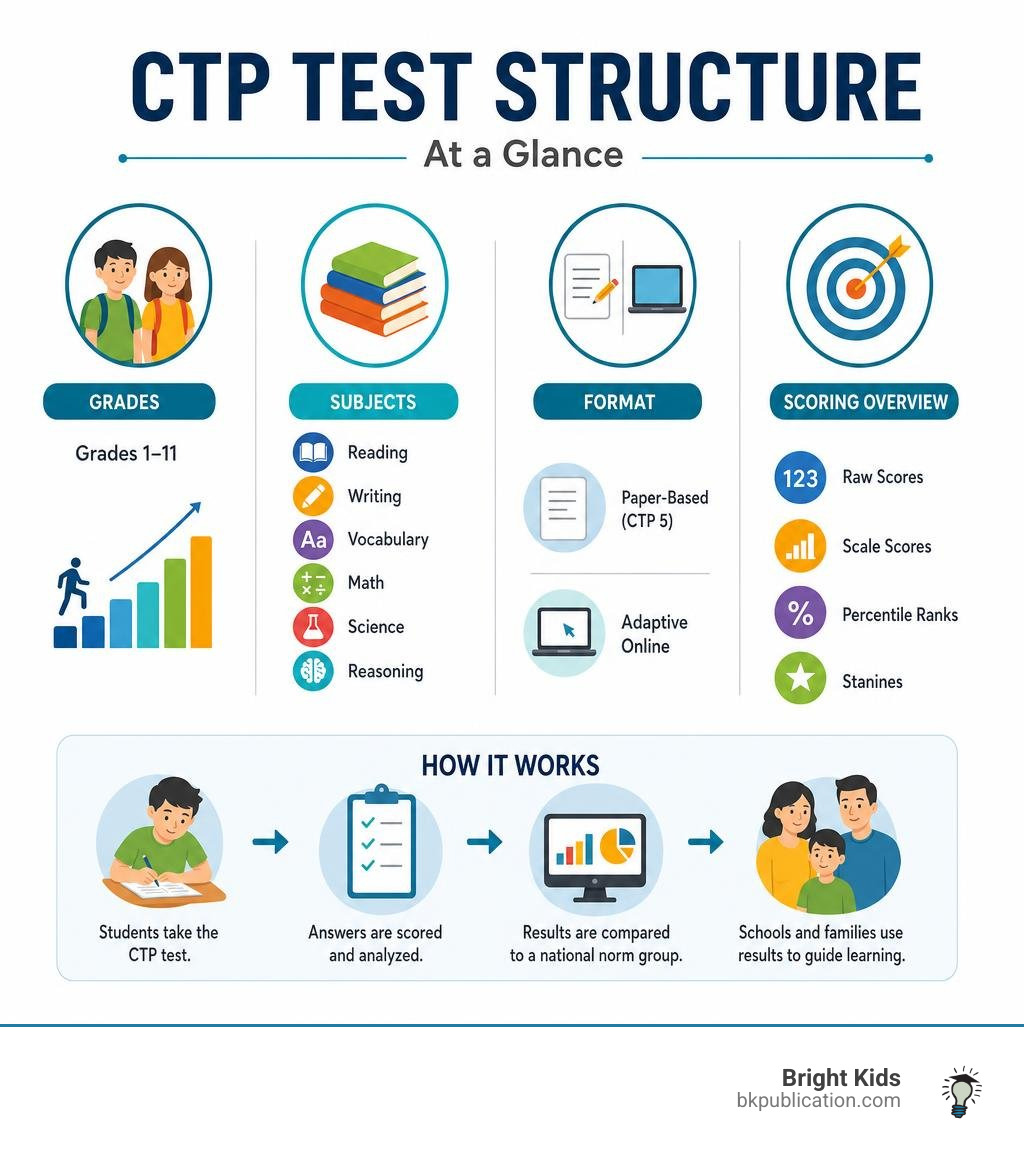
| Question | Quick Answer |
|---|---|
| Who makes it? | Educational Records Bureau (ERB) |
| Who takes it? | Students in Grades 1-11 |
| What does it test? | Reading, writing, vocabulary, math, science, and reasoning |
| What format? | Paper-based (CTP 5) or adaptive online |
| When is it given? | Fall or spring, depending on the school |
| How is it scored? | Raw scores, scale scores, percentile ranks, and stanines |
| Who uses results? | Schools, parents, and educators to guide instruction |
ERB has been developing educational assessments for over 95 years. The CTP tests hundreds of thousands of students every year, making it one of the most trusted benchmarks in independent school education.
For many families, seeing a CTP score report for the first time can feel overwhelming. The scoring is more nuanced than a simple percentage — it depends on which norm group your child's school uses, and understanding that distinction matters a lot when interpreting results.
I'm Bige Doruk, founder of Bright Kids, and over nearly two decades of supporting students through high-stakes assessments — including the ctp test — I've helped thousands of families make sense of their scores and build real academic skills from the ground up. In this guide, I'll walk you through everything you need to know, from what the test covers to how to prepare effectively.
Understanding the CTP Test and Its Purpose
The Comprehensive Testing Program (CTP), developed and administered by the Educational Records Bureau (ERB), is a rigorous standardized assessment designed for high-achieving students in Grades 1 through 11. Unlike state-mandated public school exams, the ctp test is specifically engineered to match the high academic standards of independent, private, and select high-performing public schools globally.
At its core, the CTP is a summative assessment. This means it evaluates student learning, skill acquisition, and academic achievement at the conclusion of an instructional period (typically annually). Rather than simply testing rote memorization, the exam measures both instruction-based achievement and conceptual reasoning. This dual focus provides a highly accurate, multi-dimensional view of a student's capabilities.
Schools choose the ERB CTP Summative Assessment because it is backed by nearly a century of educational expertise. It acts as a reliable benchmark to assess the overall effectiveness of school curricula, identify institutional strengths and weaknesses, and compare student cohorts against highly competitive national and independent school averages.
Subjects and Skills Assessed in the CTP Test
The CTP is tailored to the developmental stage of the student. The test battery adapts across grade levels to ensure that the questions accurately reflect what students should know and be able to do.
For the youngest students in Grades 1 and 2, the exam focuses heavily on foundational literacy and early numeracy. The subtests at this level include:
- Auditory Comprehension / Listening: Assessing how well young students process, retain, and understand spoken information.
- Reading Comprehension: Evaluating early decoding, vocabulary, and basic passage comprehension.
- Word Analysis: Testing a student's grasp of phonics, spelling patterns, and word structures.
- Writing Concepts: Measuring early understanding of sentence structure, punctuation, and usage.
- Mathematics: Assessing basic counting, simple operations, patterns, and geometric shapes.
Beginning in Grade 3 and continuing through Grade 11, the assessment expands significantly to include reasoning subtests:
- Verbal Reasoning: Assessing a student's ability to analyze relationships between words, identify patterns, and draw logical conclusions from verbal information.
- Quantitative Reasoning: Testing mathematical logic, pattern identification, and problem-solving skills rather than just computational fluency.
- Reading Comprehension: Moving into deeper analysis of literary and informational texts, tracking theme, tone, and inference.
- Vocabulary: Evaluating word knowledge in context.
- Writing Concepts & Writing Mechanics: Testing organizational writing skills, paragraph development, grammar, usage, and mechanics.
- Mathematics: Covering conceptual understanding, procedural knowledge, and real-world problem-solving.
- Science: Available for levels 3 through 10 (Grades 3-9/10), this subtest measures scientific inquiry, data analysis, and core concepts across life, physical, and earth sciences.
ERB structures these subtests around three distinct Depth of Knowledge (DOK) levels. Level 1 questions focus on recall and reproduction of facts. Level 2 questions require application of skills and concepts. Level 3 questions demand strategic thinking and complex reasoning, ensuring that high-achieving students are appropriately challenged.
CTP Test Administration: Formats and Windows
One of the key benefits of the CTP is its flexible administration. Schools can choose when and how they want to deliver the test to fit their academic calendars.
There are two primary annual testing windows:
- Fall Administration: Typically administered early in the school year. Because students are just starting their new grade, fall testing generally assesses retention of the previous grade's material. It acts as a diagnostic baseline, allowing teachers to see where students stand as they begin the academic year.
- Spring Administration: Administered toward the end of the school year. This serves as a true summative evaluation of the student's mastery of their current grade-level curriculum.
Student Accommodations
ERB is committed to making the CTP accessible to all learners. Standardized testing accommodations are available for students with documented learning differences. Schools typically review and approve these accommodations at their discretion, aligning them with the student’s existing Individualized Education Program (IEP) or 504 plan. Common accommodations include extended testing time, frequent breaks, a separate quiet testing space, or the use of assistive reading technologies.
CTP 5 Paper-Based vs. CTP Online Adaptive Testing
Schools can choose between administering the traditional paper-and-pencil version (referred to as CTP 5) or the newer, computer-based CTP Online. While both versions assess the same core standards, their structures differ fundamentally.
The paper-based CTP 5 is a linear, fixed-form test. Every student in a specific grade level receives the exact same set of questions in the same order. It consists of multiple-choice questions and can include optional open-ended, constructed-response questions that require students to write out their answers.
In contrast, CTP Online is an adaptive test. It utilizes "stage routing" to tailor the test experience to the individual student’s performance in real time.
In Stage 1, all students receive a standard set of core questions. Based on their accuracy in this first stage, the testing software routes them to an appropriate Stage 2 section—either more challenging or standard grade-level questions. This ensures that high-performing students are pushed to demonstrate their maximum potential without frustrating students who may be struggling.
To help you decide which format fits your child's needs, we've broken down the key differences below:
| Feature | CTP 5 Paper-Based | CTP Online Adaptive |
|---|---|---|
| Test Structure | Fixed-form, linear (same questions for everyone) | Computer-adaptive (Stage routing based on performance) |
| Scoring Speed | Requires physical shipping; results take several weeks | Near-instant scoring and rapid data reporting |
| Science Subtest | Not standard across all paper levels | Seamlessly integrated for levels 3 through 10 |
| Question Types | Multiple-choice + optional written constructed-response | Fully digital multiple-choice |
| Depth of Knowledge | Levels 1-3 | Levels 1-3 |
| Platform Convenience | Traditional paper/pencil | Accessible via web browsers and the ERB-CTP Online app |
For more details on navigating the digital version of this exam, check out our comprehensive guide to CTP Online Testing.
How is the CTP Test Scored?
Understanding a CTP score report can feel like learning a new language. Unlike classroom tests where a 90% is an "A," the CTP uses comparative metrics. When you receive your child's report via ERB's interactive 360 Access data reporting platform, you will see four primary types of scores:
- Raw Score: This is simply the number of questions your child answered correctly. There is no penalty for incorrect answers on the CTP, so students are always encouraged to make an educated guess rather than leave a question blank.
- Scale Score: The raw score is converted into a three-digit scale score (ranging from 100 to 900+ depending on the grade level). Scale scores are standardized to account for minor variations in difficulty between different test forms. This is the most reliable metric for tracking a student's year-over-year academic growth.
- Percentile Rank: This indicates the percentage of students in a specific comparison group (norm group) who scored at or below your child's score. For example, a percentile rank of 82 means your child performed better than 82% of the students in that specific norm group.
- Stanine Score: A simplified scale from 1 (lowest) to 9 (highest) that divides the normal distribution of scores into nine intervals. Stanines 4, 5, and 6 represent average performance, while 7 and 8 are above average, and 9 represents exceptional performance.

Understanding CTP Test Norm Groups
The percentile rank is highly dependent on the "norm group" selected for comparison. Schools can choose to compare your child's scores against several different populations:
- National Norm: Compares your child to a representative sample of all students across the United States.
- Suburban Norm: Compares your child to students attending public schools in affluent suburban districts.
- Independent School Norm: Compares your child to other students attending independent and private schools.
This distinction is critical. Because independent schools are highly selective and academically rigorous, the Independent School Norm group is exceptionally competitive.
An Important Example: A student who scores in the 95th percentile nationally in mathematics might find themselves in the 65th percentile when compared to the highly competitive independent school norm group. This does not mean the student is struggling; rather, it indicates they are performing well within an elite cohort of peers.
Other available comparison groups include Class Norms (comparing the student to their immediate classmates), Grade Norms (comparing them to their entire grade level at their school), and Association Norms (comparing them to students in specific regional private school associations).
How Schools and Parents Use CTP Results
Because the CTP is not a pass/fail exam, its value lies in how the data is applied. Schools use CTP results as a diagnostic mirror to evaluate their own curriculum. If an entire grade level scores lower than expected in "Writing Mechanics," the school may adjust its language arts curriculum for the following year.
For teachers, the 360 Access platform provides immediate insights into individual student needs. It helps educators identify students who require targeted enrichment or those who need extra support in specific foundational areas.

For parents, CTP results offer a clear, objective look at their child’s academic trajectory. It can highlight hidden strengths—such as exceptional quantitative reasoning skills—that might not be fully reflected in daily classroom grades. Furthermore, some independent schools utilize CTP scores as part of their internal admissions or placement processes when students transition from lower to middle school, or middle to upper school.
How to Prepare for the CTP Test
Because the CTP is designed to measure cumulative learning and reasoning skills, cramming vocabulary lists the night before will not yield results. Instead, effective preparation focuses on building familiarity, reducing anxiety, and developing strong test-taking strategies.
Here are our top tips for preparing your child for the CTP:
- Practice the Format: Ensure your child is comfortable with the mechanics of the test. If they are taking the paper-based version, practice filling in bubble sheets. If they are taking the online adaptive version, practice navigating a digital interface.
- Emphasize Guessing Strategy: Since there is no penalty for wrong answers, teach your child to eliminate obviously incorrect choices and always make a guess. Leaving a question blank guarantees zero points.
- Utilize Interactive Tools: ERB’s partnership with Kahoot! offers game-based practice quizzes aligned to CTP standards, making prep feel engaging rather than tedious.
- Target the Reasoning Sections: Reasoning subtests (Verbal and Quantitative) require a different style of thinking than standard school tests. Working on analogies, pattern recognition, and logic puzzles can significantly boost confidence.
At Bright Kids, we have spent 17 years developing specialized materials and tutoring methodologies designed to take the stress out of standardized testing. We recommend starting with high-quality, realistic practice questions to identify specific areas of need.
To help your child get started, you can access our CTP 5 Free Practice Questions. If you are looking for localized, hands-on support, explore our options for CTP Test Prep NYC or work directly with our highly trained educators through the Best CTP Tutors NYC.
Frequently Asked Questions about the CTP Test
What is the difference between achievement and reasoning subtests?
Achievement subtests (like Reading Comprehension, Mathematics, and Vocabulary) measure what has actually been taught in the classroom. They assess curriculum-specific knowledge.
Reasoning subtests (Verbal Reasoning and Quantitative Reasoning) measure a student’s innate ability to find patterns, make logical connections, and solve novel problems. Comparing these two scores allows educators to see if a student's academic output matches their underlying cognitive potential.
How often can a student take the CTP?
The CTP is typically administered once per year by schools, either in the fall or the spring window. However, under ERB guidelines, every new CTP application is valid for six consecutive testing windows (which equates to three years of flexible registration options). This multi-window validity gives schools and families ample flexibility to coordinate testing schedules over a multi-year academic plan.
Conclusion
The ctp test is a highly respected, comprehensive tool that provides invaluable academic insights for independent schools and families alike. While it is a rigorous exam, it should never be a source of intense stress for your child. With the right approach—focusing on familiarization, conceptual understanding, and stress-free practice—your child can approach test day with confidence.
At Bright Kids, we are proud to have spent the last 17 years helping families navigate these academic milestones. Our proven test preparation books and customized tutoring services are designed to mimic real exam structures, ensuring superior results while fostering a genuine love for learning.
Ready to support your child's academic journey? Prepare with Bright Kids today and set them up for long-term success!