

Don't Let Them Go In Cold: The Best CTP-5 Practice Questions
May 13, 2026
Where to Find CTP-5 Free Practice Questions (And What to Do With Them)
CTP-5 free practice questions are available from reputable sources right now — here is the best place to start:
- ERB's own materials — Schools that administer the CTP may share sample materials directly through the ERB 360 Access portal
- Specialized Practice Sets — High-quality resources provide sample questions across verbal, math, and science categories, often including detailed explanations and full-length simulations
If your child is in fifth grade and preparing for the CTP-5, you are probably already feeling the pressure. This is a rigorous test used by private and independent schools to measure academic achievement across reading, writing, math, reasoning, and science. It is not a test most kids can walk into cold — and finding the right practice materials makes a real difference.
The good news? There are solid free resources out there. The challenge is knowing which ones match the actual test format, and how to use them effectively so your child builds real skills — not just test-taking habits.
This guide walks you through exactly that.
I'm Bige Doruk, founder of Bright Kids, and over nearly two decades I've helped more than 10,000 students prepare for assessments like the CTP-5 — including building targeted practice materials specifically designed around CTP-5 practice questions and full test simulations. In the sections ahead, I'll break down every subject area, share where to find the best free resources, and show you how to turn practice into real performance gains.
Understanding the ERB CTP-5 Assessment
The ERB CTP-5 (Comprehensive Testing Program, 5th Edition) is a rigorous assessment designed by the Educational Records Bureau. In our experience working with families in New York, Chicago, and across the country, we've seen how independent and private schools rely on this test to benchmark student growth. Unlike some state tests that focus on minimum competency, the CTP-5 is designed for high-achieving populations, measuring both what a student has learned (achievement) and how they think (reasoning).
The CTP by ERB | Summative Assessment for Grades 1-11 is typically administered annually. For fifth graders, this test is a critical snapshot of their academic trajectory as they head toward middle school. It provides a "common yardstick" that allows schools to compare their students against other high-performing independent school norms nationwide.
Testing Levels and Grade Alignment
One common point of confusion we hear from parents is which "Level" their child should take. For a student currently in Grade 5, the testing level depends on when the test is administered:
- Fall Testing Window: Students usually take Level 4.
- Spring Testing Window: Students move up to Level 5.
As of April 2026, the CTP-5 remains closely aligned with the Common Core State Standards, but it goes beyond them by emphasizing higher-order thinking. Schools often set a January 15 deadline for testing completion if the scores are being used for admissions or placement for the following academic year.
Core Subjects and Skills in CTP-5
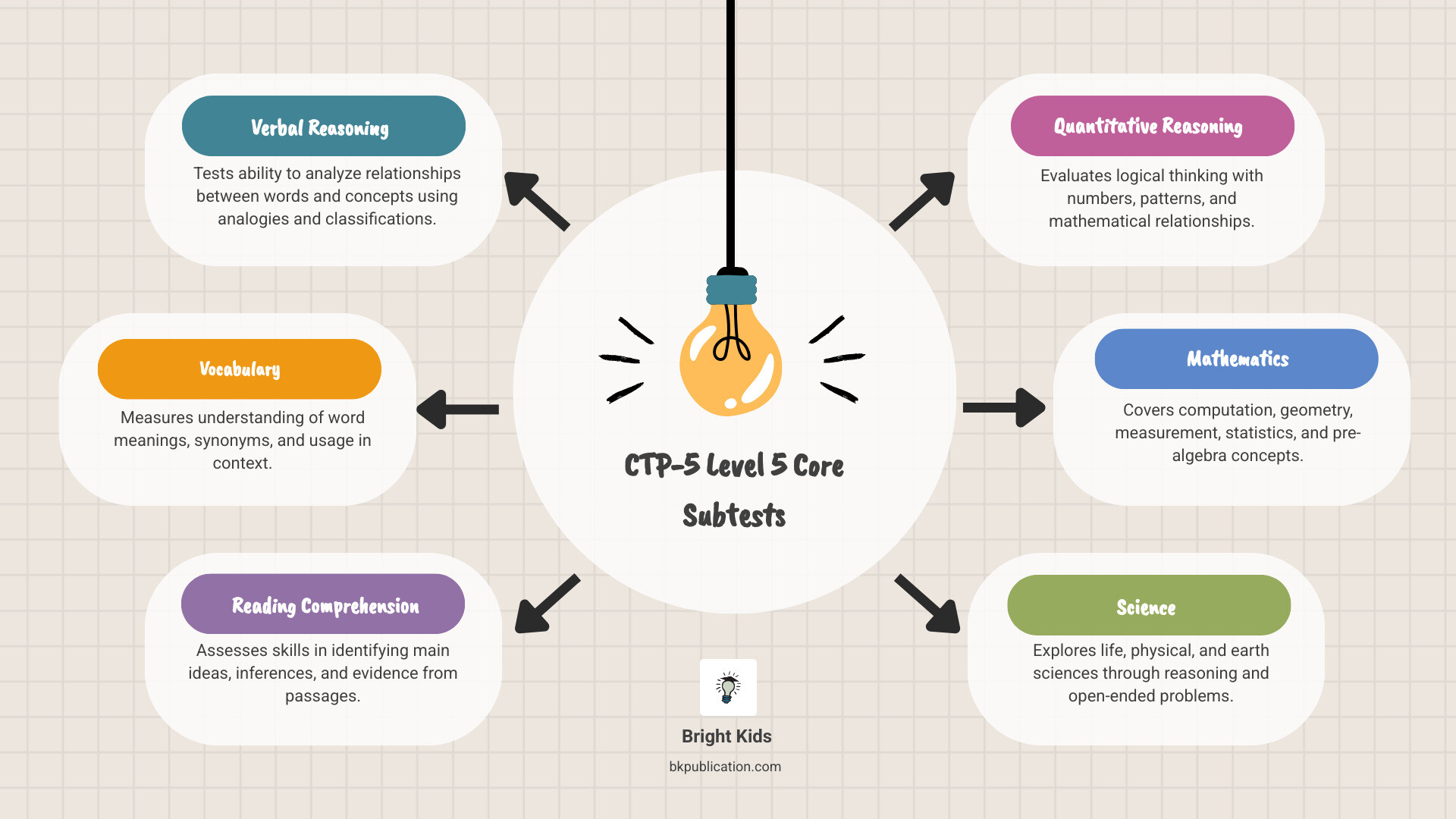
The CTP-5 is a comprehensive battery. When you begin searching for ctp-5 free practice questions, you’ll find they are divided into several distinct subtests. Understanding these categories is the first step to a balanced study plan.
Verbal and Reading Comprehension Skills
At the Level 5 stage, the CTP moves away from simple decoding and focuses heavily on interpretation. We like to tell our students to become "evidence detectives."
- Reading Comprehension: Students must identify the main idea, draw inferences, and analyze the author's purpose. For example, a passage about Antarctica might ask why there are only temporary residents there, requiring the student to connect facts about the climate to human habitation.
- Verbal Reasoning: This measures the ability to conceptualize relationships between words. Analogies are a staple here (e.g., MONOTONOUS : LIVELY :: DISTRAUGHT : CALM).
- Writing Mechanics & Concepts: These sections test language conventions like punctuation and pronoun usage. A classic "tutor's trick" we teach: if a sentence has two subjects (like "Me and him went to the store"), remove the other person to see if it still sounds right ("Me went to the store" vs. "I went to the store").
Math and Quantitative Reasoning in CTP-5
The mathematics portion of the CTP-5 is split into two distinct philosophies:
- Mathematics Achievement: This tests what the child has learned in class—Number Systems, Geometry, Measurement, Statistics, Probability, and Pre-Algebra.
- Quantitative Reasoning: This is all about "math logic." It involves pattern recognition and comparing quantities. For instance, a question might present two columns with different mathematical expressions and ask which is greater, or if they are equal.
Mastering Specialized Sections: Science and Math Communication
The CTP-5 has evolved to include sections that require more than just bubbling in a circle. Specifically, if your child takes the CTP Online, they will encounter a Science section.
- Science: This covers Physical Science (forces/motion), Life Science (cells/DNA), and Earth Science (water cycle/astronomy). A sample question might ask which planet is furthest from Earth or how a specific force (like a "pull") opens a door.
- Math Communication: These are "constructed-response" or open-ended questions. They are the ultimate test of "showing your work."
Strategies for Math Communication Questions
We encourage students to "think out loud on paper." For these questions, getting the right numerical answer is only half the battle. To earn full credit, a student must:
- Show all work: Include every calculation.
- Provide a logical explanation: Use words to describe why they took certain steps.
- Use Visuals: If appropriate, a quick drawing or diagram can help clarify the reasoning.
- The "Baby Steps" Rule: Don't jump to the conclusion. Explain each small logical step forward.
Finding High-Quality CTP-5 Practice Questions Online
When looking for ctp-5 free practice questions, quality matters more than quantity.
- PDF Downloads: High-quality prep resources offer downloadable PDFs that mimic the paper-and-pencil experience.
- Detailed Explanations: Look for resources that don't just give the answer but explain the "how and why." This is where error analysis happens—if a child understands why they missed a question about a parallelogram's coordinates, they won't make that mistake on test day.
Test Format, Scoring, and Administration Logistics
The CTP-5 is a timed test, which can be a major source of anxiety for fifth graders. Most sections are multiple-choice, but as mentioned, Level 5 includes constructed-response math questions.
Understanding the Score Report
When you receive your results, usually 2-4 weeks after the test via the ERB 360 Access portal, you will see several numbers. Here is how to decode them:
| Score Type | What it Means |
|---|---|
| Raw Score | The actual number of questions answered correctly. (No penalty for guessing!) |
| Scale Score | A score adjusted for the difficulty of that specific test version. |
| Percentile Rank | How your child performed compared to a norm group (0-99%). |
| Stanine | A "Standard Nine" score ranging from 1 to 9. |
Stanines 7, 8, and 9 are considered above average to superior. A Stanine 5 is exactly average. In the competitive landscape of NYC or San Francisco independent schools, schools often look for students scoring in the top quartiles (Stanines 7-9).
Registration and Accommodations
Registration is typically handled through your child's current school. If you are applying to a new school, you may need to register for a "Flex" test. Regarding accommodations, the ERB generally follows the protocols already in place for a student, such as those outlined in a 504 plan or IEP. This might include extended time or a quiet testing environment.
Effective Preparation Strategies
Preparation should be a marathon, not a sprint. We recommend starting with CTP-5 practice questions to identify weak areas.
- Simulate Test Conditions: Use a timer. The CTP-5 is as much about time management as it is about knowledge.
- Progressive Difficulty: Start with easier quizzes to build confidence, then move to full-length simulations.
- Targeted Tutoring: If your child consistently struggles with Quantitative Reasoning or Writing Mechanics, specialized support can help. For families in our service areas, Best CTP Tutors NYC can provide that personalized edge.
Frequently Asked Questions about CTP-5
What is considered a "good" CTP-5 score?
While "good" is subjective, most independent schools view Stanines 7, 8, and 9 as indicators of strong academic potential. A Stanine 7 means your child scored better than about 75% of the norm group. However, these norms are based on students already attending high-achieving independent schools, so even an "average" CTP score is quite an accomplishment.
Are calculators allowed on the CTP-5?
Calculators are generally allowed on the Mathematics Achievement subtest for Levels 5 through 10. However, they are not allowed on the Quantitative Reasoning section or the Algebra I section. It is vital that your child practices mental math and long-form calculations so they aren't overly reliant on technology.
How long does it take to receive CTP-5 results?
Typically, results are available within two to four weeks. Schools usually receive the reports first and then release them to parents via the ERB 360 portal. These reports are incredibly detailed, showing performance across specific "strands" like Geometry or Reading Inference.
Conclusion
Preparing for the CTP-5 doesn't have to be a high-stress event for your family. By using CTP-5 practice questions as a diagnostic tool, you can help your child feel familiar with the format and confident in their skills. At Bright Kids, we believe that the best preparation combines high-quality practice materials with a growth mindset.
Whether you are looking for comprehensive practice books that mimic the real exam or seeking the guidance of expert tutors in New York, Chicago, or Los Angeles, we are here to support your journey. For more localized information on preparing in the city, check out our guide on CTP Test Prep NYC. With the right tools and a little bit of "evidence detective" work, your child will be ready to shine on test day.