

How to Master ERB Block Design
May 15, 2026
What Is Block Design ERB — and Why NYC Parents Need to Know About It
Block design ERB is a non-verbal subtest used in the Early Childhood Admissions Assessment (ECAA) — the test that determines whether your child gets into a top NYC private school kindergarten.
Here's a quick breakdown of what it means and why it matters:
- What it is: A hands-on task where a child arranges colored blocks to match a visual pattern
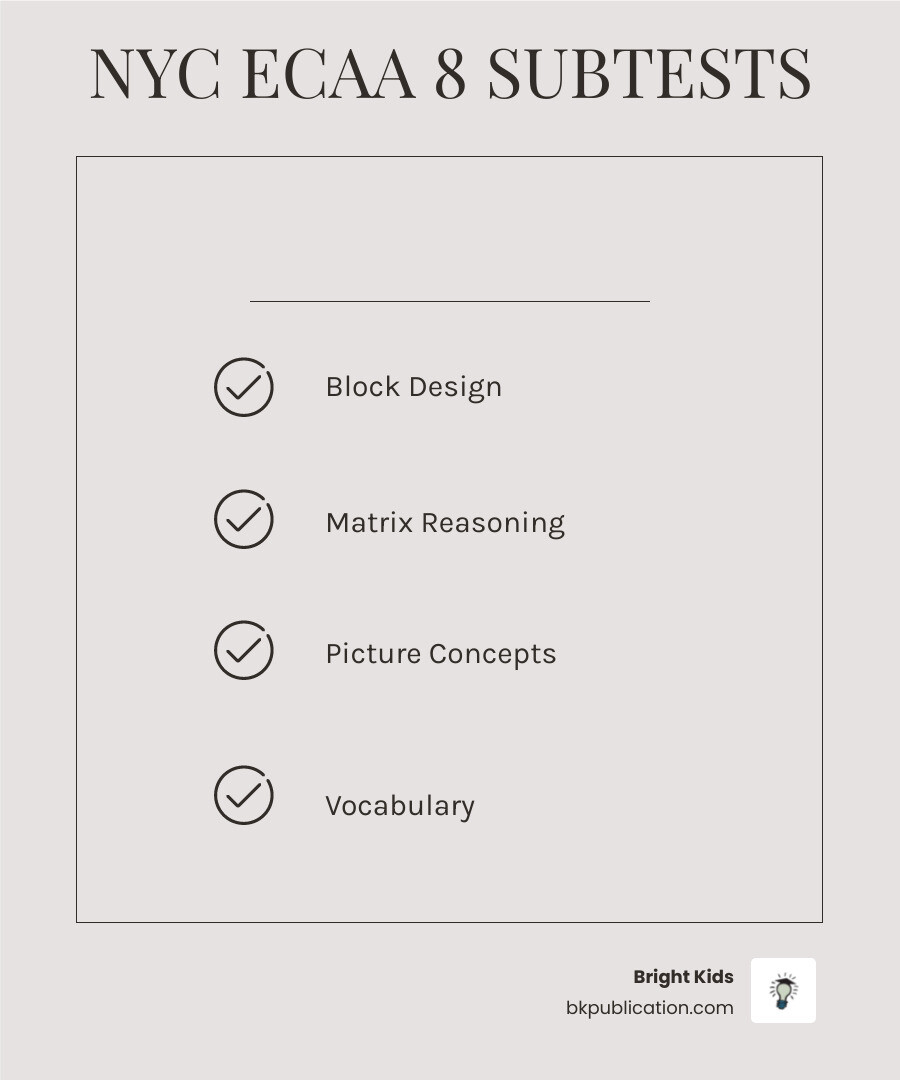
- Which test it's on: The ECAA (administered by ERB), which draws from 8 subtests of the WPPSI-IV
- Who takes it: Children ages 2–7 applying to NYC private schools
- What it measures: Visual-spatial reasoning, fine motor coordination, and pattern recognition
- Why it matters: There are roughly 10,000 admission spots at NYC private and nursery schools, competing against hundreds of thousands of children under 5 in Manhattan alone
This subtest trips up a lot of kids — especially those who prefer dolls over building toys and haven't spent much time with blocks or puzzles. The good news? It's one of the most practicable subtests on the assessment.
I'm Bige Doruk, founder of Bright Kids, and over nearly two decades of helping more than 10,000 students with early childhood test prep — including block design ERB practice — I've seen which strategies actually move the needle for young learners. In the sections below, I'll walk you through exactly how to prepare your child, whatever their starting point.
Understanding the Block Design Subtest in ERB and WPPSI
When we talk about the Block design ERB subtest, we are diving into non-verbal intelligence. The ERB (Educational Records Bureau) uses a modified version of the Wechsler Preschool and Primary Scale of Intelligence (WPPSI-IV) to create the ECAA. While the full WPPSI-IV can include up to 15 subtests, the ECAA for children ages 2-7 focuses on a specific battery of eight.
The non-verbal portion of this assessment includes tasks like matrix reasoning, picture concepts, and, most notably, block design. Unlike verbal subtests that measure vocabulary or similarities, block design requires the child to physically manipulate objects to solve a puzzle. It’s a pure measure of fluid reasoning—the ability to solve new problems without relying on prior academic knowledge. To see where your child currently stands, we often recommend starting with ERB Diagnostic Practice Tests to identify specific areas for improvement.
The Difference Between ERB and WPPSI
It is a common point of confusion for parents: is my child taking the ERB or the WPPSI? Historically, the ERB was the organization that administered the WPPSI test for NYC admissions. Today, the ECAA is the actual assessment used, which is essentially a "short-form" WPPSI-IV tailored for the NYC market.
The WPPSI (first developed by David Wechsler nearly 50 years ago) is an IQ test designed to measure intelligence without requiring reading or writing. The ERB's ECAA takes the most predictive subtests from that IQ test to help schools determine if a child is a good fit for their curriculum. While newer tests like the AABL (Admission Assessment for Beginning Learners) have emerged, the ECAA remains a cornerstone for many elite institutions.
| Feature | WPPSI-III (Older) | WPPSI-IV / ECAA (Current) |
|---|---|---|
| Subtests | Often used 8 subtests | Specifically utilizes 8 targeted subtests |
| Administration | Paper/Physical | Physical blocks + Digital components |
| Non-Verbal Focus | Block Design, Object Assembly | Block Design, Matrix Reasoning, Bug Search |
What the Block Design ERB Subtest Measures
The Block design ERB subtest is much more than just "playing with blocks." It is a sophisticated measure of several cognitive functions:
- Visual-Spatial Processing: The ability to understand how objects relate to each other in space.
- Fine Motor Skills: The dexterity required to place blocks precisely.
- Part-Whole Synthesis: Understanding how smaller components (the blocks) combine to form a larger image (the pattern).
- Geometric Recognition: Identifying squares, triangles (formed by bi-color sides), and larger rectangles.
- Coordination: The hand-eye link required to execute a mental plan.
Why Block Design ERB Performance Matters for NYC Admissions

In the competitive landscape of NYC, the numbers are sobering. With approximately 10,000 spots available across all private nursery and continuing schools and several hundred thousand children under five in Manhattan alone, every point on the ECAA matters.
Schools look at the Block design ERB score as a window into a child's problem-solving potential. A high score suggests that the child can focus on a task, analyze a complex problem, and persist until they find a solution. Because this is a timed subtest, it also measures processing speed—how quickly a child’s brain can "click" into a pattern. For parents looking to boost these specific skills, we offer WPPSI Spatial Skills Practice materials that mirror the complexity of the actual exam.
Scoring and Benchmarks for Preschoolers
Scoring is based on age-appropriate norms. A four-year-old isn't expected to solve the same complex patterns as a six-year-old. Points are awarded for accuracy and, in many cases, the speed of completion.
Children are presented with a printed pattern or a model made by the administrator and must recreate it using their own blocks. As the test progresses, the patterns become increasingly difficult—moving from two blocks to four, and eventually to nine blocks for older children. Mental rotation—the ability to look at a half-blue/half-white block and know which way to turn it to match a diagonal line—is the "gold standard" skill for high scorers.
The Role of Non-Verbal Skills in Gifted Assessments
Non-verbal skills are often seen as a "fairer" measure of innate intelligence because they aren't as heavily influenced by the language spoken at home or the number of books a child has read. Block design ERB tasks tap into abstract thinking and visual-motor integration. In gifted and talented assessments, these "fluid" reasoning powers are highly valued because they indicate a child can adapt to new, challenging academic materials.
Essential Skills and Manipulatives for Block Design ERB Success
To master this subtest, children need to be familiar with the exact tools used during the assessment. The blocks used in the WPPSI-IV are specific: they are bi-colored cubes.
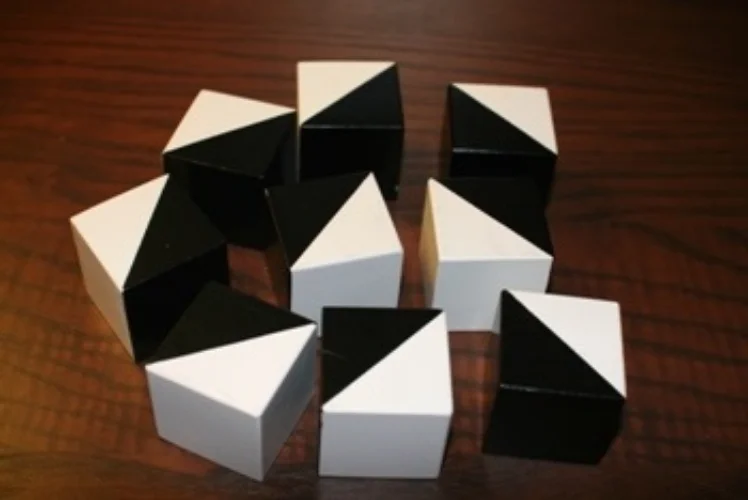
At Bright Kids, we emphasize the use of specialized Bright Kids Block Design Materials that replicate the test environment. A standard set includes 16 blocks:
- 6 entirely white blocks
- 6 entirely blue blocks
- 4 bi-colored blocks (featuring two white sides, two blue sides, and two sides split diagonally into half-white and half-blue).
The half-and-half sides are almost always where children get stuck. Understanding that two triangles can form a square or a larger diagonal line is a breakthrough moment in prep.
Mastering the Block Design ERB Subtest for Doll-Players
We often hear from parents: "My child just isn't a 'block kid.' They only want to play with dolls or stuffed animals." If your child is manipulative-averse, don't panic. You can build spatial familiarity through guided play.
Start by having the "doll" help solve the puzzle. Make it a narrative: "The doll needs a blue floor for her house. Can we find all the blue sides?" By removing the "test" feeling and replacing it with a story, children who usually avoid Legos or blocks often find the confidence to engage with patterns.
Alternative Toys to Build Spatial Reasoning
You don't always need test-specific blocks to build the underlying skills. Many common toys are excellent for developing the visual-spatial processing needed for the Block design ERB subtest:
- Legos and Duplos: Great for fine motor skills and following step-by-step visual instructions.
- Magna Tiles: Excellent for understanding how 2D shapes (triangles/squares) create 3D structures.
- Tangoes Jr. and Block Buddies: These toys specifically use cards to show patterns that the child must recreate, which is the exact format of the ERB.
- Stickers and Pipe Cleaners: These improve finger dexterity (fine motor skills), which is a "nuisance factor" that can slow a child down even if they understand the pattern.
Interestingly, scientific research on blocking and precision suggests that controlling for outside variables (in this case, your child's comfort level with the medium) can lead to much more accurate measurements of their actual ability.
Effective Preparation Strategies for Every Child
Preparation should never feel like a "boot camp." At Bright Kids, we advocate for play-based learning that integrates naturally into your child's day. If you feel you need professional guidance to strike this balance, our ERB Upper Level Tutoring (and early childhood equivalents) can help structure a plan that builds curiosity rather than anxiety.
How to Practice Block Design ERB Without Anxiety
The key to low-stress prep is "natural engagement."
- Short Sessions: Keep practice to 10–15 minutes. Stop while they are still having fun.
- Conversational Tone: Instead of saying "You got that wrong," try "Hmm, that block looks a little different than the picture. Should we try turning it?"
- Positive Reinforcement: Celebrate the process ("I love how you didn't give up on that tricky triangle!") rather than just the result.
- Avoid Over-Coaching: ERB testers are trained to spot children who have memorized specific patterns. Focus on the skill of rotating blocks, not the memorization of the test designs.
Recommended Practice Frequency and Research
How much is too much? Research into learning suggests that "spaced repetition" is far more effective than "cramming."
Statistical insights on randomized block designs show that reducing "noise" or nuisance factors—like a child being tired or hungry—is crucial for performance. Aim for 3–4 times a week for 15 minutes. This frequency builds long-term agility and ensures the skills become second nature.
Avoiding Common Pitfalls and Statistical Confusion
When searching for "Block Design," parents often stumble upon high-level math or biology papers. It's important to distinguish between the cognitive test and the statistical concept.
Distinguishing Cognitive Tests from Statistical Block Design
In statistics, a "Randomized Complete Block Design" (RCBD) is a method used in experiments to reduce "nuisance factors" (unwanted variables). For example, if a scientist is testing a drug, they might "block" the participants by age to ensure age doesn't confuse the results. While this is fascinating for researchers reading Chapter 12 Block Designs | Statistical Methods II, it has nothing to do with your child’s kindergarten test!
If you see terms like "variance reduction," "restricted randomization," or "v treatments," you’ve wandered into the math department. For NYC admissions, you only care about the physical blocks and the patterns.
Common Mistakes in Block Design Practice
We’ve seen it all, and these are the most common errors parents make:
- Introducing the Timer Too Early: Speed is important, but accuracy must come first. If you start timing a child before they are comfortable, they may develop a "freeze" response.
- Using Overly Complex Patterns: Don't jump to 9-block patterns if your child is still struggling with 4. Success builds confidence.
- Ignoring Fine Motor Gaps: Sometimes a child knows the pattern but can't get the blocks to sit straight. Use stickers or small puzzles to build the finger strength they need.
- Rigid Instruction: If you always tell them exactly which block to move, they won't learn the "trial and error" strategy necessary for the actual test.
Frequently Asked Questions about Block Design ERB
What is the difference between the ECAA and the WPPSI?
The ECAA is the name of the assessment service provided by the ERB. It uses a subset of 8 tasks taken directly from the WPPSI-IV (Wechsler Preschool and Primary Scale of Intelligence). In short, the ECAA is the "NYC version" of the WPPSI.
Are there free or low-cost resources for block design practice?
Yes! While specialized bi-color blocks are best, you can use any square blocks and paint the sides, or use "pattern block" sets found in many preschool classrooms. Drawing patterns on graph paper for your child to "color in" with blocks is another great, low-cost way to build the same mental muscles.
How do I know if my child is being "over-coached" for the ERB?
A child is over-coached if they can solve a specific pattern from memory but cannot explain why they are turning a block a certain way. Testers look for flexibility. If a child gets frustrated the moment a pattern looks slightly different than what they practiced at home, they might be relying too much on memory and not enough on reasoning.
Conclusion
Mastering the Block design ERB subtest is a journey of developing spatial confidence. At Bright Kids, we bring 17 years of expertise to this process, providing families with comprehensive workbooks and tutoring that mimic the real exam environment.
Whether your child is a natural builder or a "doll-player" who needs a little extra encouragement, the right tools and a play-based approach can make all the difference. Our NYC-based team is here to help you navigate the high-stakes world of private school admissions with ease. For more information on how we can support your child's journey, explore more info about admissions services on our blog.