

What is the WPPSI-IV Block Design Subtest?
Jul 08, 2026
What the WPPSI-IV Block Design Subtest Actually Measures (And Why It Matters)
The WPPSI-IV Block Design subtest is one of the most revealing tasks in the entire WPPSI-IV assessment — and one of the most misunderstood by parents.
Here's a quick summary of what you need to know:
| Question | Answer |
|---|---|
| What is it? | A timed subtest where a child replicates visual patterns using red and white colored blocks |
| What does it measure? | Visual-spatial reasoning, abstract visual analysis, visual-motor coordination, and nonverbal concept formation |
| Which index does it contribute to? | The Visual Spatial Index (VSI) — and through that, the Full Scale IQ (FSIQ) |
| Who takes it? | Children ages 2:6 to 7:7 (two age bands with different requirements) |
| Average scaled score range | 7–12 (scores range from 1 to 19 across the full normative sample of 1,700 children) |
| Why does it matter for admissions? | It is a core subtest used in gifted program screening and private school admissions like the ECAA® |
Simply put: a child looks at a design printed in a booklet and uses physical blocks to recreate it — within a time limit. It sounds straightforward. But performance on this one subtest can be shaped by vision, fine motor skills, processing speed, and test familiarity all at once.
That combination is why some children score significantly lower on Block Design than on every other subtest — even children who are clearly bright.
One parent on a testing forum described exactly this situation: her 5-year-old son received an FSIQ of 125, but his Block Design score was noticeably lower than all his other scores. After investigation, vision tracking issues turned out to be a likely contributing factor — something that affects Block Design specifically but may not show up on processing speed tasks.
That kind of discrepancy is more common than most parents realize, and understanding why it happens is the first step to addressing it.
I'm Bige Doruk, founder of Bright Kids, and over nearly two decades of supporting families through gifted and admissions testing — including WPPSI-IV Block Design preparation — I've helped thousands of children build the spatial reasoning skills this subtest demands. In the sections below, I'll walk you through everything you need to know to interpret, prepare for, and approach this subtest with confidence.
Understanding the WPPSI-IV Block Design Requirements
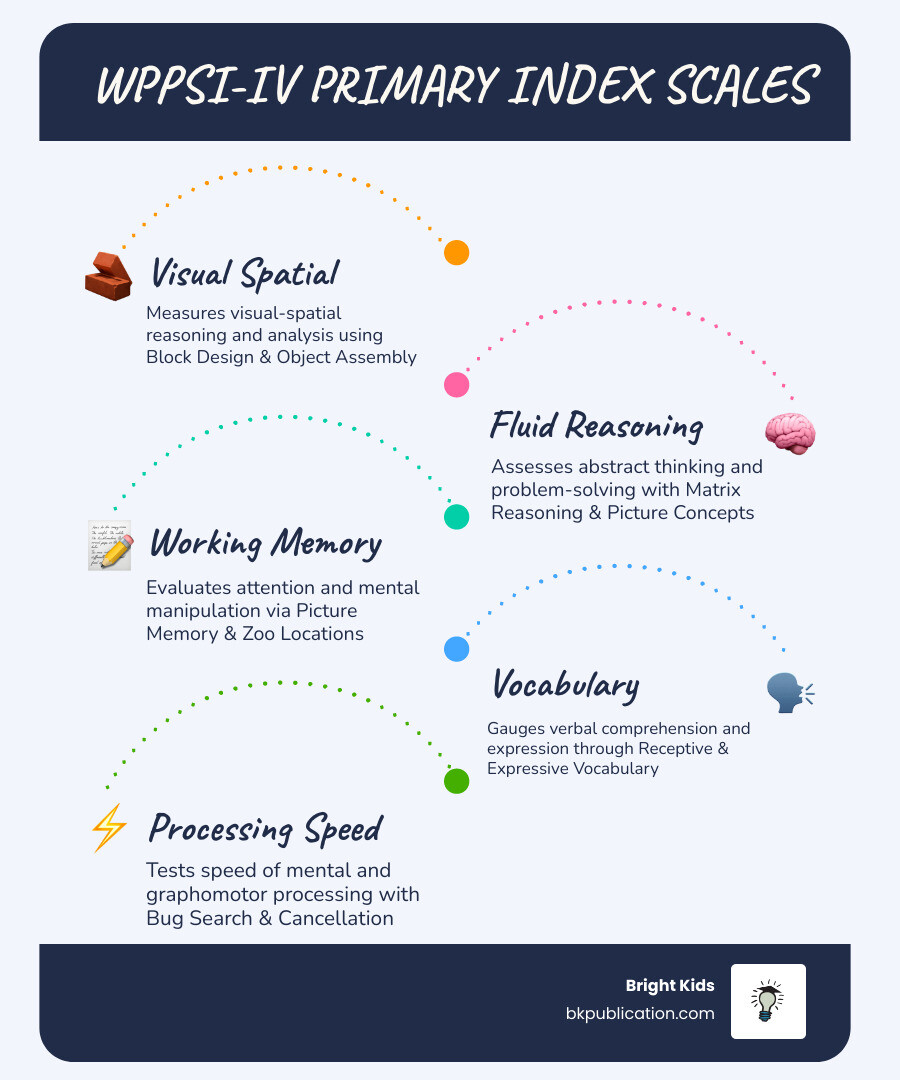
When we talk about the wppsi iv block design subtest, we are looking at a cornerstone of the Visual Spatial Index (VSI). This task isn't just about playing with blocks; it’s a sophisticated tool designed to measure how a child analyzes and synthesizes abstract visual stimuli.
In a clinical or school admissions setting, such as the WPPSI-IV Assessment for Children in NYC, the examiner is looking for several key cognitive markers. First is the ability to perceive visual details accurately. Second is the capacity for nonverbal concept formation—can the child see a two-dimensional picture and understand how to translate that into a three-dimensional object? Finally, it measures simultaneous processing, which is the ability to see multiple parts of a pattern and integrate them into a whole.
How the WPPSI-IV Block Design Subtest is Administered
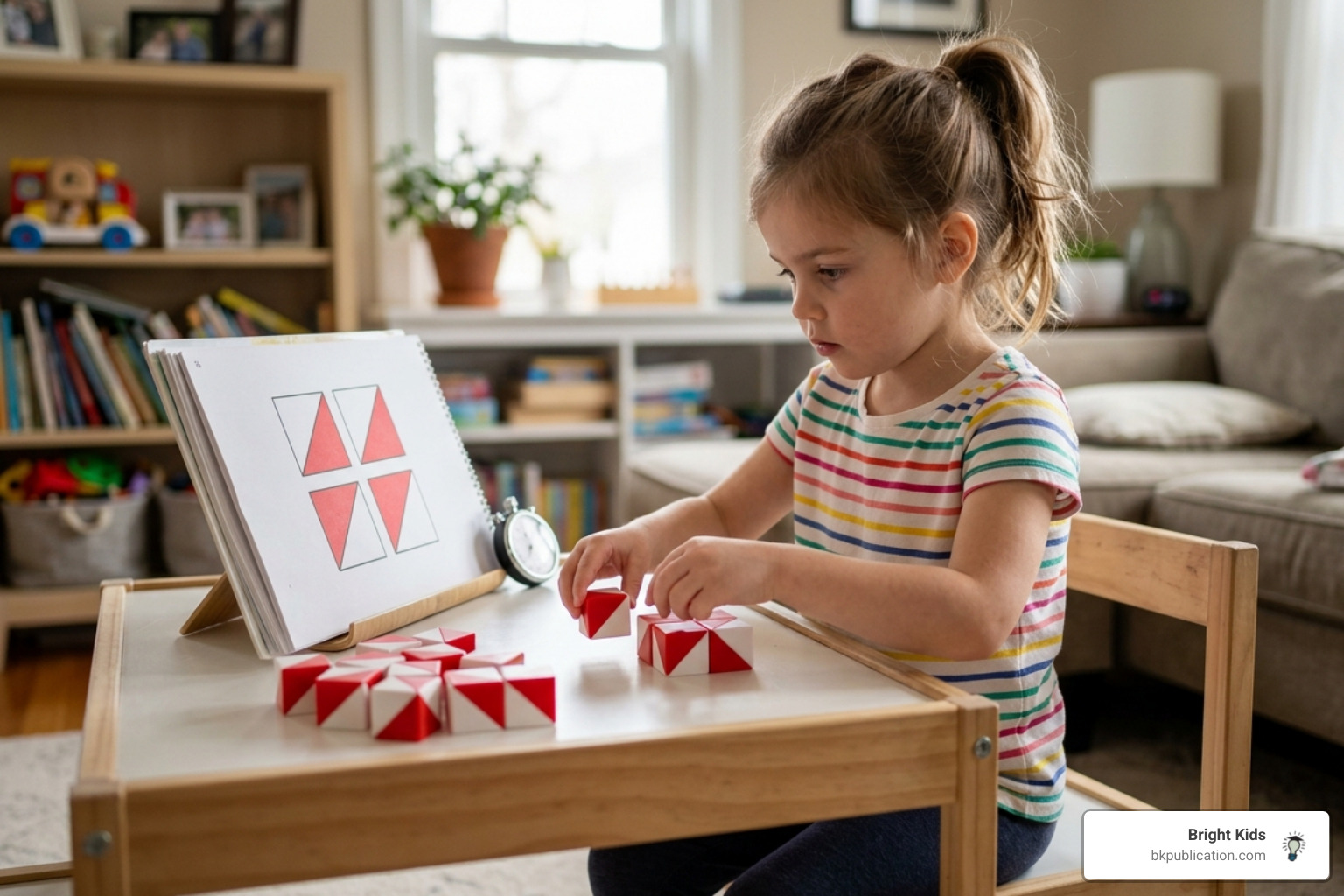
The administration of the wppsi iv block design subtest is highly standardized to ensure fairness. The materials include a stimulus book (containing the patterns) and a set of colored plastic blocks. These blocks are unique: some sides are all red, some are all white, and some are split diagonally with both red and white.
The procedure generally follows these steps:
- Demonstration: For early items, the examiner physically builds a model while the child watches.
- Replication: The child is then asked to recreate that model using their own blocks.
- Picture Modeling: As the test progresses, the physical model is replaced by a picture in the stimulus book. The child must "read" the picture and replicate it.
- Timing: The examiner uses a stopwatch. While accuracy is the primary goal, speed becomes increasingly important for higher scores.
- Discontinue Rule: If a child misses a certain number of consecutive designs, the subtest ends to avoid frustration.
Differences Between Age Bands (2:6-3:11 vs. 4:0-7:7)
The WPPSI-IV is split into two distinct age bands because a two-year-old's brain works very differently from a seven-year-old's. We see significant changes in item complexity and requirements between these groups.
| Feature | Younger Age Band (2:6–3:11) | Older Age Band (4:0–7:7) |
|---|---|---|
| Role of Subtest | Core (One of only 5 subtests) | Core (One of 10+ subtests) |
| Block Type | Primarily solid-colored blocks | Solid and two-colored (diagonal) blocks |
| Task Goal | Simple stacking and side-by-side matching | Complex geometric pattern replication |
| Time Limits | Shorter, focus on basic motor control | Longer, with significant time bonuses |
In the younger band, the wppsi iv block design focuses more on developmental appropriateness—can the child grasp the block and place it next to another? By the older band, the test shifts toward high-level spatial visualization and speed.
Scoring and Impact on the Visual Spatial Index (VSI)
Scoring for this subtest results in a "scaled score" ranging from 1 to 19. A score of 10 is the absolute average. If your child receives a scaled score of 16, they are in the 98th percentile (PR = 98), meaning they performed better than 98% of their same-age peers.
The Block Design score is a primary driver for the Visual Spatial Index (VSI). For example, a child might have a VSI of 118, which puts them in the "High Average" range. This index is then used alongside others—like Verbal Comprehension and Working Memory—to calculate the Full Scale IQ (FSIQ). You can find more technical details on how these scores are weighted in the WPPSI-IV Overview and Technical Details.
Why a Child Might Score Lower on WPPSI-IV Block Design
It can be jarring for a parent to see a child who is advanced in vocabulary struggle with the wppsi iv block design. When we see a discrepancy of more than 1.5 standard deviations (about 15 points) between indices, it suggests a "jagged" cognitive profile.
Common reasons for lower scores include:
- Preference for Concrete over Abstract: Some children excel at puzzles (Object Assembly) but struggle when the task becomes an abstract geometric pattern.
- Base Rate Rarities: Sometimes a child’s Block Design score is significantly higher or lower than their own mean score. For instance, a difference of 5.6 points from the mean is only seen in 1%–2% of the normative sample.
- Anxiety and Timing: Because the subtest is timed, a child who is a perfectionist may work too slowly to earn "time bonuses," dragging down their scaled score even if their designs are perfect.
To help bridge these gaps, we often recommend targeted WPPSI Spatial Skills Practice to build confidence with the physical manipulation of the blocks.
Factors Influencing Performance: Vision, Motor Skills, and Speed
Success in wppsi iv block design requires a "symphony" of skills working together. If one instrument is out of tune, the whole performance suffers.
Fine Motor Coordination is the first hurdle. If a child struggles to pick up and rotate the blocks quickly, they lose precious seconds. This is why the WPPSI-IV introduced ink daubers for other subtests like Bug Search—to reduce motor demands—but Block Design remains a hands-on, manual task.
Processing Speed is also vital. A child must not only know where the block goes but must execute that thought immediately. If a child is a "slow and steady" thinker, their score might not reflect their true spatial intelligence because of the stopwatch.
Visual Tracking is perhaps the most overlooked factor. The child must look at the stimulus book, then down at their blocks, then back to the book, all while maintaining their place in the pattern.

Addressing Vision Issues and Tracking Problems
If a child’s Block Design score is unexpectedly low while their verbal scores are high, we often suggest a visit to a Developmental Optometrist. Standard school vision screenings often miss issues like strabismus (eye misalignment) or weak eye muscles that cause tracking problems.
Vision therapy can often correct these issues, helping the eyes work together to "scan" a design more efficiently. As noted in Scientific research on Wechsler subtest performance, these visuospatial performances are generally stable measures of ability, but they are highly sensitive to sensory and motor deficits. Addressing the physical "input" (vision) can sometimes lead to a significant jump in "output" (test scores).
Preparing for Success: Practice Strategies and Resources
At Bright Kids, we believe that "preparing" isn't about memorizing the test—it's about developing the underlying thinking skills. For the wppsi iv block design, this means building a child’s comfort with spatial manipulation.
Our practice resources include 50 replication designs that increase in difficulty. We teach children specific strategies, such as:
- The "Whole-to-Part" Approach: Looking at the big picture first, then breaking it down into a 2x2 or 3x3 grid.
- Color Matching: Identifying all the solid red or solid white blocks first to "anchor" the design.
- The Diagonal Challenge: Practicing with two-color blocks, which are often the hardest for preschoolers to rotate correctly.
By using physical block sets that mimic the real exam, children move from "What do I do with this?" to "I know exactly how this works." This familiarity reduces test-day anxiety and allows their true intelligence to shine.
Frequently Asked Questions about WPPSI-IV Block Design
When should parents seek further evaluation for low scores?
We recommend seeking further evaluation if there is a significant discrepancy—usually 19 points or more—between the Verbal Comprehension Index and the Visual Spatial Index. This could indicate a non-verbal learning disability (NVLD) or an issue with visual-motor integration. A full neuropsychological evaluation can provide a clearer picture than a single IQ test.
How does Block Design differ from Object Assembly?
While both are part of the Visual Spatial Index, they measure different things. Object Assembly involves putting together a puzzle of a familiar object (like a car or a bird). It's more concrete. Block Design is purely abstract. A child who is great at puzzles but poor at Block Design may have a preference for concrete "part-whole" relationships but struggle with abstract analysis.
Can practice improve a child's performance on this subtest?
Yes, but the goal is to improve spatial visualization and cognitive proficiency, not just to "beat the test." When children are exposed to wide-ranging thinking activities and spatial puzzles, they become more efficient at processing visual information. This familiarity helps them work faster and more accurately.
Conclusion
The wppsi iv block design subtest is a powerful window into how a child's mind organizes the world around them. Whether your child is a natural "visual thinker" or someone who finds spatial tasks challenging, understanding the mechanics of this subtest is key to a holistic assessment of their cognitive strengths.
If you are preparing for NYC private school admissions or simply want to understand your child's developmental profile better, we are here to help. From our NYC headquarters to our locations in Miami, Chicago, and Los Angeles, Bright Kids offers the most comprehensive resources to ensure your child feels confident on test day.
For more information on how to support your child's journey, explore More info about Bright Kids test prep and our specialized curriculum. Together, we can turn a daunting set of blocks into a building block for your child's educational success.