A Quick Start Guide to SHSAT Prep
Jul 06, 2026
The Real Stakes of SHSAT Preparation — And How to Get Started
SHSAT preparation is the single most important step your child can take toward earning a seat at one of New York City's elite specialized high schools.
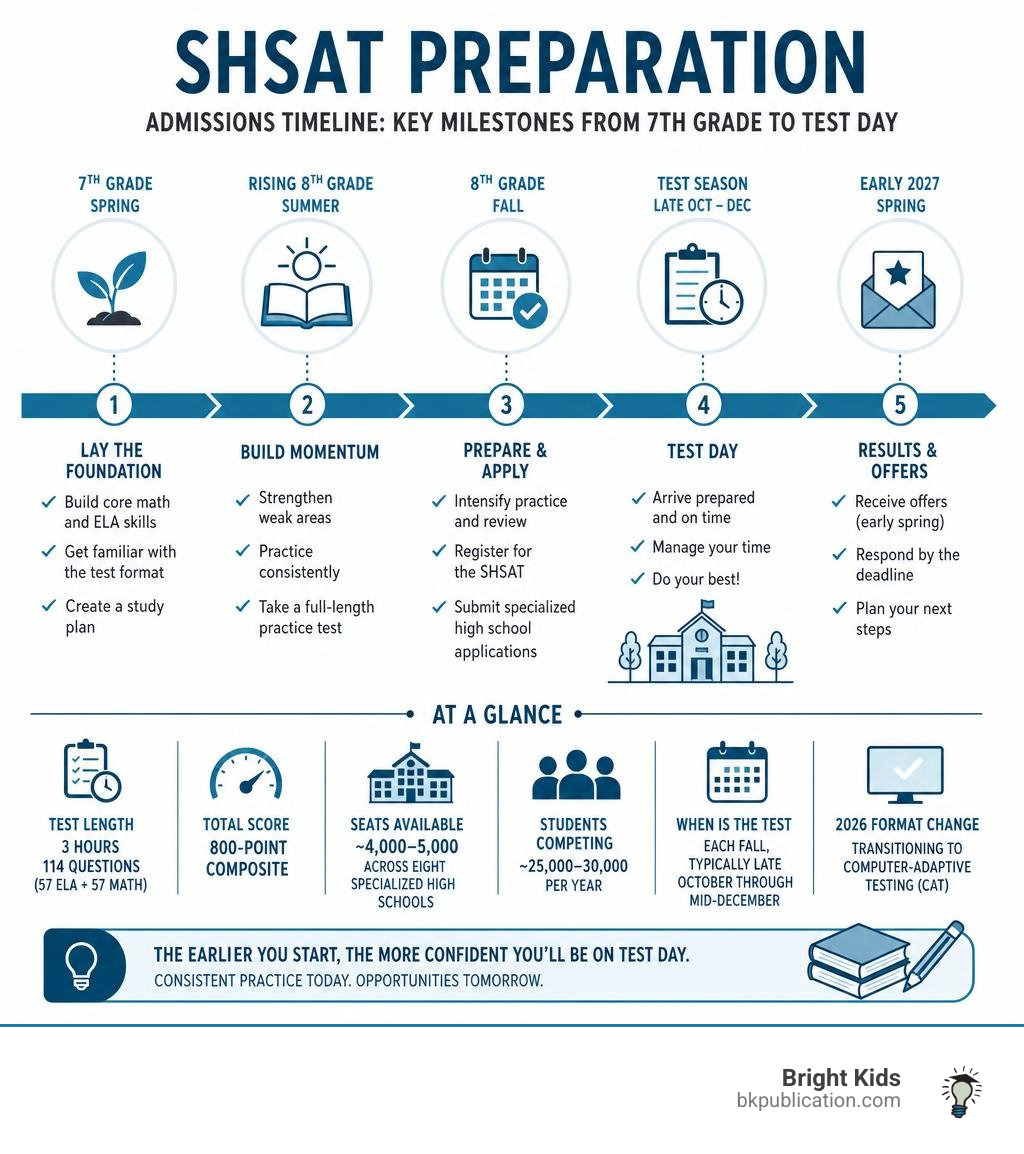
Here's a quick snapshot of what you need to know:
| Key Fact | Detail |
|---|---|
| Who takes the SHSAT | Current 8th graders (and eligible first-time 9th graders) |
| When is the test | Each fall, typically late October through mid-December |
| Test length | 3 hours, 114 questions (57 ELA + 57 Math) |
| Total score | 800-point composite |
| Seats available | ~4,000–5,000 across eight specialized high schools |
| Students competing | ~25,000–30,000 per year |
| Ideal prep start | Spring of 7th grade (12–18 months before the test) |
| 2026 format change | Transitioning to computer-adaptive testing (CAT) |
The numbers are sobering. Every year, roughly 25,000 to 30,000 students compete for around 4,000 to 5,000 seats. That means most students who take this test will not get in — not because they aren't smart, but because they weren't prepared.
The good news? Preparation genuinely moves the needle. Students who start early, practice consistently, and learn the right strategies see real score improvement.
This guide walks you through everything — from how the test works, to when to start, to which topics to study first.
I'm Bige Doruk, founder of Bright Kids, where for nearly two decades our team has helped thousands of students navigate SHSAT preparation and competitive school admissions. We've developed and distributed over 200,000 workbooks and practice tests, always with the same philosophy: build real skills, not just test anxiety.
What is the SHSAT and How Does It Work?
The Specialized High Schools Admissions Test (SHSAT) is the sole academic criterion for admission to eight of New York City’s nine specialized high schools. These schools are public, tuition-free institutions designed for gifted students who excel in academics, science, math, and the humanities.
The eight schools that require the SHSAT for entry are:
- Stuyvesant High School (the most selective school in NYC)
- Bronx High School of Science
- Brooklyn Technical High School
- Staten Island Technical High School
- High School of American Studies at Lehman College
- High School for Mathematics, Science and Engineering at City College
- Queens High School for the Sciences at York College
- Brooklyn Latin School
(Note: The ninth specialized high school, Fiorello H. LaGuardia High School of Music & Art and Performing Arts, requires an audition or portfolio submission rather than the SHSAT.)
To understand the exam's structure and admissions process in full, check out our New York City SHSAT overview.
Admissions are based purely on a student's score and their school preferences. When registering for the exam, students rank their preferred specialized schools in order. Once the tests are scored, the NYC Department of Education (DOE) ranks all test-takers from highest to lowest score. Seats are then filled sequentially. The highest-scoring student gets their first-choice school, and this continues down the list until all seats at each school are filled.
Because of this system, there is no "passing" score. Instead, there are "cutoff scores" that change slightly every year based on the performance of the applicant pool. Historically, Stuyvesant High School has the highest cutoff score, often requiring a composite score of 560 or higher out of a maximum of 800.
The composite score is calculated using a complex scaling system that converts raw scores (the number of questions answered correctly) from the English Language Arts (ELA) and Math sections into scaled scores. Both sections are weighted equally, and there is no penalty for guessing incorrectly. Therefore, leaving a blank answer is never a good strategy!
The 2026 Digital and Computer-Adaptive Test Format
We are currently in June 2026, which means students preparing for the upcoming fall administration will experience a modernized testing environment. Following the digital transition initiated in Fall 2025, the SHSAT is officially launching its computer-adaptive testing (CAT) format in Fall 2026.
This is a major shift from the traditional paper-and-pencil exams of the past. Here is how the computer-adaptive SHSAT works:
- Dynamic Question Selection: The testing software selects questions based on your ongoing performance. If you answer a question correctly, the next question will be slightly more challenging. If you answer incorrectly, the system presents an easier question.
- Grade-Level Boundaries: Don't panic! The system will only test your child on grade-level standards. They will not be hit with high school calculus or advanced college-level reading.
- The No-Revisiting Rule: In the Math section and standalone ELA items, students must answer sequentially. Once a student submits an answer to a question, they cannot go back to change it or review it later.
- Passage-Based ELA Sets: The exception to the no-revisiting rule is passage-based ELA reading comprehension. Students can review and edit their answers within a single passage set before submitting the entire set.
The exam remains 3 hours (180 minutes) long and contains 114 questions in total. It may also include Technology-Enhanced Items (TEIs), which require students to interact with the screen (such as drag-and-drop or select-in-passage) rather than just clicking a multiple-choice bubble.
To help your child practice in this exact environment, we recommend utilizing adaptive digital tools and diagnostic tests that simulate the computer-adaptive format. Getting a feel for how adaptive testing software adjusts to student performance is crucial for building confidence before test day.
Core Sections: ELA and Math Breakdown
The SHSAT is split into two main sections: English Language Arts (ELA) and Mathematics. Each section contains 57 questions, of which 47 are scored and 10 are unscored experimental questions. Because these experimental questions are mixed in seamlessly, students must treat every single question as if it counts!
Students have 180 minutes total and can split their time however they choose. A standard recommendation is to spend roughly 90 minutes on ELA and 90 minutes on Math.
High-Yield Math Topics for SHSAT Preparation
The Math section tests pre-algebra and algebra concepts typically taught through the 7th grade and early 8th grade. There is no trigonometry or calculus on this test. However, the questions are structured as complex, multi-step word problems designed to test logical reasoning rather than simple calculation.
The Math section is entirely calculator-free. This means building mental math fluency is absolutely vital.
The math questions are broken down into four main categories:
- Algebra & Functions (~17 questions): Evaluating expressions, solving linear equations, systems of equations, and translating word problems into algebraic equations. This is the single largest category on the test.
- Number Sense & Operations (~14 questions): Fractions, decimals, percents, absolute values, and prime factorization.
- Geometry & Measurement (~11 questions): Angle relationships, coordinate geometry, volume, and circle geometry (specifically arc length and sector area, which are historically tricky).
- Statistics & Probability (~8 questions): Mean, median, mode, weighted averages, and basic probability.
To get the highest return on investment (ROI) during your SHSAT preparation, prioritize percents, ratios, proportions, and linear equations first. These topics appear in roughly 6 to 8 questions and form the foundation for more complex word problems.
ELA Strategy and Reading Comprehension
The ELA section is designed to evaluate reading comprehension, analytical skills, and command of standard English grammar. It is split into two major parts:
-
Revising & Editing:
- Standalone items: 3 to 4 questions testing specific grammar rules, punctuation, and sentence structure.
- Passage-based items: A short passage accompanied by questions that ask how to improve its organization, clarity, and grammatical correctness.
-
Reading Comprehension:
- This subsection contains several long passages (ranging from 350 to 700 words) across diverse genres, including informational texts, historical documents, literary essays, and poetry.
- Questions require students to identify central ideas, analyze character motivations, interpret metaphors, and draw logical inferences.
Many students find poetry and non-fiction analysis difficult because they require reading between the lines. Success in ELA comes down to recognizing common grammar patterns in the editing section and finding direct, textual evidence for every reading comprehension answer.
Designing Your SHSAT Preparation Timeline
Structuring a realistic timeline is what separates successful test-takers from stressed-out crammers. Because the SHSAT is administered in the fall of 8th grade, waiting until September of 8th grade to start studying leaves families with only 6 to 8 weeks of prep time. This is a recipe for burnout.
Why 7th Grade is the Ideal Time for SHSAT Preparation
We strongly recommend starting SHSAT preparation in the spring of 7th grade. This provides a comfortable 12-to-18-month window.
Starting in 7th grade allows students to:
- Build foundational algebra and ELA skills before they are introduced in their regular school curriculum.
- Learn the unique format of the SHSAT at a relaxed pace.
- Maximize the summer between 7th and 8th grade—which is the single highest-leverage period for academic growth.
For families in our suburban service areas, checking out specialized regional guides like our SHSAT Connecticut Prep can help align local middle school curricula with the rigorous standards of the SHSAT.
Month-by-Month Study Schedule and Weekly Commitment
To make the prep process manageable, we recommend breaking it down into three distinct phases:
-
Phase 1: Foundation Building (Spring of 7th Grade)
- Commitment: 45 to 60 minutes, 3 to 4 days per week.
- Focus: Reviewing basic math concepts (fractions, decimals, percentages) and mastering core grammar rules. Take an initial diagnostic test to establish a baseline.
-
Phase 2: The Summer Intensive (Summer between 7th & 8th Grade)
- Commitment: 60 to 90 minutes, 5 days per week.
- Focus: This is where the real progress happens. Students should take a full-length, timed practice test every 10 to 14 days and spend equal time reviewing their mistakes. Focus heavily on multi-step algebra word problems and poetry.
-
Phase 3: Pacing and Refinement (Fall of 8th Grade)
- Commitment: 2 hours of targeted practice per week, plus weekly mock exams.
- Focus: Transitioning to the computer-adaptive format, practicing under strict time constraints, and building the mental stamina required for a 3-hour exam. Stop taking full-length tests two weeks before the exam to avoid exhaustion.
| Feature | 7th Grade Start (Recommended) | 8th Grade Start (Compressed) |
|---|---|---|
| Prep Window | 12–18 months | 2–3 months |
| Weekly Study Time | 3–4 hours (low stress) | 8–10 hours (high stress) |
| Summer Leverage | High (fully utilized for practice) | None (already passed) |
| Skill Mastery | Deep conceptual understanding | Rote memorization and shortcuts |
| Mock Exam Capacity | 10 to 16 full-length tests | 2 to 3 full-length tests |
Effective Resources for SHSAT Preparation
Preparing for the SHSAT doesn't have to cost a fortune. There are several high-quality free, low-cost, and premium resources available to families across our locations in New York, Connecticut, Florida, Texas, and California.
- NYC DOE Specialized High Schools Student Handbook: This is the single most important free resource. It contains official, released practice tests. You should treat these tests as gold standards and save the most recent ones for timed mock exams close to test day.
- The DREAM Program: A free, DOE-run prep program designed for eligible NYC public school students. It includes a 22-month program starting in 6th grade and an intensive summer/fall program for rising 8th graders.
- Prep Books: High-quality prep books are an excellent, budget-friendly option. For comprehensive practice that perfectly mimics the actual test format, check out our curated list of the Best SHSAT Prep Books.
- Tutoring and Courses: If your child needs structured guidance, personalized feedback, or struggles with self-study, professional tutoring is highly effective. Working with experienced tutors who understand the nuances of the SHSAT can help students target their weaknesses and build test-taking stamina.
- National and Regional Resources: For families living in our various service areas, local community resources can help build foundational test-taking skills. For example, in California, local libraries host great free events, such as the Workshop: SAT Test Prep for Teens | San Francisco Public Library , which help middle schoolers transition to standardized testing formats and build academic confidence.
Practice Test Strategies and Review Methods
Taking practice tests is crucial, but how your child reviews those tests is what actually increases their score. Simply taking test after test without reviewing mistakes is a waste of valuable time.

Here is our step-by-step method for reviewing a practice test:
- Take the Test Under Realistic Conditions: Use a timer set for 180 minutes, sit at a quiet desk, and practice using digital adaptive interfaces to simulate the 2026 CAT environment.
-
Categorize Every Mistake: Do not just look at the correct answer and say, "Oh, I get it now." Have your child write down why they missed the question. Categorize the error into one of two buckets:
- Careless Error: The student knew the concept but made an arithmetic mistake, misread the question, or rushed.
- Content Gap: The student did not understand the underlying math concept or grammar rule.
- Drill the Weakness: If the mistakes are mostly content gaps (e.g., circle geometry or percent change), pause the practice tests and spend 3 to 4 days drilling that specific topic using target worksheets.
- Use the Two-Pass Method: Because the 2026 digital format does not allow returning to questions in the Math section, students must learn to make quick, confident decisions. If they hit a highly complex word problem, they should use estimation to eliminate obviously incorrect answers, make their best educated guess, and move forward without looking back.
Frequently Asked Questions About the SHSAT
Is the SHSAT computer-adaptive in 2026?
Yes. Beginning with the fall 2026 administration, the SHSAT is transitioning to a computer-adaptive test (CAT). The testing software selects questions in real-time based on student performance. It is important to remember that under this new format, students cannot go back to review or change answers in the Math section or standalone ELA items once they are submitted.
What is a good cutoff score for Stuyvesant High School?
Stuyvesant High School is the most selective specialized high school in New York City. While cutoff scores fluctuate slightly every year, a composite score of 560 or higher is typically required. In recent years, approximately 28% of accepted students scored 556 or higher, meeting or exceeding the competitive threshold for Stuyvesant.
Can 9th graders take the SHSAT?
Yes. Eligible 9th-grade students can take the SHSAT in the fall of their 9th-grade year to gain admission for 10th-grade entry. However, the 9th-grade exam is incredibly competitive, as there are only a handful of seats available (often fewer than 10 to 15 seats per school). The 9th-grade test also includes advanced math concepts, such as basic trigonometry and coordinate geometry.
Conclusion
At Bright Kids, we have spent 17 years earning the trust of families and top schools across New York, Connecticut, and nationwide. We know that standardized tests can feel overwhelming, but we also know that with the right preparation, any student can build the skills and confidence needed to succeed. Our comprehensive practice materials are specifically designed to mimic real exams, and when paired with our expert tutoring, they provide a proven path to superior results.
If you want to give your child the ultimate advantage for the upcoming exam, dive into our SHSAT Complete Guide or reach out to us to schedule a personalized diagnostic assessment. With steady habits, early preparation, and a positive mindset, those specialized high school doors are well within your reach!