

An Essential Guide to Common Core Math
Jul 03, 2026
Why Common Core Math Matters for Your Child's Academic Success
Common Core math is a set of educational standards that defines what students in kindergarten through high school should know and be able to do in mathematics at each grade level.
Here is a quick overview of what you need to know:
| Topic | Key Facts |
|---|---|
| What it is | A shared set of K-12 math standards adopted by most U.S. states |
| Who created it | A state-led initiative coordinated by the National Governors Association and Council of Chief State School Officers |
| Core focus | Conceptual understanding, procedural fluency, and real-world application |
| Three key shifts | Focus, Coherence, and Rigor |
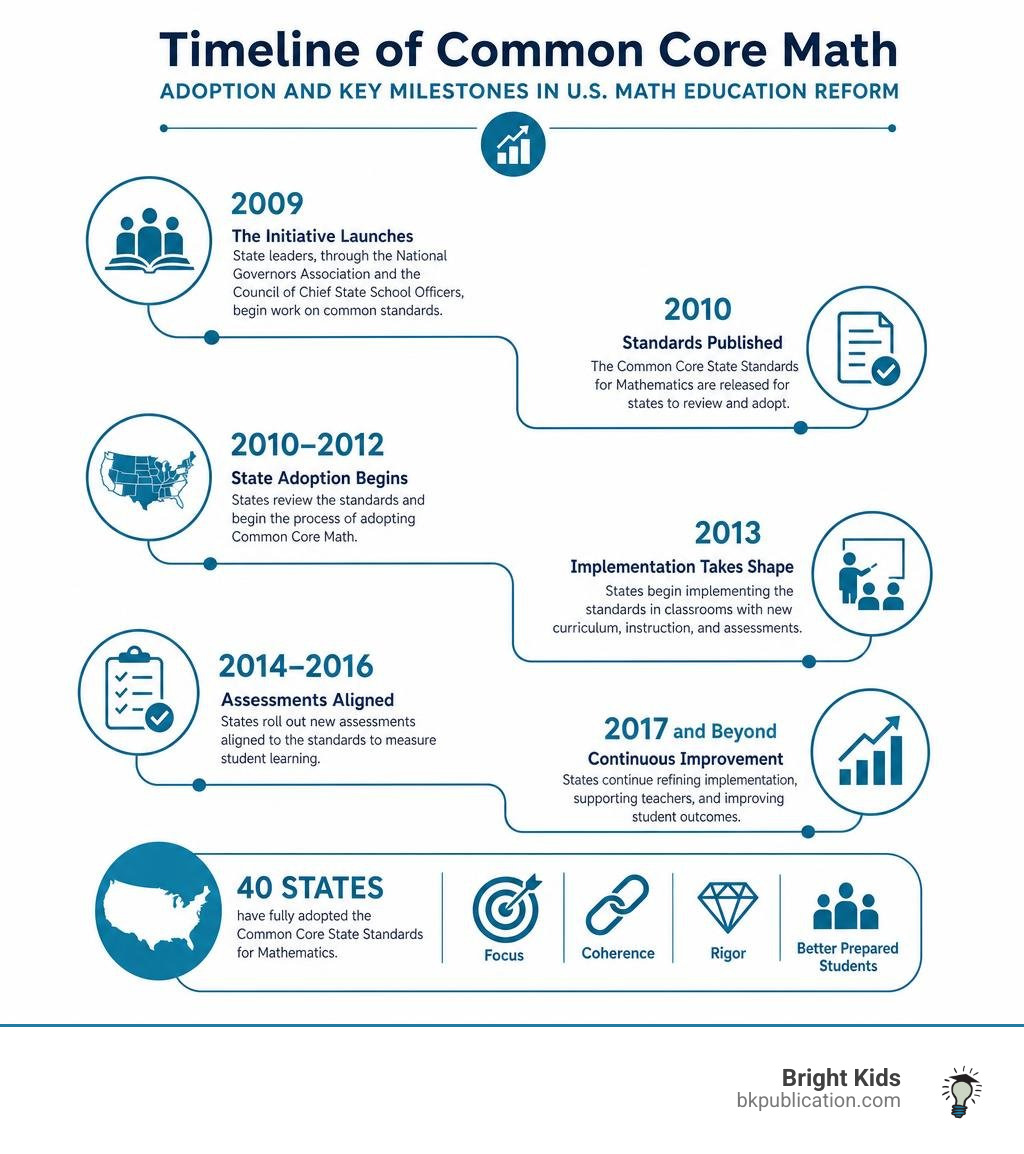
| Adoption | 40 states have fully adopted the standards |
| Eight Practices | Standards for Mathematical Practice guide how students think and work |
For more than a decade, researchers studying math education in high-performing countries reached the same conclusion: the U.S. approach to math was too scattered. It tried to cover too many topics too quickly, leaving students with surface-level knowledge instead of deep understanding. This pattern became known as a curriculum that is "a mile wide and an inch deep."
The Common Core State Standards for Mathematics were developed to fix exactly that. The goal was simple: fewer topics, taught more deeply, in a logical sequence that builds from one grade to the next.
Whether your child is in kindergarten learning to count or in high school working through algebra, these standards shape what they are taught, how teachers assess their understanding, and what skills they are expected to master before moving on.
I'm Bige Doruk, founder of Bright Kids, and over nearly two decades of supporting more than 10,000 students through admissions testing, gifted programs, and standardized assessments, I've seen how a strong grasp of common core math concepts gives students a real edge. In this guide, I'll walk you through everything parents and students need to know about these standards — clearly and without the jargon.
What is Common Core Math and Why Was It Developed?
The development of the Common Core State Standards was a response to a long-standing challenge in American education: the lack of consistent, high-quality learning goals across state lines. Historically, each state designed its own curriculum, leading to vast differences in what a student in New York was expected to know compared to a student in Florida or California.
To address this disparity, a state-led initiative was launched in 2009. This collaborative effort was coordinated by the National Governors Association (NGA) and the Council of Chief State School Officers (CCSSO). Educators, researchers, and state representatives came together to draft a unified set of expectations. By establishing clear, consistent guidelines, the creators aimed to ensure that all students—regardless of their zip code—would graduate from high school prepared for college and the modern workforce.
For a broader perspective on the history and adoption of these standards, you can explore the Common Core - Wikipedia page.
In states where we support families, such as Texas, higher education institutions also align their foundational courses with these rigorous expectations. For example, the UHD Common Core - University of Houston-Downtown resources show how these academic expectations transition seamlessly from high school preparation into university-level coursework.
The Shift Away from "Mile-Wide, Inch-Deep" Curricula
Before the introduction of common core math, traditional math curricula in the United States were frequently criticized for trying to cover too many topics in a single school year. Teachers felt pressured to rush through chapters to prepare students for state exams, resulting in superficial coverage. Students memorized formulas for a Friday test, only to forget them by Monday because they never understood the underlying logic.
This traditional "mile-wide and an inch-deep" model contributed to a widening achievement gap between American students and their international peers. When compared to high-performing countries on international assessments, U.S. students often struggled with multi-step problem-solving and non-routine mathematical challenges.
The Common Core standards directly addressed this issue by narrowing the scope. By focusing on fewer core topics each year, teachers can dedicate the necessary time to ensure students achieve true mastery. To see how these standards are structured to combat curriculum bloat, you can review the official Mathematics Standards - Common Core State Standards Initiative portal.
Research-Backed Foundations of Common Core Math
The design of common core math was not arbitrary; it was built on a solid foundation of cognitive research, international benchmarking, and extensive stakeholder input. The drafting committees studied the curricula of top-performing countries in mathematics, such as Singapore, South Korea, and Japan. They found that these nations focused heavily on building early numerical fluency and structured their curricula around clear "learning progressions."
A learning progression is a research-tested sequence that respects how children actually develop mathematical understanding over time. For instance, a child cannot fully grasp fraction multiplication without first mastering visual models of fractions and understanding multiplication as scaling. By aligning the standards with these natural learning pathways, the curriculum ensures that each grade level serves as a sturdy stepping stone for the next.
You can read the complete, research-informed framework in the official Common Core State Standards for Mathematics document.
Core Principles: Focus, Coherence, and Rigor
To successfully implement common core math, educators and curriculum developers must embrace three structural shifts: Focus, Coherence, and Rigor.
- Focus: Rather than racing through dozens of disconnected math topics, teachers focus deeply on the major work of each grade. This allows students to build strong foundations before moving on to more complex mathematics.
- Coherence: Math is not a list of isolated tricks. Coherence means connecting learning within and across grade levels, helping students see how algebraic thinking grows out of basic arithmetic.
- Rigor: In the context of the Common Core, rigor does not mean "making things unnecessarily hard." Instead, it refers to a balanced pursuit of three equal components: conceptual understanding, procedural skill and fluency, and real-world application.
To see how these principles translate into classroom instruction, take a look at our detailed guide on Common Core Math Instructional Strategies.
Balancing Conceptual Understanding and Procedural Fluency in Common Core Math
One of the most significant differences between traditional math instruction and common core math is the emphasis on balancing conceptual understanding with procedural fluency. In the past, math class often consisted of memorizing a step-by-step algorithm (like "carry the one" or "invert and multiply") without understanding why that algorithm worked.
While procedural speed is still highly valued, the Common Core requires students to understand the mathematical reasoning behind the steps. For example, instead of just memorizing the multiplication tables, a third-grade student learns to use the distributive property to break down a tough problem:
$$7 \times 8 = 7 \times (5 + 3) = (7 \times 5) + (7 \times 3) = 35 + 21 = 56$$
By asking students to justify their answers and explain where a mathematical rule comes from, teachers can verify that students are not just mimicking a process, but truly understanding the math. You can explore how these balanced expectations are outlined in the Math Standards.indb reference.
Real-World Application and Problem-Solving
A common complaint among students in traditional math classrooms has always been, "When am I ever going to use this in real life?" The Common Core math standards directly address this by prioritizing real-world application and mathematical modeling.
Students are regularly asked to apply their mathematical skills to solve open-ended, practical problems. Whether they are analyzing a budget, calculating proportional relationships to scale up a recipe, or using geometry to design a physical space, they learn that math is an active tool for understanding the world.
For excellent classroom examples of how these real-world applications come to life, you can view the resources provided by Common Core in Mathematics: Overview | PBS LearningMedia.
Grade-Level Organization and Higher Math Pathways
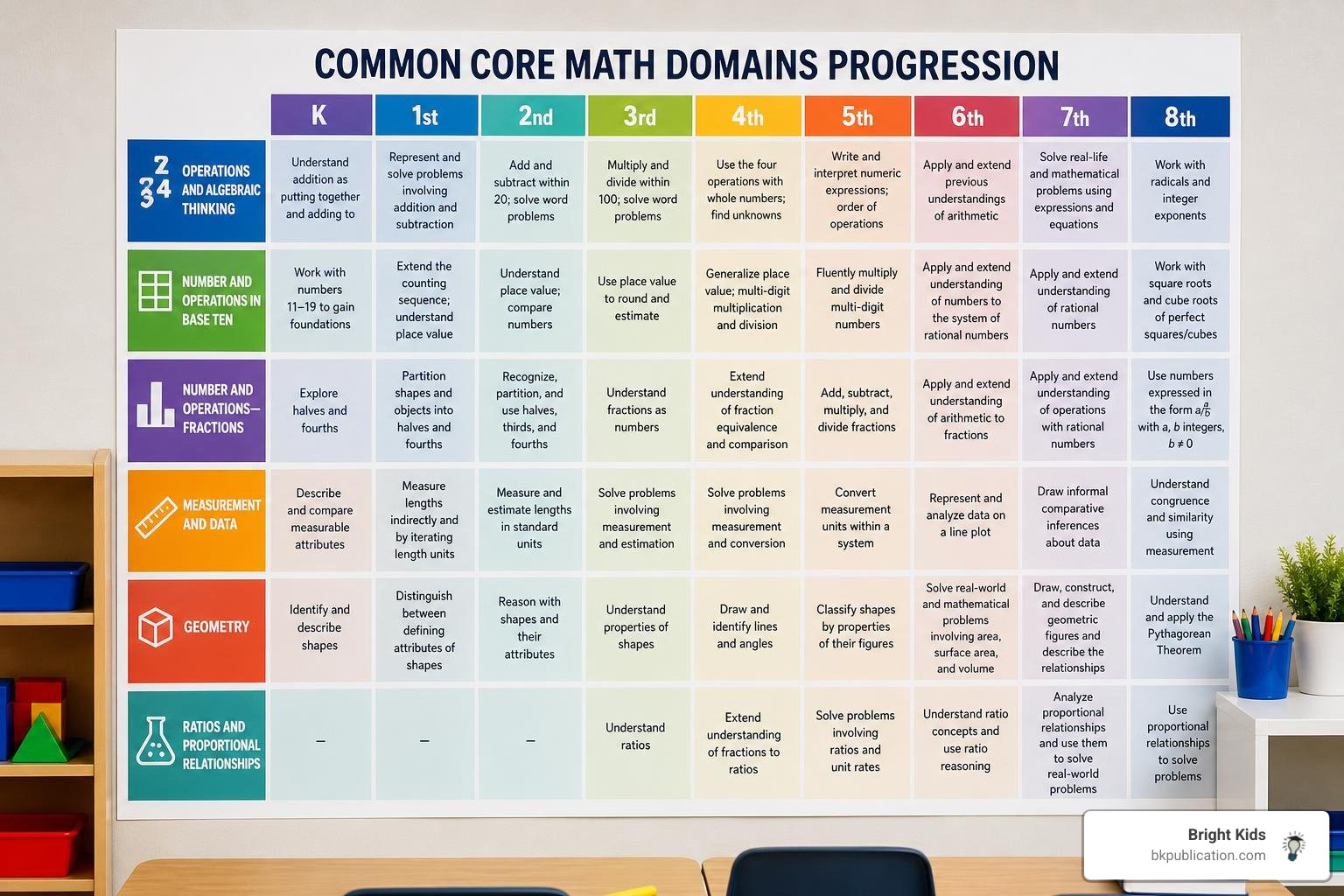
The Common Core math standards are organized systematically to support continuous development. From kindergarten through eighth grade, the standards are divided into specific domains that progress logically. In high school, the standards transition into broader conceptual categories.
At Bright Kids, we understand how crucial these early and middle school transitions are. If you are preparing your child for competitive elementary school admissions, you can explore our specialized 3rd Grade Admissions Math Practice materials to see how we align our practice with these rigorous standards.
Kindergarten through Middle School Emphases
As students progress from kindergarten through eighth grade, the focus shifts to match their cognitive development:
- Kindergarten: Focuses heavily on counting, cardinality, and comparing quantities. Students learn to represent addition and subtraction with concrete objects.
- Grades 1–2: Emphasizes addition and subtraction within base-ten notation, building foundational place-value understanding.
- Grades 3–5: Shifts focus to multiplication, division, and fractions. Students develop visual models to understand fractions as numbers on a number line.
- Grades 6–8: Introduces ratios, proportional relationships, early algebraic expressions, and linear equations.
In New York, for example, the state education department provides detailed breakdowns of these progressions to ensure local classrooms stay on track. You can read more about these state-specific curriculum maps at the Mathematics | New York State Education Department website.
Traditional vs. Integrated Pathways in Higher Mathematics
When students reach high school, the Common Core standards offer two distinct pathways for organizing coursework:
- The Traditional Pathway: This pathway consists of three sequential courses that parents are likely familiar with: Algebra I, Geometry, and Algebra II.
- The Integrated Pathway: This pathway blends algebra, geometry, and statistics concepts together each year across three courses: Mathematics I, Mathematics II, and Mathematics III.
Both pathways cover the exact same rigorous standards; they simply organize the material differently. Choosing the right progression is essential for college readiness. To understand how higher education institutions evaluate these mathematical backgrounds, you can review the admissions and course placement guidelines on the Mathematics < University of Miami page.
The Eight Standards for Mathematical Practice
While the content standards define what mathematical topics students must learn at each grade level, the eight Standards for Mathematical Practice describe how students should develop as mathematicians. These practices represent critical habits of mind that educators must cultivate in their students.

Here are the eight essential practices:
- Make sense of problems and persevere in solving them: Students analyze givens, constraints, relationships, and goals, planning a solution pathway rather than simply jumping into a calculation.
- Reason abstractly and quantitatively: Students learn to represent real-world situations mathematically and manipulate the symbols fluidly.
- Construct viable arguments and critique the reasoning of others: Students make conjectures, build logical progressions, and analyze whether the reasoning of their peers makes sense.
- Model with mathematics: Students apply the math they know to solve everyday problems in community life and the workplace.
- Use appropriate tools strategically: Students consider available tools (such as rulers, protractors, calculators, or algebra tiles) and decide when each might be helpful.
- Attend to precision: Students communicate precisely to others, using clear definitions, stating the meaning of symbols, and calculating accurately.
- Look for and make use of structure: Students look closely to discern patterns or structures, such as realizing that a complex algebraic expression can be simplified by recognizing a familiar pattern.
- Look for and express regularity in repeated reasoning: Students notice if calculations are repeated and look for both general methods and shortcuts.
Connecting Practice Standards to Content Standards
In a high-quality classroom, these practice standards are not taught as separate lessons. Instead, they are deeply integrated into daily content instruction.
For instance, when California adopted the Common Core standards, educators emphasized that combining mathematical practices with content standards was the key to unlocking student success. In major school districts across Southern and Northern California, teachers design lessons where students must construct arguments (Practice 3) while learning about geometric proofs, or use tools strategically (Practice 5) while learning about coordinate planes.
To learn more about how this integration has influenced student achievement in California, you can read the analysis on Does Common Core Add Up for California's Math Students ....
Frequently Asked Questions about Common Core Math
How many states currently use Common Core math?
Currently, forty states have fully adopted and implemented the Common Core State Standards for Mathematics. Several states initially adopted the standards and later chose to repeal or rename them, modifying specific elements to fit their regional needs while keeping the core principles of focus, coherence, and rigor intact.
What does mathematical understanding look like in practice?
In a Common Core classroom, true understanding goes beyond getting the right answer on a worksheet. It looks like a student being able to explain why a particular mathematical rule works, using visual models, drawings, or written explanations. If a student can solve $12 \times 15$ by drawing an area model and explaining how it relates to the distributive property, they are demonstrating true mathematical understanding.
How can teachers assess student understanding under these standards?
Teachers use a variety of assessment strategies to measure student progress. Rather than relying solely on multiple-choice tests, they use performance tasks, open-ended word problems, and interactive rubrics.
For example, in Northern California, the San Francisco Unified School District emphasizes using formative assessments—such as student math journals, structured tasks, and observational data—to guide daily instruction. You can explore how these assessment practices are integrated into district-wide curricula by visiting the Curriculum, Assessments, and Data - SFUSD resource portal.
Conclusion
The transition to common core math represents a profound shift toward preparing students for the analytical demands of the modern world. By prioritizing conceptual understanding, logical progressions, and real-world problem-solving, these standards help students develop the critical thinking skills they need to succeed in higher education and beyond.
At Bright Kids, we have spent 17 years helping families navigate changing educational landscapes. We know that mastering these core mathematical concepts is essential—not only for daily classroom success but also for excelling on competitive standardized exams.
If your child is preparing for admissions testing or needs to build deep mathematical confidence, our comprehensive test preparation materials and personalized tutoring programs are designed to deliver superior results. Equip your student with the ultimate resource by checking out our Best ISEE Math Book to build a rock-solid mathematical foundation today.