

Cracking the Cognitive Code: Sample CogAT Practice Test Questions
Jul 10, 2026
Why CogAT Practice Test Questions Make a Real Difference
CogAT practice test questions are the fastest way to get your child ready for the Cognitive Abilities Test — the most widely used gifted screening tool in U.S. schools.
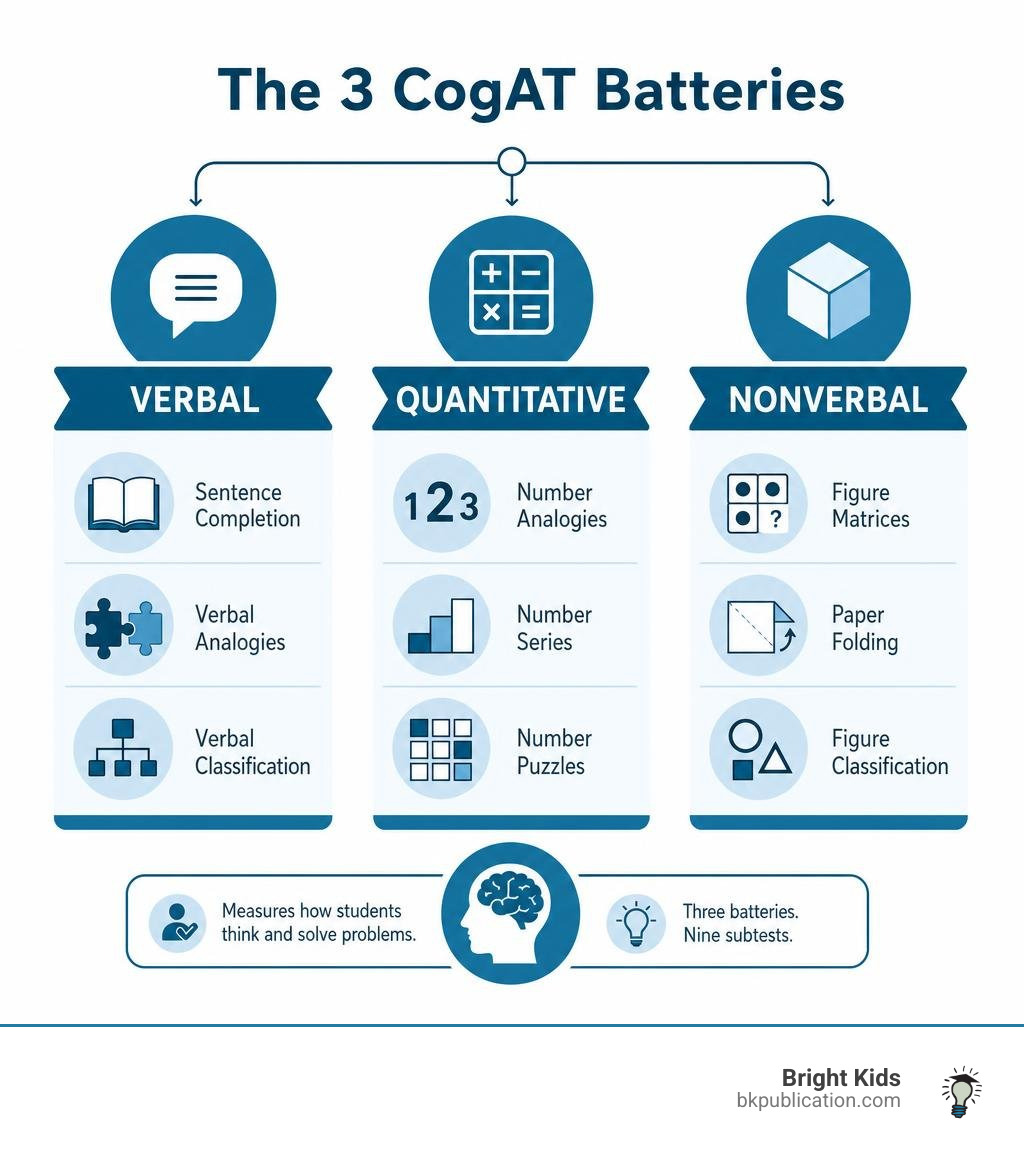
Here is a quick look at what you'll find on the CogAT, organized by battery:
| Battery | What It Tests | Sample Question Types |
|---|---|---|
| Verbal | Word relationships, vocabulary, reasoning | Sentence Completion, Verbal Analogies, Verbal Classification |
| Quantitative | Math-based reasoning and pattern recognition | Number Analogies, Number Series, Number Puzzles |
| Nonverbal | Spatial and visual reasoning | Figure Matrices, Paper Folding, Figure Classification |
The CogAT is not a test of memorized facts. It measures how your child thinks — through patterns, relationships, and logic. That means the right practice can meaningfully improve performance, because familiarity with the format reduces anxiety and sharpens reasoning skills.
Students who practice with CogAT-style questions consistently outperform unpracticed peers with similar underlying ability. The test covers three batteries across nine subtests, with question formats that most children have never seen in a regular classroom — things like paper folding, figure matrices, and number analogies.
This guide walks through sample questions for every grade level and every battery, so your child knows exactly what to expect.
I'm Bige Doruk, founder of Bright Kids, and over nearly two decades I've helped more than 10,000 students prepare for assessments just like this — including developing structured CogAT practice test questions used in both our workbooks and tutoring programs. That experience shapes everything in this guide, so let's get into it.
What is the CogAT and How is it Scored?
The Cognitive Abilities Test (CogAT) is a standardized, multiple-choice assessment designed to measure a student’s developed reasoning and problem-solving abilities. Administered to millions of students from Kindergarten through 12th grade across the United States, it plays a central role in admissions decisions for gifted and talented programs.
Unlike achievement tests that evaluate what a student has already learned in class (such as spelling or history dates), the CogAT focuses on cognitive development. It assesses how well a child can manipulate abstract shapes, identify numerical patterns, and deduce relationships between words.
The test is divided into three distinct sections, known as batteries:
- Verbal Battery: Evaluates a student’s vocabulary, verbal memory, comprehension, and ability to discover relationships between words.
- Quantitative Battery: Appraises abstract reasoning and mathematical problem-solving through number relationships and sequences.
- Nonverbal Battery: Uses geometric shapes and figures to test spatial visualization and logic. Because it requires no reading and is least influenced by language background, it is often considered the fairest measure for English language learners.
Understanding Your Child’s CogAT Scores
When you receive your child’s score report, you will see several metrics that school districts use to determine gifted program eligibility:
- Standard Age Score (SAS): This is a normalized scale score with a mean of 100 and a standard deviation of 16. The maximum score is typically 160. An SAS of 125 represents approximately the 94th percentile, which is a common baseline threshold for many gifted programs.
- Percentile Rank (PR): This indicates how your child performed compared to a national sample of same-age peers. For example, a Percentile Rank of 96 means your child scored higher than 96% of children in their exact age bracket.
- Stanines: This scale ranges from 1 (lowest) to 9 (highest). A stanine of 5 is average, while a stanine of 9 represents the top 4% of test-takers and is highly sought after for competitive gifted placements.
As students grow, the complexity of these batteries increases. For older students transitioning into middle and high school levels, the cognitive demands shift toward highly abstract reasoning. You can learn more about these advanced levels in our guide to High School CogAT Levels 13-18.
CogAT Form 7 vs. Form 8: Key Differences
If you are researching test prep resources, you will likely see references to both Form 7 and Form 8. It is important to know where these stand as of June 2026.
Form 7 was released in 2011 and served as the primary version for over a decade. Form 8 was released in 2022 and is the current standard version adopted by the vast majority of school districts transitioning to modern testing standards.
Here is how the two versions compare:
| Feature | CogAT Form 7 | CogAT Form 8 |
|---|---|---|
| Release Year | 2011 | 2022 |
| Primary Format | Originally paper-based | Designed primarily for digital/online administration |
| Norms | Older national standardization data | Updated, modern national norms reflecting current demographics |
| Question Types | Classic Verbal, Quantitative, and Nonverbal subtests | Identical subtest structure, but with updated styling and interface |
| Primary Use | Still used by select districts | The standard choice for most U.S. school districts in 2026 |
While Form 8 is the modern digital standard, the underlying cognitive skills tested in both forms are virtually identical. This means practicing with high-quality Form 7 materials remains incredibly beneficial. Families preparing for school districts that utilize older testing formats can still utilize resources like the Bright Kids CogAT Form 7 Practice Test to build core skills. For additional physical prep options, you can also view the CogAT Form 7 Practice Test - 3rd and 4th Grade (Level 9-10).
Mastering the Exam with CogAT Practice Test Questions
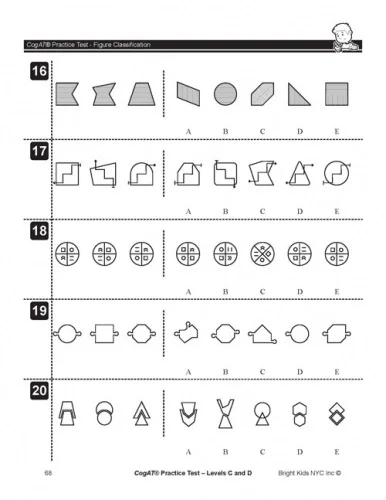
Many parents ask us if it is truly possible to prepare for a cognitive test. The answer is a resounding yes.
While you cannot easily change a child’s innate cognitive potential overnight, you can absolutely help them perform at their true potential by removing the hurdles of the unknown. When a child sees a multi-step paper folding puzzle or a complex number matrix for the very first time on test day, they often freeze. This test anxiety can cause their scores to plummet, regardless of how bright they are.
By practicing with realistic cogat practice test questions, your child will:
- Build Pattern Recognition: They will learn to look for specific transformations (like rotations, color inversions, or alternating arithmetic patterns).
- Manage Time Effectively: With subtests often limiting students to less than a minute per question, pacing is vital.
- Develop Elimination Strategies: They will learn how to quickly rule out obviously incorrect answers, boosting their odds on difficult questions.
To give your child the comprehensive practice they need to build these habits, we recommend exploring our curated Bright Kids CogAT Practice Materials.
Verbal Battery: Sample CogAT Practice Test Questions by Grade
The Verbal Battery measures a student’s ability to find relationships between words and complete verbal patterns. In Kindergarten through 2nd Grade (Levels 5/6 to 8), the test uses picture-based questions to ensure that reading level does not interfere with the measurement of reasoning. Starting in 3rd Grade (Level 9), the questions transition to text.
Let's look at sample questions across different grade levels. If you want to focus specifically on the sentence completion subtest, check out our dedicated guide to CogAT Sentence Completion Practice.
Kindergarten (Level 5/6) - Sentence Completion
For Kindergarten, parents or proctors read the question aloud.
- Question: "The wind moved the _________ on the lake."
- Options: [A car] [A sailboat] [An airplane] [A train]
- Answer Explanation: A sailboat is the only object listed that is propelled on a lake by the wind.
1st Grade (Level 7) - Picture Analogies
- Question: [Picture of a Kayak] is to [Picture of a River] as [Picture of a Car] is to [Picture of a _________].
- Options: [A cloud] [A railroad track] [A road] [The ocean]
- Answer Explanation: A kayak travels on a river, just as a car travels on a road.
2nd Grade (Level 8) - Sentence Completion
- Question: "We rode in a _________ since the store was 20 miles away."
- Options: [Bicycle] [Car] [Airplane] [Roller skates]
- Answer Explanation: A store 20 miles away is too far for a bicycle or roller skates, but too close to justify an airplane flight. A car is the most logical choice.
3rd Grade (Level 9) - Verbal Analogies
- Question: Honey → Bees : Wool → _________
- Options: [A] Sweater [B] Sheep [C] Warm [D] Yarn
- Answer Explanation: Honey is produced by bees, just as wool is produced by sheep. (The answer is B).
4th Grade (Level 10) - Verbal Classification
- Question: Lemon, Orange, Lime
- Options: [A] Apple [B] Grapefruit [C] Banana [D] Carrot
- Answer Explanation: Lemon, orange, and lime are all citrus fruits. A grapefruit is also a citrus fruit, so it belongs in the same category. (The answer is B).
5th Grade (Level 11) - Sentence Completion
- Question: "To _______ an article, we must first understand the ________ of it."
- Options: [A] criticize .. length [B] summarize .. gist [C] write .. font [D] read .. author
- Answer Explanation: To summarize an article, you must first grasp its "gist" (the main point). This is the most logically coherent pair. (The answer is B).
6th Grade (Level 12) - Verbal Analogies
- Question: persuade → convinced : heal → _________
- Options: [A] doctor [B] cured [C] medicine [D] sick
- Answer Explanation: Persuading someone results in them being convinced; healing someone results in them being cured. (The answer is B).
Quantitative Battery: Math-Based CogAT Practice Test Questions
The Quantitative Battery does not test advanced math calculations. Instead, it measures mathematical logic, pattern detection, and mental flexibility.
A great way to help your child master these concepts is to practice regularly. For deep-dive practice on sequences, see our CogAT Number Series Exercises.
Sample Question 1: Number Series (2nd Grade / Level 8)
-
Question: What number comes next in this pattern?
2, 7, 12, 17, 22, ___ - Options: [A] 23 [B] 25 [C] 27 [D] 32
- Answer Explanation: The rule is to add 5 to the previous number. 22 + 5 = 27. (The answer is C).
Sample Question 2: Number Analogies (5th Grade / Level 11)
-
Question: Find the missing number that completes the third pair:
[28 → 4] [21 → 3] [35 → ?] - Options: [A] 5 [B] 7 [C] 10 [D] 15
- Answer Explanation: Look at the relationship in the first two pairs. 28 divided by 7 is 4. 21 divided by 7 is 3. Applying the same rule: 35 divided by 7 is 5. (The answer is A).
Sample Question 3: Number Puzzles (4th Grade / Level 10)
-
Question: Solve for the missing symbol:
(4 + 7) + 10 = (10 + ℑ) + 4 - Options: [A] 4 [B] 10 [C] 7 [D] 11
- Answer Explanation: Due to the commutative and associative properties of addition, both sides of the equation must contain the same numbers to balance. Both sides have a 4 and a 10. Therefore, the missing symbol must be 7. (The answer is C).
Nonverbal Battery: Spatial Reasoning and Figure Matrices
The Nonverbal Battery requires zero reading and evaluates how well a child can mentally manipulate shapes and figures. It is highly visual and abstract. To help your child master the matrix-style questions in this battery, you can practice with our CogAT Figure Matrices Exercises.
Sample Question 1: Figure Matrices (5th Grade / Level 11)
- Question Concept: A 2x2 grid where the top row shows a transformation, and the bottom row must follow the same rule.
- Rule: The top-left shape is a white square that turns into a grey square with a black border on the top-right. The bottom-left shape is a white circle.
- Solution: Following the same transformation, the bottom-right shape must be a grey circle with a black border.
Sample Question 2: Paper Folding (All Grades)
- Question Concept: A square piece of paper is folded in half, then folded in half again. A single hole is punched through the folded layers. What does the paper look like when fully unfolded?
- Answer Explanation: Since the paper was folded twice, there are 4 layers of paper. Punching 1 hole through 4 layers will result in exactly 4 holes when unfolded. These holes will be perfectly symmetrical across the fold lines.
Effective Preparation Strategies Using a CogAT Practice Test PDF

Preparing for the CogAT should be a positive, confidence-building experience. Here are our top expert strategies to help your family get the most out of your preparation:
- Download and Print a Practice Test PDF: While the actual exam may be digital, practicing with a physical printable PDF allows you to sit with your child, highlight key patterns, and easily write down step-by-step explanations.
- Keep Practice Sessions Short and Fun: For younger children (K-2), limit practice to 10–15 minutes a day using play-based, low-pressure games. For older students, 20–30 minutes is the sweet spot. Consistent daily practice is far more effective than marathon cramming sessions.
- Teach the "Process of Elimination": Show your child how to instantly cross out answers that are obviously wrong (e.g., shapes that are the wrong color or numbers that are far too large). This narrows their focus and increases accuracy.
- Have Your Child Explain Their Logic: Don't just check if an answer is right or wrong. Ask your child, "Why did you pick that one?" Having them vocalize their reasoning helps solidify their pattern-recognition skills.
- Transition to Timed Simulations: In the final two weeks before the test, run a few timed mini-sessions. This helps your child get comfortable with the pacing of the actual exam so they don't panic if they run low on time.
Frequently Asked Questions about the CogAT
Is the CogAT an IQ test?
No, the CogAT is not an IQ test. While IQ tests measure innate, fixed intellectual potential, the CogAT measures developed cognitive abilities. This means it evaluates how well a child has learned to think, reason, and solve problems using the tools and experiences they have gathered so far. Because these are developed skills, they can be sharpened and improved through targeted practice.
When is the CogAT administered?
Administration schedules vary widely depending on your local school district. Most schools administer the CogAT either in the mid-fall (October/November) or early spring (February/March). We recommend checking with your school's administration or gifted coordinator at the start of the academic year to find out your district's specific timeline.
How long does the CogAT take to complete?
The length of the test depends on the grade level. For Kindergarten through 2nd Grade, the test is untimed and paced by the teacher, usually taking about 120 to 130 minutes spread across multiple sessions. For Grades 3 through 12, the test is timed. Each of the nine subtests typically has a limit of 10 to 12 minutes, meaning the entire exam takes approximately 90 to 120 minutes of active testing time.
Conclusion
Cracking the cognitive code of the CogAT doesn't require magic tricks or stressful cramming. It simply requires demystifying the exam through targeted, high-quality practice. By introducing your child to cogat practice test questions in a supportive, low-pressure environment, you can help them build the spatial, mathematical, and verbal reasoning habits they need to shine.
For 17 years, Bright Kids has been trusted by families and top schools across New York, Connecticut, Chicago, California, Texas, Florida, and nationwide to deliver prep materials that truly mimic the real exams. Combining our comprehensive test prep books with our expert tutoring programs is the proven way to achieve superior results.
Ready to unlock your child's full cognitive potential? Explore our premium gifted child test prep resources today and give them the confidence to succeed!