

Finding the Perfect NNAT Nonverbal Reasoning Test Practice
May 18, 2026
Why the NNAT Nonverbal Reasoning Test Is the Gateway to Gifted Programs
The nnat nonverbal reasoning test is one of the most widely used assessments for identifying gifted students across the United States, covering grades K–12 (ages 5–17).
Quick facts about the NNAT:
| Feature | Details |
|---|---|
| Full name | Naglieri Nonverbal Ability Test (NNAT3) |
| Created by | Jack A. Naglieri, published by Pearson Education |
| Questions | 48 multiple-choice questions |
| Time limit | 30 minutes |
| Grade levels | Kindergarten through Grade 12 (Levels A–G) |
| Average score | 100 (Nonverbal Ability Index), SD of 16 |
| Question types | Pattern Completion, Reasoning by Analogy, Serial Reasoning, Spatial Visualization |
| Language required | None — fully nonverbal and culture-fair |
| Primary use | Gifted and talented program identification |
If your child is preparing for gifted program testing, this guide compares the best NNAT practice materials available so you can choose the right fit — fast.
Finding the right practice resource can feel overwhelming. There are dozens of options, and not all of them reflect what the real test looks like. The wrong prep can waste your child's time — or worse, build the wrong habits before test day.
That's exactly why a clear, side-by-side comparison matters.
I'm Bige Doruk, founder of Bright Kids, and over nearly two decades I've helped more than 10,000 students prepare for assessments including the nnat nonverbal reasoning test — distributing over 200,000 workbooks in the process. In the sections below, I'll walk you through everything you need to choose the right practice materials with confidence.
Understanding the nnat nonverbal reasoning test
The Naglieri Nonverbal Ability Test is a unique assessment designed to measure general cognitive ability without the interference of language skills. As of April 2026, it remains the gold standard for districts seeking a "culture-fair" way to identify gifted potential. Because the test uses abstract shapes and geometric designs, it removes the barriers often faced by students who are still learning English or those who may have had fewer educational opportunities at home.
The NNAT was developed by Dr. Jack A. Naglieri and is currently published by Pearson Education. Its primary purpose is to find students with high reasoning skills who might be missed by traditional verbal tests. It doesn't ask your child to read a paragraph or solve a word problem; instead, it asks them to look at a puzzle and figure out the underlying logic.
Mastering the nnat nonverbal reasoning test Question Types
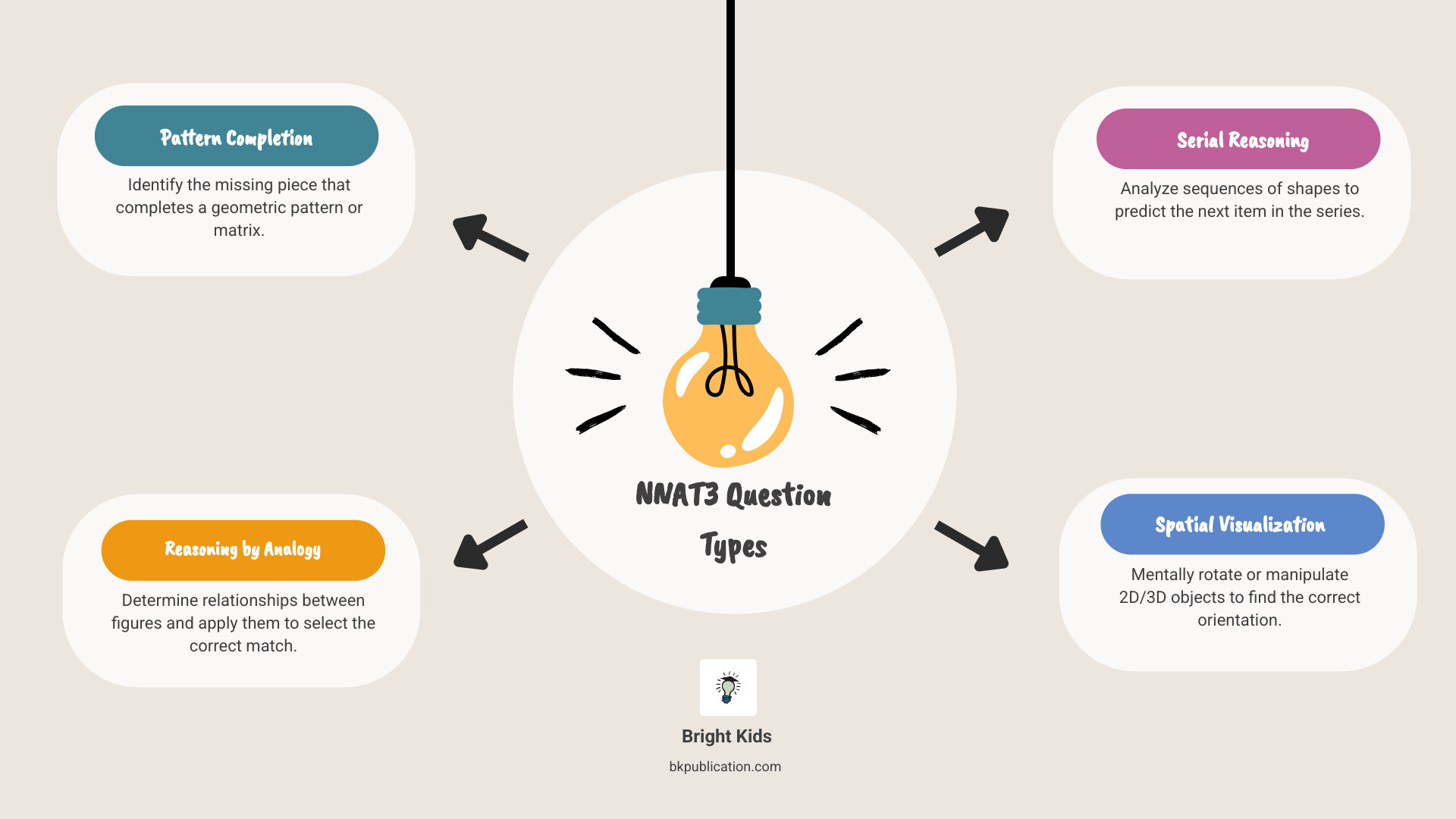
To excel, students need to be familiar with the four specific ways the test challenges their brains. Each type requires a different kind of mental manipulation:
- Pattern Completion: Imagine a large design with a piece missing. Your child must choose the correct piece from several options to complete the pattern. This tests basic perceptual reasoning.
- Reasoning by Analogy: This is like a visual "this is to that" puzzle. For example, if a small circle becomes a large circle, a small square must become a large square. Mastering Nnat Reasoning By Analogy involves recognizing how shapes change in size, color, or orientation.
- Serial Reasoning: These questions present a sequence of shapes that change according to a rule. The student must identify the next shape in the series. It often involves tracking movement or rotation across a grid.
- Spatial Visualization: This is the most complex type. It asks students to imagine what happens when shapes are moved, rotated, or even folded. For example, "If I fold this piece of paper and punch a hole, what will it look like when I open it?"
NNAT Levels A through G by Grade
The test is divided into seven levels to ensure the difficulty matches the child's developmental stage. While the question types remain consistent, the complexity increases significantly as you move up the levels.
- Level A (Kindergarten): Focuses heavily on Pattern Completion and simple analogies.
- Level B (Grade 1): Introduces more complex reasoning and basic serial patterns.
- Level C (Grade 2): Challenges students with more sophisticated analogies and sequences.
- Level D (Grades 3-4): Begins to lean into Spatial Visualization.
- Level E (Grades 5-6): Higher-level abstract reasoning.
- Level F (Grades 7-9): Focuses on advanced visual-spatial manipulation.
- Level G (Grades 10-12): The most difficult level, used for high school gifted placement.
NNAT3 vs. NNAT2: Evolution of the Naglieri Test
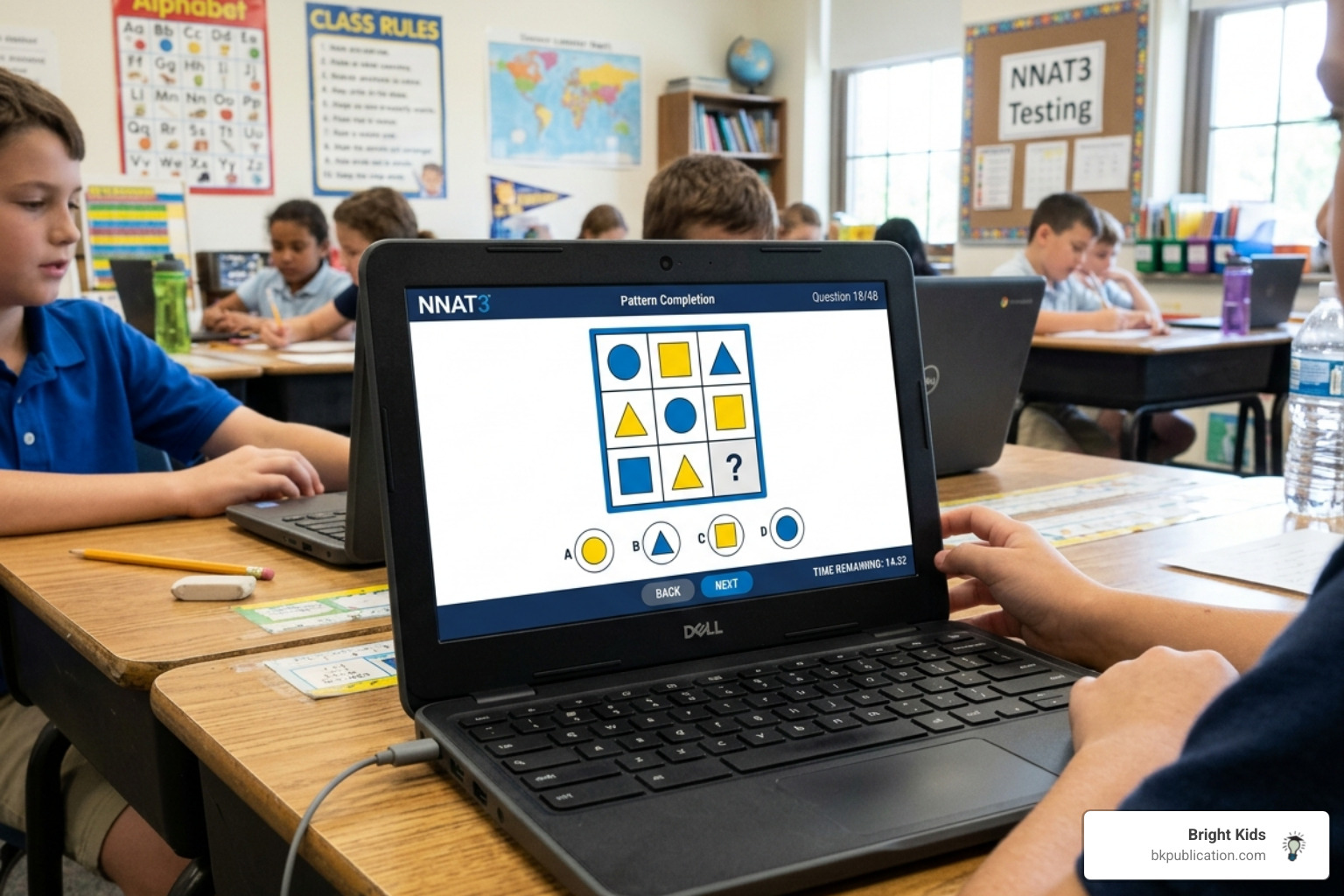
Many parents ask us about the difference between the NNAT2 and the current NNAT3- Naglieri Nonverbal Ability Test | Pearson Assessments US. While both versions measure the same core skills, the NNAT3 brought several important updates that changed how children experience the test.
First, the NNAT3 was built with digital administration in mind. While paper-and-pencil versions still exist, most modern school districts prefer the online format. The NNAT3 also features updated "norms," which are the statistical benchmarks used to compare your child's score to other students across the country.
One of the most thoughtful changes in the NNAT3 is its color palette. To be fair to students with color vision impairments, the test primarily uses blue and yellow. These colors are easily distinguishable for almost all children, ensuring that a vision issue doesn't get mistaken for a lack of reasoning ability. Additionally, the directions are pictorial, meaning the proctor doesn't have to give long, complicated verbal instructions that might confuse a young student or an English Language Learner.
Scoring, Percentiles, and the Nonverbal Ability Index
When you receive your child's results, you won't just see a "number correct." Instead, you'll see a Nonverbal Ability Index (NAI). This is a standardized score.
The average NAI score is 100, with a standard deviation of 16. This means a score of 116 is considered high, and scores above 130 are typically in the range required for gifted and talented program admission. Many high-IQ societies, such as Intertel, accept NNAT scores at or above the 99th percentile for membership.
| NNAT Level | Grade Level | Primary Question Types Included |
|---|---|---|
| A | Kindergarten | Pattern Completion, Reasoning by Analogy |
| B | Grade 1 | Pattern Completion, Analogy, Serial Reasoning |
| C | Grade 2 | Pattern Completion, Analogy, Serial Reasoning |
| D | Grades 3-4 | All four types (including Spatial Visualization) |
| E | Grades 5-6 | All four types |
| F | Grades 7-9 | All four types |
| G | Grades 10-12 | All four types |
Scoring and Interpretation of the nnat nonverbal reasoning test
The NNAT uses "age-based norms," which is a fancy way of saying your child is compared to other children who are exactly their age. These comparisons are usually done in 3-month age bands. This is important because a child who just turned six is at a different developmental stage than a child who is six and eleven months.
Interestingly, research by Lohman et al. found that the NNAT can sometimes produce very high scores more often than expected. In fact, their studies showed that 3.4 times as many students scored in the 130+ range than a standard bell curve would predict. This variability is why many districts use the NNAT alongside other tests like the OLSAT or CogAT to get a full picture of a child's abilities.
Finding the Perfect Practice Materials for Gifted Identification
If you are looking for the best way to help your child, we always recommend mimicking mock exam conditions. Because the nnat nonverbal reasoning test consists of 48 questions to be completed in just 30 minutes, time management is just as important as pattern recognition.
When practicing at home, we suggest:
- Start with untimed practice: Let your child understand the "logic" of the puzzles first.
- Move to timed sets: Gradually introduce a timer so they get used to the pace.
- Focus on the "Guessing Strategy": On the NNAT, there is no penalty for wrong answers. We tell all our students: never leave a bubble blank! If the proctor says there are two minutes left, your child should fill in an answer for every remaining question.
- Develop Spatial Skills: Beyond workbooks, playing with tangrams, puzzles, and building blocks can naturally improve the spatial visualization skills needed for the harder levels of the test.
Why Nonverbal Reasoning Skills Matter in 2026
In 2026, the ability to solve problems without a "manual" is more valuable than ever. Nonverbal reasoning is the foundation for higher-order thinking and STEM (Science, Technology, Engineering, and Math) fields. By focusing on how objects relate to one another in space, children develop the mental flexibility needed for coding, engineering, and advanced mathematics.
Furthermore, the NNAT remains the most equitable assessment tool we have. It is particularly effective for identifying "twice-exceptional" students—those who are gifted but may also have a learning disability like dyslexia that makes verbal tests difficult. By stripping away the language, we can see the raw engine of the child's mind.
Frequently Asked Questions about the NNAT
Should my child guess on the NNAT?
Yes, absolutely. Because the score is based only on the number of correct answers (and no points are taken away for mistakes), guessing is a statistically sound strategy. If your child can eliminate even one or two obviously wrong choices, their probability of picking the right answer increases significantly.
Why does the NNAT only use blue and yellow?
This is a specific design choice to ensure visual accessibility. By avoiding red and green—the most common colors involved in color blindness—the test ensures that a child's inability to distinguish certain colors doesn't negatively impact their score. It’s all about creating a level playing field.
How is the NNAT used in NYC G&T programs?
In NYC, the NNAT-2 (and now NNAT3) became a major component of the Gifted and Talented entrance exam starting in the 2012-13 school year, replacing the Bracken School Readiness Assessment (BSRA). Typically, the NNAT accounts for 50% of the total score, with the OLSAT (Otis-Lennon School Ability Test) accounting for the other 50%. This combination ensures that both verbal and nonverbal abilities are measured.
Conclusion
Preparing for the nnat nonverbal reasoning test doesn't have to be a stressful experience for your family. At Bright Kids, we have spent 17 years refining our approach to these assessments. We understand that every child learns differently, which is why our practice books are designed to mimic the actual exam as closely as possible, and our NYC-based tutoring provides the personalized support students need to feel confident on test day.
Whether you are in New York, Chicago, or Los Angeles, the key to success is early exposure and consistent, high-quality practice. By focusing on the logic behind the shapes, you aren't just helping your child pass a test—you're helping them develop the thinking skills they will use for a lifetime.