

The Essential Guide to WPPSI Visual Spatial Prep
May 20, 2026
Why WPPSI Visual Spatial Prep Matters for Your Child's Test Success
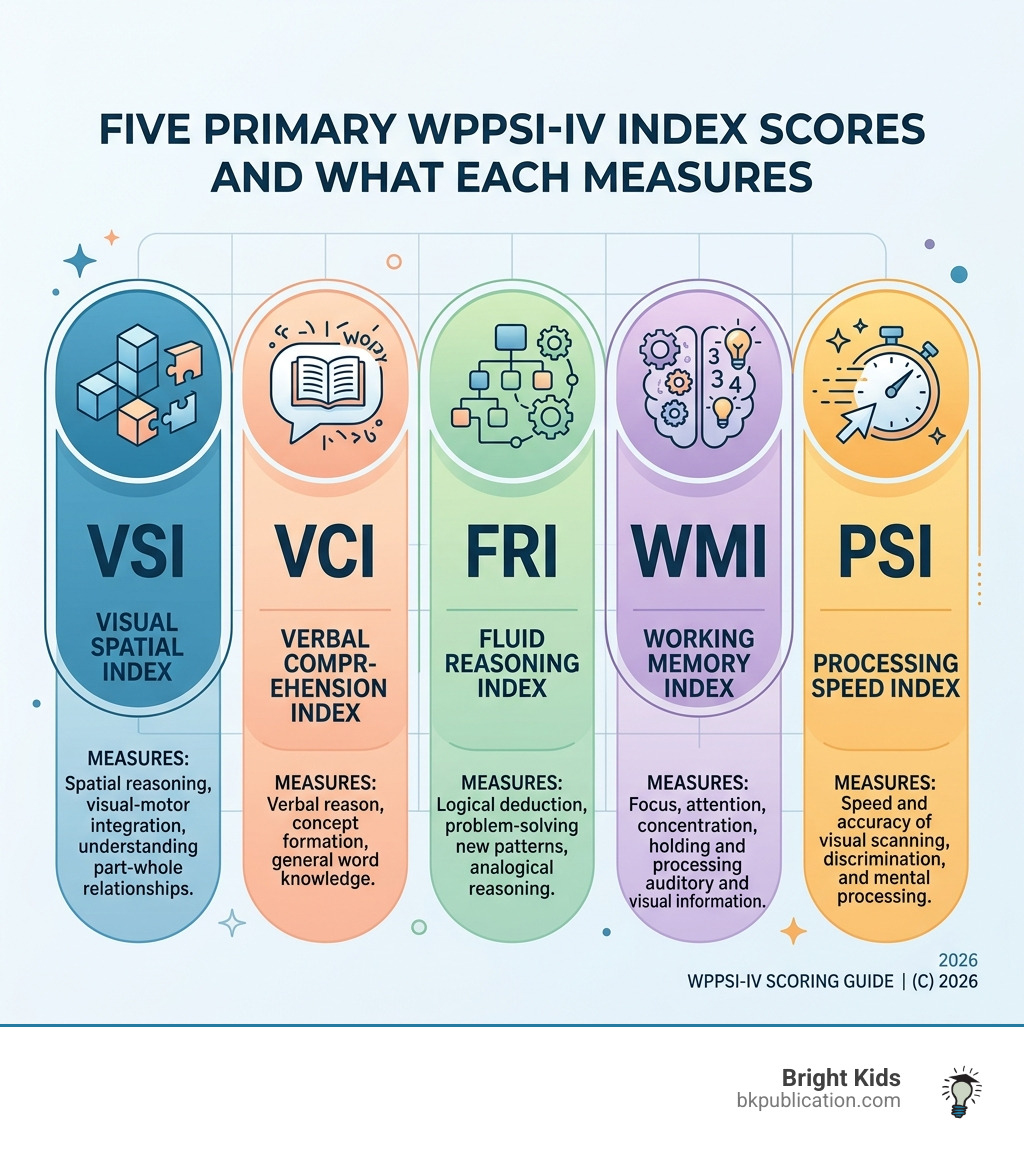
WPPSI visual spatial prep is one of the most impactful ways parents can help their preschooler build the specific skills tested on the WPPSI-IV's Visual Spatial Index (VSI).
Here's a quick snapshot of what to know and do:
| What You Need | Details |
|---|---|
| What is the VSI? | A primary WPPSI-IV index measuring spatial processing, visual-motor integration, and part-whole relationships |
| Key subtests | Block Design (core) and Object Assembly (supplemental) |
| Target score range | High Average = 110-119; score of 118 = 88th percentile |
| Best prep activities | Block play, puzzles, tangrams, Legos, attribute blocks |
| Recommended prep time | 15 minutes daily over 1-6 months before testing |
| Best resources | Skill-building bundles like the Ages 4-5 WPPSI Test Prep Bundle (1,584 activities) |
The WPPSI-IV is used widely in 2026 for gifted program screenings and private school admissions across the country. For children ages 4 to 7, it measures five cognitive areas — and the Visual Spatial Index is often where strong thinkers shine brightest.
A child who loves building with blocks, constructing Lego sets, or solving puzzles already has the instincts that the VSI rewards. The goal of prep isn't to teach the test — it's to develop the underlying skills so your child walks in confident and ready.
I'm Bige Doruk, founder of Bright Kids and a Harvard MBA with nearly two decades of experience helping over 10,000 students excel on assessments — including targeted WPPSI visual spatial prep for gifted and private school admissions. In the sections below, I'll walk you through exactly how the VSI works, what the scores mean, and how to build your child's spatial skills at home.
Understanding the Visual Spatial Index (VSI)
In our 17 years of experience at Bright Kids, we have found that the Visual Spatial Index is often the most "fun" part of the test for children, yet it requires a high level of cognitive sophistication. The VSI evaluates a child's ability to understand visual details, organize information in space, and comprehend how parts fit together to form a whole.
When we talk about spatial processing, we are looking at how a child's brain interprets the location and relationship of objects. This involves visual-motor integration—the "hand-eye" coordination required to physically manipulate objects based on what the eyes see. For a four-year-old, this might look like recreating a geometric design using red and white blocks or putting together a puzzle without seeing the final picture first.
To help you understand where your child stands, the WPPSI-IV uses a standardized scoring system. Here is a breakdown of how these scores are classified:
| Score Range | Classification | Percentile Rank |
|---|---|---|
| 130 and above | Very Superior | 98th+ |
| 120–129 | Superior | 91st–97th |
| 110–119 | High Average | 75th–90th |
| 90–109 | Average | 25th–73rd |
| 80–89 | Low Average | 9th–23rd |
| 70–79 | Borderline | 2nd–8th |
| Below 70 | Extremely Low | Below 2nd |
Core Subtests: Block Design and Object Assembly
The VSI is primarily derived from two key tasks: Block Design and Object Assembly. According to the WPPSI-IV Assessment Guide, these subtests are designed to be engaging but increasingly challenging.
- Block Design: This is the "gold standard" of spatial testing. Your child is shown a 2D image of a pattern and must recreate it using 3D blocks within a specific time limit. This requires abstract synthesis—the ability to look at a whole design, break it down into its component parts (mental rotation), and then physically build it.
- Object Assembly: Often used as a supplemental or substitute subtest, this involves puzzles. However, unlike the puzzles at home, the child often doesn't have a "box cover" to look at. They must use their understanding of part-whole relationships to figure out how the pieces fit together to form a recognizable object, such as a car or a tree.
Interpreting Scores for WPPSI Visual Spatial Prep
When you receive a test report, the numbers can feel overwhelming. Let's look at a real-world example. A child named Charlie scored a 118 on his Visual Spatial Index. This puts him in the High Average range, specifically at the 88th percentile.
What does a 118 mean? It indicates that Charlie is significantly better at spatial tasks than 88% of his peers. In Charlie’s case, this was a "standout strength" because his Verbal Comprehension score was only in the 25th percentile. This 2.2% base rate difference suggests Charlie is a "visual thinker." He might struggle to explain a concept in words, but he can build a complex structure with ease. Recognizing these score discrepancies is vital because it tells us to lean into a child's strengths while supporting their growth areas.
How Visual Spatial Skills Impact Learning and Academics

We often call a child with high VSI scores a "Lego brain." These children don't just play; they engineer. They can visualize how a map works, they sense physical boundaries naturally, and they often excel in early math foundations.
In the classroom, visual-spatial skills are the silent engine behind many academic tasks:
- Mathematics: Understanding place value, geometry, and even basic "greater than/less than" concepts requires a sense of number alignment in space.
- Reading Pacing: Keeping your place on a page and moving your eyes from left to right is a spatial skill. Children with VSI weaknesses might skip lines or struggle with the "tracking" required for fluent reading.
- Organization: Knowing how to organize a desk or a backpack involves spatial awareness.
- Physical Boundaries: High VSI helps children navigate "body boundaries," meaning they are less likely to accidentally bump into peers in line or struggle with personal space.
Relationship to Fluid Reasoning and Processing Speed
The VSI doesn't exist in a vacuum. It is closely related to the Nonverbal Index (NVI), which estimates overall ability for children who might have language delays. It also interacts with Fluid Reasoning (FRI)—the ability to solve new problems—and Processing Speed (PSI).
If a child has high spatial skills but low processing speed, they might know exactly how to solve a block puzzle but take longer to physically move the pieces. Conversely, a child with high WPPSI Spatial Skills Practice and strong working memory can hold a complex visual pattern in their head while they search for the right block, leading to much higher efficiency.
Effective Strategies for wppsi visual spatial prep
Preparation for the WPPSI shouldn't feel like "school." It should feel like play with a purpose. When we design wppsi visual spatial prep plans at Bright Kids, we focus on three pillars: pattern recognition, mental manipulation, and motor coordination.
To see real results, we recommend a 1-6 month timeline with consistent, daily 15-minute sessions. This "short and sweet" approach prevents fatigue and keeps the child excited.
- Attribute Blocks: Use these to teach your child about shapes, colors, and sizes. Ask them to "find the large red triangle" or "group all the thin blue squares." This builds the foundational visual discrimination needed for Block Design.
- Building Thinking Skills®: This is a fantastic resource for developing the logic behind spatial tasks. It moves from simple matching to complex pattern completion.
- Pattern Cards: Create or buy cards that show a design. Have your child recreate it using blocks, then ask them to "rotate" the design 90 degrees. This builds the mental rotation skills that are essential for higher-level subtests.
Building Spatial Awareness at Home
You don't always need a workbook for wppsi visual spatial prep. Some of the best "training" happens in the living room or out in the community.
- Tangrams and 3D Puzzles: These are excellent for practicing part-whole relationships. Tangrams, in particular, force a child to see how two triangles can form a square.
- Supervised Community Conversations: As noted in the Wechsler Scale Overview, language can sometimes "mask" or "hinder" spatial performance if a child doesn't understand the instructions. Practice giving your child spatial directions at the grocery store: "Look for the box on the bottom shelf, to the left of the cereal."
- Visual-Motor Coordination: Activities like catching a baseball or even tying shoes reinforce the connection between what the eyes see and what the hands do.
Recommended Resources and Bundles for WPPSI Visual Spatial Prep
At Bright Kids, we believe in using materials that mimic the "look and feel" of the actual assessment. Our Ages 4-5 WPPSI Test Prep Bundle is a powerhouse of 1,584 activities. It includes specific sections on Block Design and Object Assembly that use colorful, engaging stimuli to keep children focused.
We suggest starting with a pre-test assessment. This allows you to identify if your child is already a "Lego brain" (scoring in the High Average range) or if they need more foundational support in visual-motor integration. By targeting the areas where they struggle—and skipping the ones they've mastered—you make the most of your prep time.
Frequently Asked Questions about Visual Spatial Testing
How much time should parents spend on visual spatial practice?
Consistency is more important than duration. We recommend about 15 minutes a day. If you start 3 to 6 months before the test, your child will have plenty of time to internalize these skills without feeling pressured. For a "crash course" (2 weeks before the test), you might increase this to two 15-minute sessions, but always keep it game-like.
Can language delays affect a child's visual spatial score?
Yes. Although the VSI is a nonverbal index, the instructions are delivered orally. If a child has a receptive language delay, they might not fully understand the task (e.g., "Make yours look exactly like mine"). This is why we encourage parents to practice following multi-step directions during their wppsi visual spatial prep.
What does a High Average VSI score of 118 mean for school admissions?
In competitive markets like New York City or Chicago, a score of 118 (88th percentile) is very strong. It signals to admissions officers that the child has a high capacity for "hands-on" learning, engineering, and mathematical thinking. It can often offset an "Average" score in other areas, showing that the child has specific cognitive talents.
Conclusion
The WPPSI-IV is more than just a hurdle for school admissions; it is a cognitive snapshot that helps us understand how a child's mind works. By focusing on wppsi visual spatial prep, you aren't just helping your child get a higher score—you are giving them the tools for long-term academic success. Spatial thinking is the foundation for STEM fields, artistic expression, and daily problem-solving.
Whether your child is already a master builder or needs a little help seeing how the pieces fit together, the right resources and a bit of daily play can make all the difference. Start your child's prep today and watch their confidence—and their "Lego brain"—grow.