

Cogat Test Prep: Everything You Need to Know
Jul 15, 2026
What Parents Need to Know About CogAT Test Prep
CogAT test prep is the process of helping your child get familiar with the Cognitive Abilities Test — a reasoning assessment used by schools across the U.S. to identify students for gifted and talented programs.
Here's a quick snapshot of what effective CogAT prep looks like:
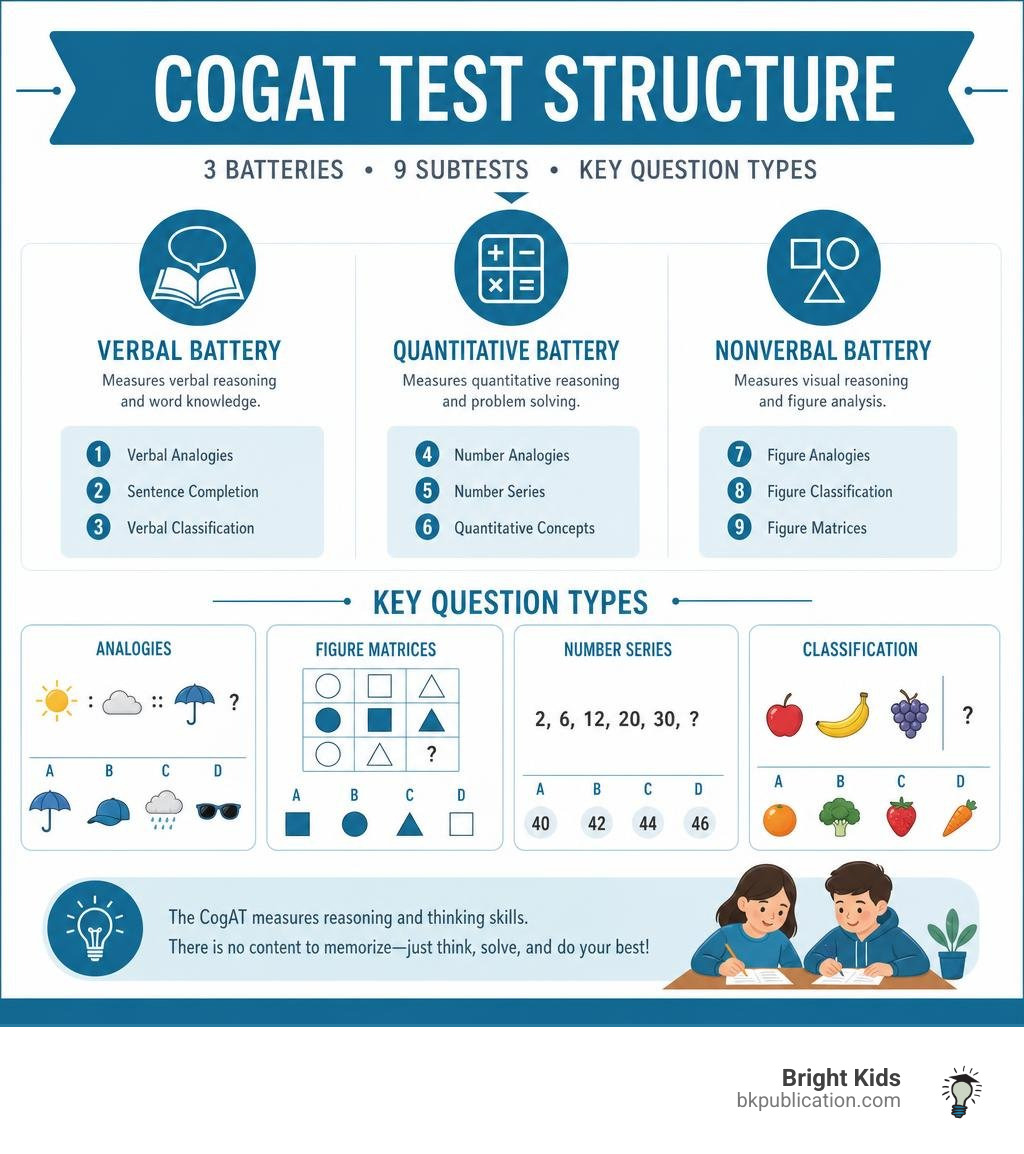
- Understand the test format — The CogAT has three batteries: Verbal, Quantitative, and Nonverbal
- Practice question types — Analogies, figure matrices, number series, and more
- Build reasoning skills — Not memorization, but pattern recognition and logical thinking
- Start 4–8 weeks before the test — Shorter for younger kids, longer for advanced prep
- Use timed practice — Students often have less than a minute per question
- Review mistakes — Ask your child to explain their reasoning out loud
The CogAT is not a subject knowledge test. There's no content to memorize. That makes prep feel unfamiliar at first — but it also means the right preparation strategy can make a real difference.
Schools use CogAT scores to make placement decisions for gifted programs, so the stakes can feel high. But the good news is that with the right approach, most children can improve their comfort, speed, and accuracy on this test — without stress or burnout.
I'm Bige Doruk, founder of Bright Kids, and over nearly two decades I've helped more than 10,000 students with CogAT test prep and other gifted and admissions assessments. The strategies in this guide reflect what actually works for real families — not just theory.
What is the CogAT and How Do Schools Use It?
The Cognitive Abilities Test (CogAT) is a standardized, group-administered assessment designed to evaluate a student's learned reasoning abilities. Originally developed in 1954 as the Lorge-Thorndike Intelligence Test, the modern CogAT focuses on measuring cognitive development and academic potential rather than specific classroom curriculum.
While a traditional classroom test might ask your child to multiply fractions or identify a state capital, the CogAT asks them to find patterns in geometric shapes, solve visual puzzles, and determine logical relationships between words.
School districts across our primary service areas—including New York, Connecticut, Miami, Orlando, Chicago, Fairfax, Dallas, Houston, Denver, Seattle, Los Angeles, and San Francisco—rely heavily on the CogAT to identify candidates for gifted and talented (G&T) programs. Because the test measures how a student processes information, reasons through novel problems, and finds connections, educators view it as a reliable indicator of how well a student will perform in highly accelerated academic environments.
Preparing for this type of test requires a unique approach. It is not about cramming facts; it is about training the brain to recognize logical structures quickly and efficiently. At Bright Kids, we have spent 17 years developing targeted curricula that mirror these exact reasoning challenges. By combining high-quality practice materials with personalized instruction, we help students build the confidence and mental flexibility needed to excel. If you are looking to give your child an edge, explore our specialized Bright Kids Tutoring Services.
Understanding the Core Batteries
The CogAT is divided into three distinct sections, known as "batteries." Each battery focuses on a different modality of reasoning, ensuring that the test evaluates a broad spectrum of cognitive talents:
- The Verbal Battery: This section measures a student's ability to understand word relationships, analyze verbal patterns, and perform logical thinking using language. It includes subtests like Verbal Analogies, Sentence Completion, and Verbal Classification. Developing a strong vocabulary and critical thinking skills is vital to mastering this battery.
- The Quantitative Battery: This battery evaluates mathematical reasoning and numerical problem-solving. Instead of testing arithmetic speed, it assesses the student's understanding of quantitative relationships through Number Analogies, Number Series, and Number Puzzles.
- The Nonverbal Battery: This section relies entirely on geometric shapes and figures, making it highly spatial and abstract. Because it requires no reading or language skills, it is often considered the fairest measure of cognitive potential for English language learners. The subtests include Figure Classification, Paper Folding, and Figure Matrices. To help your child master these visual-spatial puzzles, you can practice with our targeted cogat figure matrices exercises.
CogAT Structure by Grade Level
The structure, format, and pacing of the CogAT vary significantly depending on the student's grade level. The test is divided into different "Levels" that correspond roughly to the student's age and grade:
- Primary Levels (Kindergarten through Grade 2 / Levels 5/6, 7, and 8): At these early levels, the test is highly visual and interactive. To accommodate developing reading skills, proctors read instructions aloud, and the questions rely almost entirely on pictures and geometric shapes. For example, a 2nd-grade test consists of approximately 154 questions, and the exam takes roughly 90 minutes to 2 hours depending on the proctor's pacing.
- Multilevel Batteries (Grades 3 through 12 / Levels 9 through 17/18): Starting in third grade, the proctor no longer reads questions aloud. Students must read and solve the problems independently. The questions transition from pictures to written words, abstract numbers, and complex spatial relationships.
- Middle & High School Levels (Levels 13 through 18): Designed for older students, these levels feature highly sophisticated logic puzzles, algebraic pattern recognition, and multi-step spatial manipulations. If you have an older student preparing for these advanced assessments, you can read our detailed guide on high school cogat levels 13 18 or explore specialized Grade 7/8 prep workbooks.
Effective CogAT Test Prep vs. Traditional Test Prep
Many parents approach CogAT test prep the same way they would prepare a child for a spelling test or a math quiz. This is a common mistake. Traditional achievement tests measure what a student has already learned (content retention), while cognitive tests like the CogAT measure how a student thinks (reasoning capacity).
Because of this fundamental difference, traditional "cramming" or rote memorization will not work. Effective preparation must focus on pattern recognition, logical deduction, and spatial visualization.
| Feature | Cognitive Tests (e.g., CogAT) | Achievement Tests (e.g., State Tests, MAP) |
|---|---|---|
| What it Measures | Reasoning, logic, and cognitive potential | Curriculum mastery and academic knowledge |
| Preparation Style | Pattern recognition, spatial training, logic games | Memorization, factual review, formula practice |
| Question Format | Abstract analogies, matrices, paper folding | Multiple choice reading, arithmetic, science facts |
| Goal of Practice | Familiarity with formats, reducing test anxiety | Learning and retaining academic subject matter |
By practicing with realistic question formats, students close the "format-unfamiliarity gap." Many bright children score poorly on the CogAT simply because they have never encountered a matrix or a paper-folding puzzle before. Practicing eliminates the shock factor, allowing their true cognitive potential to shine through on test day. To help your child get comfortable with these unique formats, check out our cogat practice test questions guide 2026.
How to Build a Balanced CogAT Test Prep Plan at Home

Preparing for a cognitive assessment should never feel like a chore. The goal is to build a consistent, low-stress routine that keeps your child engaged and curious. Over-prepping or creating a high-pressure environment can lead to test anxiety, which ultimately hurts performance.
We recommend a structured preparation window of 4 to 8 weeks leading up to the test. Here is a simple, step-by-step timeline you can follow at home:
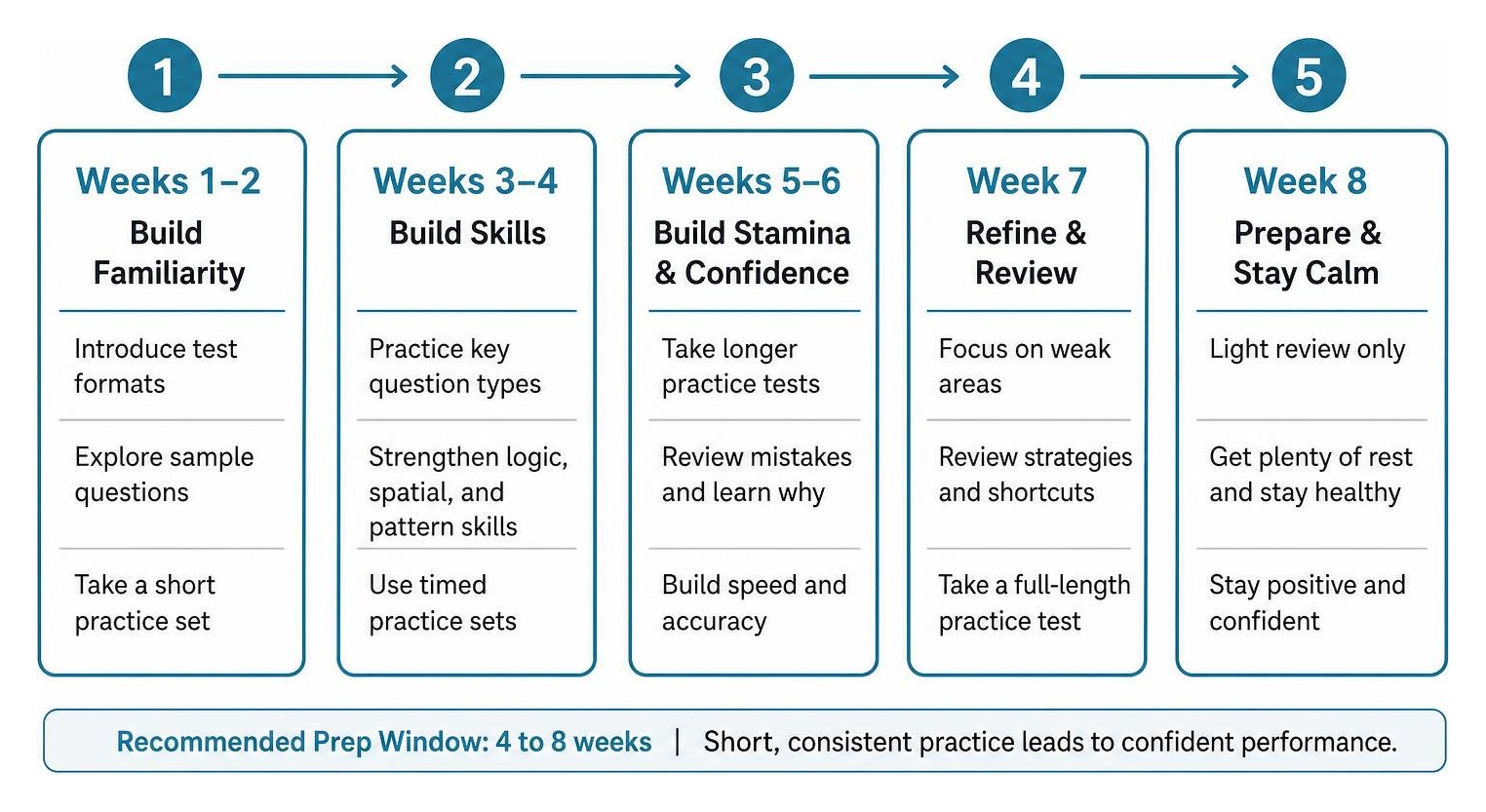
To keep preparation balanced and effective, keep these strategies in mind:
- Keep sessions short and sweet: For younger students (K-2), limit practice to 10–15 minutes daily. For older students, 30–45 minutes is the sweet spot.
- Incorporate physical games: Play family board games that require logic and strategy (like Chess, Checkers, Qwirkle, or Rush Hour). These build the same spatial and logical muscles tested on the CogAT.
- Reduce test anxiety: Avoid calling it an "intelligence test" or a "gifted test." Instead, refer to it as a "brain game day" or a "puzzle challenge." Reassure your child that their only job is to do their best and have fun solving the puzzles.
- Use high-quality resources: Ensure your practice materials closely match the style and difficulty of the actual exam. Explore our curated selection of Bright Kids Test Prep Resources to find the perfect fit for your child's grade level.
Verbal and Quantitative cogat test prep Strategies
To help your child excel on the Verbal and Quantitative batteries, teach them to use systematic problem-solving strategies rather than guessing:
- For Verbal Analogies: Teach your child to explicitly state the relationship between the first pair of words before looking at the answer choices. For example, if the pair is honey : bee, they should say, "Honey is made by a bee." Then, they apply that exact sentence to the next word: "Wool is made by a... [sheep]."
- For Sentence Completion: Encourage your child to read the entire sentence with a blank space and predict the missing word before reading the multiple-choice options. This prevents them from getting confused by distracting, partially correct answers. You can practice this skill with our cogat sentence completion practice.
- For Number Series: Teach your child to look at the relationship between consecutive numbers first. Are the numbers increasing or decreasing? By how much? Identifying whether the sequence adds, subtracts, multiplies, or alternates is key. Practice these numerical patterns with our cogat number series exercises.
Nonverbal and Spatial cogat test prep Tactics
The Nonverbal Battery can be the most intimidating section because it is entirely visual. However, it is also the easiest section to improve with targeted strategies:
- For Figure Classification: Help your child look for shared attributes among the shapes. Ask questions like: Are they all shaded? Do they all have the same number of sides? Are they all pointing in a certain direction?
- For Paper Folding: This subtest simulates folding a piece of paper, punching a hole in it, and determining what it will look like when unfolded. The best way to teach this is with real paper! Grab a square piece of paper, fold it, punch a hole with a pencil, and let your child unfold it. This hands-on practice builds the mental muscle needed to visualize the steps abstractly on the test.
- For Figure Matrices: Teach your child to analyze the matrix both horizontally and vertically. They should ask: What rule is being applied to change the top-left shape into the top-right shape? Is it rotating, changing color, growing, or shrinking? Apply that exact same rule to the bottom shape to find the answer.
Understanding and Interpreting CogAT Scores
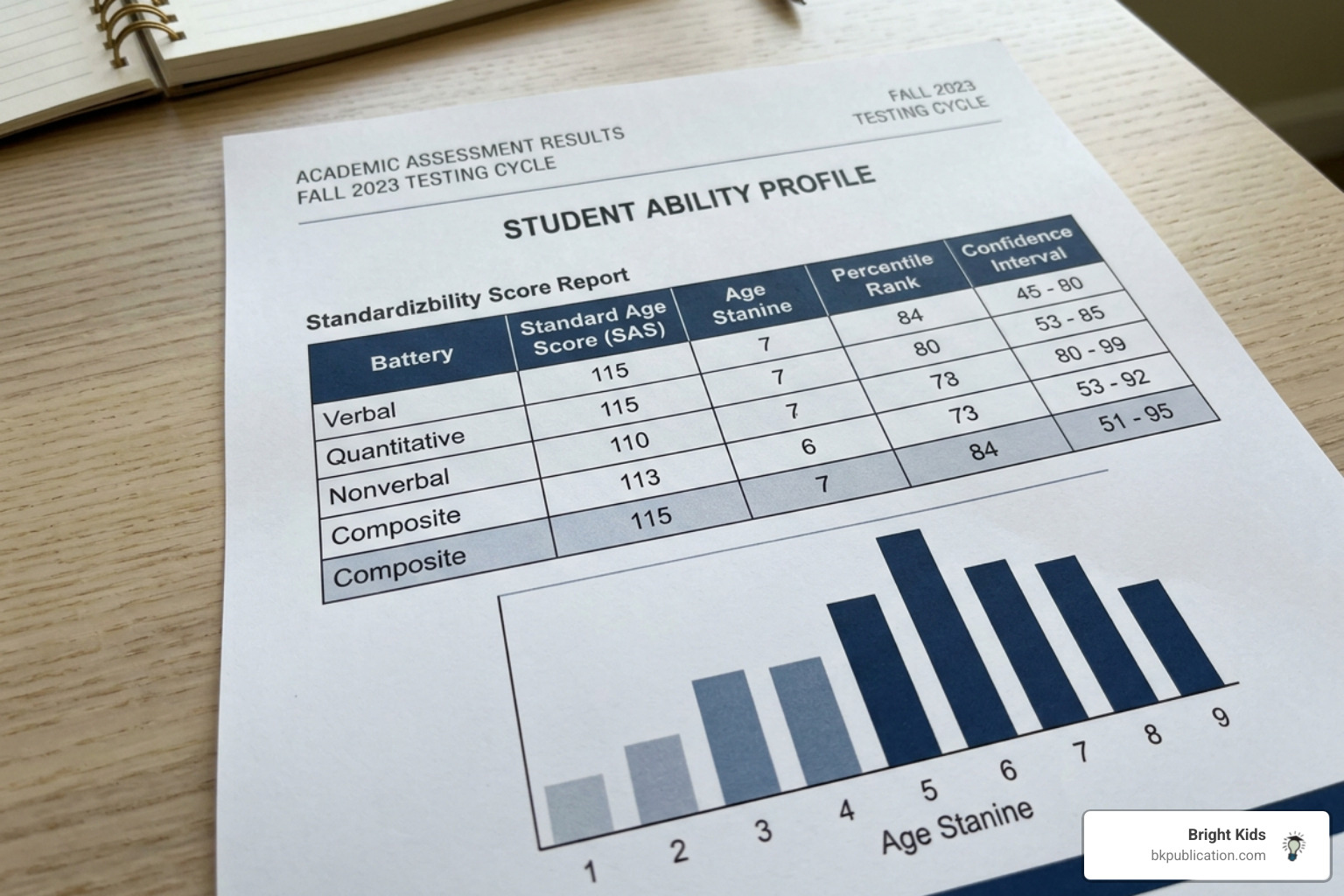
Once your child completes the CogAT, you will receive a score report that can look incredibly confusing. Unlike school tests that give a simple letter grade or percentage, the CogAT uses several comparative metrics:
- Standard Age Score (SAS): This is a normalized score with a mean of 100 and a standard deviation of 16. An SAS of 100 represents average performance for a child's exact age group. A score of 120 to 129 is above average, and a score of 130 or higher is considered very advanced.
- Percentile Rank (PR): This score compares your child to a national sample of students in the same age group. For example, a Percentile Rank of 95 means your child scored higher than 95% of their same-age peers.
- Stanine Scores: Stanines are simplified scores ranging from 1 to 9, with 5 being average. Stanines 7 and 8 are above average, while Stanine 9 represents the top 4% of students nationally (the 96th to 99th percentiles). Most selective gifted and talented programs require a Stanine of 9 in at least one battery for admission.
- Score Profile: The report will also feature a code (like "8E" or "9A") that describes your child’s reasoning profile. This indicates whether their abilities are balanced across all three batteries (represented by "A" for active/balanced) or if they have a relative strength or weakness in one specific area (represented by "V", "Q", or "N").
Understanding these scores helps you and your child's teachers tailor future instruction to their unique cognitive strengths.
Frequently Asked Questions about CogAT Prep
Are commercial CogAT prep programs worth the cost?
Many parents wonder if they should invest in structured prep programs or if free online practice materials are sufficient. While free sample questions are excellent for an initial introduction, they are rarely comprehensive enough for thorough preparation.
High-quality commercial programs and targeted workbook packages provide hundreds of realistic questions, detailed answer explanations, and timed simulations that accurately mimic the actual test environment. If your goal is to qualify for a highly competitive gifted program, investing in comprehensive, expert-designed practice materials and professional tutoring is highly effective. It ensures your child practices with accurate formatting and receives the strategic guidance they need to succeed.
What is a good CogAT score for gifted programs?
The score required for gifted eligibility varies by school district. However, as a general rule of thumb:
- Most standard gifted programs look for a Percentile Rank of 90th percentile or higher (an SAS of 120+).
- Highly selective, accelerated academies often require scores in the 97th to 99th percentile (Stanine 9, or an SAS of 132+).
Always check with your local school district to confirm their specific admission criteria, as some districts also factor in classroom grades, teacher recommendations, and achievement test scores.
How long should a child prepare for the CogAT?
A preparation window of 4 to 8 weeks is ideal for most students. This timeline allows you to introduce the question formats slowly, practice reasoning strategies, and build test-taking stamina without overwhelming your child.
- 2 to 3 weeks of light familiarity is usually enough to reduce test anxiety and teach basic formats.
- 1 to 2 months of structured practice is recommended if your child needs to build specific reasoning skills, improve their speed, or master advanced spatial concepts.
Conclusion
At Bright Kids, we believe that CogAT test prep is about far more than just qualifying for a gifted program. By introducing your child to spatial reasoning, logical deduction, and verbal analogies, you are helping them build critical thinking skills that will benefit them throughout their entire academic journey.
With the right balance of fun, structured practice, and positive reinforcement, your child can walk into test day feeling confident, relaxed, and ready to shine. To take the next step in supporting your child's academic journey, explore our comprehensive Gifted Child Test Prep programs today!