

A – Z Guide to The Digital SAT's Impact
Jun 01, 2026
How Has the Digital SAT Redefined Standardized Testing?
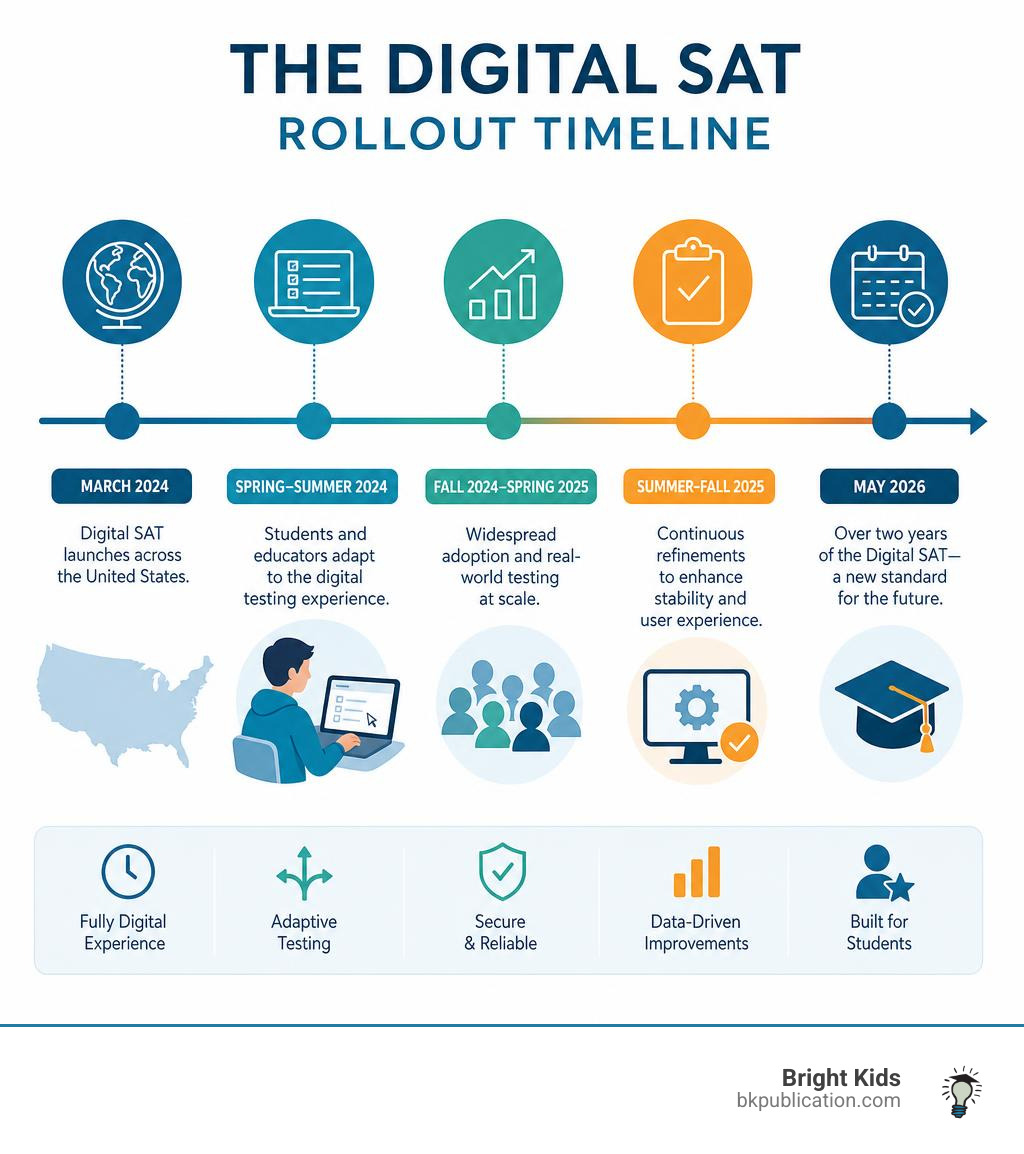
Standardized testing underwent its most radical evolution in nearly a century when the College Board retired the traditional paper-and-pencil SAT, replacing it with a fully digital, adaptive format. This transition, which launched internationally in 2023 and rolled out across the United States in March 2024, has now been active for over two years. As we assess the landscape in May 2026, the initial technical anxiety has largely subsided, replaced by a deeper understanding of how the digital exam actually functions under real-world conditions.
When the digital format was first introduced, early pilots generated overwhelmingly positive feedback. According to data released by the College Board, 80% of students in the November 2021 pilot found the digital SAT to be significantly less stressful than the paper-and-pencil version. Furthermore, 100% of educators participating in the pilot reported a positive administrative experience.
The elimination of physical test booklets, the transition away from manual bubble sheets, and the introduction of a streamlined interface were widely praised. However, as hundreds of thousands of students have now navigated the platform, we have learned that a "less stressful" testing environment does not automatically translate to an easier path to an elite score.
The Shift from Paper to Pixels
The most obvious change is the physical footprint of the exam. The Digital SAT is substantially shorter than its predecessor, lasting 2 hours and 14 minutes compared to the previous 3-hour paper test. The total number of questions was reduced by roughly 36%, dropping from 154 questions down to 98.
Additionally, the Reading and Writing section abandoned the long, multi-paragraph passages that required students to answer 10 to 11 questions per text. Instead, students now face short, single-paragraph passages (ranging from 25 to 150 words) with exactly one question per passage.
While this layout appeals to students who struggled with the stamina required for longer texts, it introduces a unique challenge: rapid context switching. Rather than settling into a single historical speech or scientific passage for fifteen minutes, students must constantly adapt their mindset from poetry to data analysis to grammar rules with every single click of the "Next" button.
To understand these structural differences in greater detail, students can explore resources like the Digital SAT vs Paper SAT: Key Differences Every Student Must Know and The New Digital SAT: Changes, Format, and Transition in 2024.
How Bright Kids Helps Families Navigate the Digital Shift
At Bright Kids, our 17-year legacy of helping families navigate competitive admissions across New York City and nationwide has taught us that structural testing changes always require a corresponding shift in preparation strategy. While the College Board’s marketing emphasizes a friendlier testing experience, our role is to ensure that students are prepared for the rigorous reality of the adaptive algorithm.
Through our custom-designed test preparation publications and targeted one-on-one tutoring, we teach students how to manage the unique cognitive demands of the digital interface. We focus not just on content mastery, but on building the digital stamina, interface familiarity, and pacing strategies required to secure top-tier scores in this new testing era.
Have Average SAT Scores Dipped Since the Digital Transition?
One of the most frequent questions we receive from parents in our offices from New York to San Francisco is whether the transition to the digital format has caused a decline in average SAT scores. Historically, major shifts in standardized testing formats have been accompanied by temporary score volatility. However, the data gathered over the last two years reveals a more nuanced reality.
According to cumulative data, average SAT scores have remained remarkably stable throughout the transition. The College Board’s extensive concordance studies confirmed that the digital and paper versions are statistically equivalent, meaning a score of 1200 on the paper test represents the same level of academic achievement as a 1200 on the digital exam. Because the test is scored on the same 400–1600 scale, admissions offices have been able to compare scores across formats without needing complex conversion tables.
To contextualize these scores, it is helpful to look at the broader educational trends that were already underway prior to 2024. Standardized test scores nationally had been experiencing a gradual downward trend, while high school grade point averages (GPAs) were rising. For instance, the share of U.S. students graduating with an "A" average grew from 39% in 1998 to 55% in 2021.
When analyzing score trends, it is crucial to separate the impact of the digital transition from these pre-existing demographic and educational shifts. In statewide testing programs where the digital transition was paired with changes in graduation requirements, overall participation rates fluctuated, which naturally impacted state-level score averages. However, for individual students testing in major metropolitan areas, the scoring standard itself has remained highly consistent. For more details on the initial rollout and its structural goals, see the Digital SAT Brings Student-Friendly Changes to Test Experience.
Analyzing the Score Data
The statistical equivalence between the paper and digital formats is maintained through a process called equating. Equating ensures that scores are comparable across different test administrations and different test forms, even when the specific questions vary in difficulty.
Because the Digital SAT is section-adaptive, the test adjusts its difficulty based on student performance. This design has led to a common misconception: many students assume that if they receive a particularly difficult second module, their score will suffer.
In reality, the equating process accounts for this difficulty. A student who faces a highly challenging second module requires fewer correct answers to achieve the same scaled score as a student who faces an easier module. This distinction between perceived difficulty and actual scaled scoring is critical for students to understand so they do not lose confidence during the exam. For a deeper look at how this transition unfolded over its first year, read The Digital SAT One Year In - The Grand Island Independent.
How Colleges and Admissions Offices Have Responded
Colleges and university admissions offices have adapted smoothly to the Digital SAT, treating digital scores as fully equivalent to their paper predecessors. However, the broader admissions landscape has shifted significantly over the last two years. While the pandemic prompted a massive wave of test-optional policies, we have seen a noticeable trend of elite institutions reinstating standardized testing requirements.
By 2026, major universities—including MIT, several Ivy League institutions, and prominent state university systems—have returned to requiring standardized test scores. These institutions have noted that high school GPAs alone, due to grade inflation, are no longer sufficient to predict academic success accurately.
Even at the more than 1,800 colleges that maintain test-optional policies, submitting a strong SAT score remains a powerful differentiator. This reality is reflected in student preferences: survey data shows that 83% of students want the option to submit standardized test scores with their college applications, recognizing that a strong score can bolster an otherwise average academic profile.
How Do Shorter Formats and Adaptive Modules Affect the Student Experience?
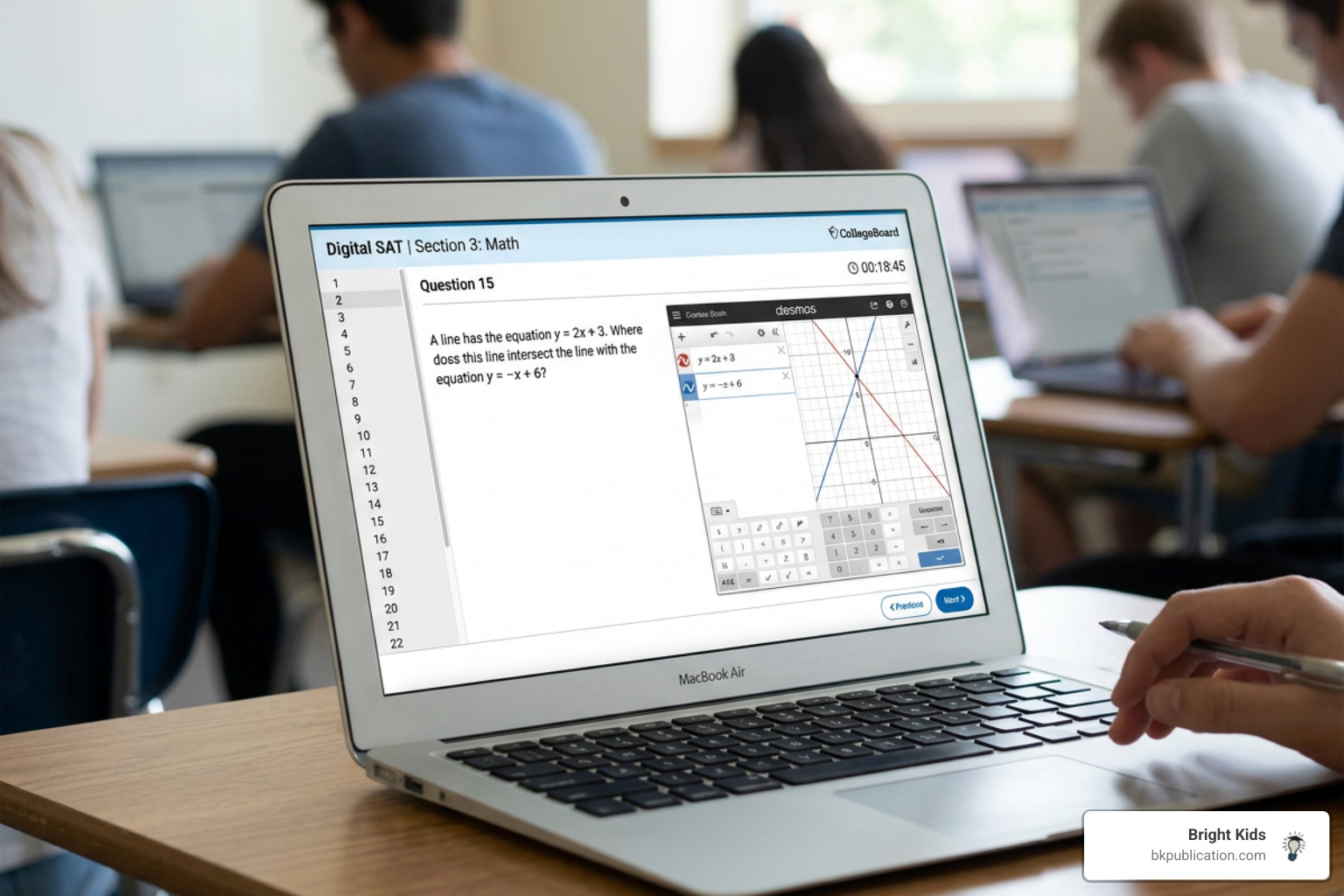
While the overall scoring scale remains unchanged, the day-to-day student experience of taking the SAT has been completely rewritten by the computer-adaptive format. The Digital SAT utilizes a multi-stage adaptive design for both the Reading and Writing section and the Math section. Each section is divided into two modules.
Every student begins with Module 1, which contains a broad mix of easy, medium, and hard questions. The student's performance on this first module determines the difficulty level of Module 2.
This adaptive routing creates a "double-edged sword." If a student performs well on Module 1, they are routed to the harder version of Module 2. This harder module unlocks the highest possible score bands, allowing them to score up to an 800 on that section.
Conversely, if a student struggles on Module 1, they are routed to the easier version of Module 2. While this easier module may feel less stressful, it places a strict score ceiling on the student's results. A student routed to the easier Module 2 is mathematically capped and cannot score above approximately 1300 to 1400 overall, regardless of whether they answer every single question in Module 2 correctly.
The Adaptive Testing Double-Edged Sword
This routing mechanism places immense psychological pressure on Module 1. Under the old paper format, students could afford a slow start, warming up as they progressed through the exam. On the Digital SAT, early mistakes in Module 1 are highly punitive.
Prioritizing accuracy on the first module is the single most important strategic adjustment a student can make. This dynamic has changed how we train students at Bright Kids; we place an intense focus on early-stage accuracy and pacing to ensure our students consistently qualify for the advanced modules.
Furthermore, managing the psychological pressure of the adaptive format is a skill in itself. Students often find themselves trying to "diagnose" their performance mid-test, worrying about whether their second module feels "too easy" or "too hard." We coach our students to ignore these internal distractions and treat every question as an isolated scoring opportunity.
The Reality of Desmos and Math Module 2
One of the most popular features of the Digital SAT is the integration of the Desmos graphing calculator directly into the Bluebook testing application, available for use on the entire Math section. In the first year of the digital rollout, many test-prep forums suggested that mastering Desmos "shortcuts" was a viable substitute for traditional algebraic problem-solving.
However, as the test has matured, the College Board has actively adjusted its question design to counter over-reliance on the calculator. As observed in recent administrations, including the March and May 2026 exams, the math sections now feature a higher density of questions utilizing algebraic variables instead of concrete numbers.
For example, instead of asking students to find the y-intercept of a specific quadratic equation, a question might ask for the relationship between variables a, b, and c in a system of equations. This shift makes it impossible to simply plug the equation into Desmos and read the answer off the graph.
Students must possess genuine conceptual understanding and algebraic fluency to solve these multi-step applied math problems. Relying on Desmos as a primary tool rather than a secondary verification method has become a dangerous trap for unprepared students.
Reading and Writing Strategy Shifts
The Reading and Writing section has seen its own share of strategic evolutions. Because the passages are short, students must develop rapid task-identification skills. They can no longer spend time mapping out a multi-page passage; instead, they must read the prompt first, identify the specific question family (e.g., main idea, scientific inference, or grammar convention), and then target the short text for that specific information.
We have also tracked a significant shift in the difficulty of transition questions. Historically, these questions tested simple transition words like however, therefore, or furthermore.
By May 2026, the College Board has increasingly replaced these single-word options with longer, more nuanced phrases of 5 to 10 words (such as "In contrast to this earlier hypothesis" or "To further illustrate this complex mechanism"). This evolution transforms transition questions from simple vocabulary matching into deep reading comprehension exercises.
Additionally, we have observed a steady rise in scientific study-design and data-analysis questions within the verbal section, requiring students to interpret charts and graphs while evaluating scientific hypotheses. For a detailed analysis of how these content shifts have manifested in recent exams, see Digital SAT · Live Coverage – The First SAT of 2026 Has Spoken. Here's Everything. and What was the Hardest SAT? — Franklin Yard.
What Impact Has the Digital SAT Had on Equity, Access, and Test Logistics?

Beyond the academic and strategic shifts, the digital transition has had a profound impact on the logistics of test administration, equity, and student access. One of the primary goals of the digital redesign was to make the exam more accessible to a broader, more diverse student population. Two years into the rollout, the results of these efforts are highly visible.
Bridging the Digital Divide
To ensure that the shift to digital testing did not disadvantage students without access to personal technology, the College Board implemented robust device-lending programs. Students who do not own a laptop or tablet can request a device from the College Board during registration, which is delivered directly to their testing site on test day.
Additionally, the Bluebook testing application was built with built-in safeguards for internet connectivity. If a student's internet connection drops mid-test, the application continues to run locally on the device without interrupting the exam. Once connection is re-established, the student's progress is securely uploaded to the cloud.
The expansion of School Day testing has also been a major driver of equity. In the class of 2021, 62% of students who took the SAT did so for free at their own school on a weekday, eliminating the logistical barriers of weekend transportation and test fees. By integrating the digital exam directly into school-day schedules across our key service areas, from New York to California, participation rates among historically underrepresented student populations have continued to rise.
Logistical Wins and Reporting Gaps
From an administrative standpoint, the Digital SAT has delivered several major victories. Test security has been vastly improved. Under the old paper system, a single leaked exam booklet could compromise an entire nationwide administration, forcing last-minute cancellations and score delays.
On the Digital SAT, the testing software utilizes a vast database of questions to generate a unique test form for every individual student. This makes cheating virtually impossible and ensures the integrity of the testing process.
Another major benefit is the speed of score reporting. Instead of waiting three to five weeks for paper bubble sheets to be shipped, scanned, and verified, students now receive their scores in approximately 13 days. This rapid turnaround allows families to make much faster, more informed decisions regarding retesting and college application timelines.
However, this streamlined reporting has come with a significant downside: the loss of detailed score feedback. The College Board discontinued the Question and Answer Service (QAS) for the digital exam.
Today, students receive only their overall section scores and broad, generalized feedback on their performance bands. This lack of granular data makes it incredibly difficult for students to identify their specific weaknesses, making targeted preparation for a retest far more challenging without professional guidance.
Frequently Asked Questions About the Digital SAT's Impact?
Is the Digital SAT easier to score high on than the paper version?
No. While the Digital SAT is shorter, features fewer questions, and generally offers a cleaner, less stressful testing environment, it is not objectively easier to achieve a high score. The exam is equated to ensure that a score on the digital test represents the exact same level of academic achievement as that same score on the paper version. The digital format rewards rapid task recognition, steady pacing, and efficient decision-making rather than rote memorization.
Can I get a top score if I am routed to the easier second module?
No. The adaptive routing of the Digital SAT places a strict mathematical ceiling on students who are routed to the easier version of Module 2. If you do not perform well enough on Module 1 to qualify for the harder Module 2, your score will be capped at approximately 1300 to 1400 overall, regardless of how well you perform on the second module. To achieve an elite score, maximizing accuracy on Module 1 is absolutely essential.
How quickly do students receive their Digital SAT scores?
One of the greatest logistical benefits of the digital transition is the speed of score reporting. Scores are typically returned to students within 13 days of their test administration, compared to the three to five weeks required for the old paper-and-pencil version. This rapid turnaround allows students to plan their academic timelines and retesting strategies with much greater precision.
What Are the Key Lessons for Future Test-Takers?
As we look back on the lessons learned since the launch of the Digital SAT, it is clear that navigating this exam successfully requires a modern, tech-forward approach to preparation. The old strategies of the paper-and-pencil era no longer apply. To achieve their full potential, future test-takers must adapt their study habits to align with the specific demands of the digital, adaptive format.
Actionable Prep Strategies
To succeed on the Digital SAT, students should integrate the following targeted strategies into their preparation plans:
- Simulate the Interface Early: Do not practice on paper. Students must download the College Board’s Bluebook application early in their preparation and practice navigating the actual digital interface. Learning how to use the built-in annotation tools, the line reader, the answer-elimination tool, and the question-flagging feature is critical for building test-day efficiency.
- Master the Newer Practice Tests: While the College Board offers multiple practice tests, the earliest releases do not fully reflect the current difficulty level of the exam. Newer practice materials, such as Bluebook Test 11, serve as the gold standard for predicting the actual difficulty, question structure, and adaptive routing of current administrations.
- Build Desmos Speed and Know When to Put It Away: Students should spend 2 to 3 hours specifically learning the most efficient graphing moves on the built-in Desmos calculator. However, they must also practice recognizing when a question is testing conceptual algebra rather than calculation, ensuring they do not waste time trying to force a calculator solution onto a variable-heavy problem.
- Prioritize Module 1 Accuracy: Because early mistakes are highly punitive under the adaptive algorithm, students should build specific drills focused on maximizing accuracy in Module 1. Training to treat the first half of each section with extreme care is the key to unlocking the harder Module 2 and securing an elite score.
- Supplement with High-Quality External Resources: Because the official practice tests can sometimes underestimate the difficulty of the harder Module 2, students should supplement their study with challenging, high-quality practice materials designed to mimic the unexpected difficulty spikes of real test administrations.
For students looking to optimize their preparation in specific metropolitan areas, exploring localized digital resources such as Digital SAT Preparation Online in San Francisco - Masterclass Space or the Best Digital SAT Prep in Dallas - Masterclas Space can provide valuable regional insights and support.
Partnering with Bright Kids for Proven Results
At Bright Kids, we understand that navigating the complexities of the Digital SAT can feel overwhelming for families. That is why we have spent the last two years refining our curriculum, analyzing real-world test data, and developing prep books that perfectly mimic the adaptive constraints of the Bluebook interface.
Our NYC-based tutoring programs, available both in-person and nationwide, are designed to help students build the academic foundation, digital fluency, and mental stamina required to excel on this exam. By combining our high-quality publications with personalized, strategic instruction, we ensure that our students are never surprised on test day.
Whether your student is aiming to break through the 1400 barrier or secure a perfect 1600, we are here to provide the expert guidance and trusted resources needed to achieve superior results. Contact us today to learn more about our publications and personalized tutoring programs at Bright Kids Publications.