

Brainstorming to Conclusions: Essential SSAT Essay Structure Tips
May 25, 2026
Why the SSAT Writing Sample Matters More Than You Think
SSAT essay structure tips can make a real difference in your child's private school application — even though the writing sample isn't scored. Here's a quick overview of what works:
Quick-Reference: SSAT Essay Structure Tips
| Essay Type | Structure | Time Split |
|---|---|---|
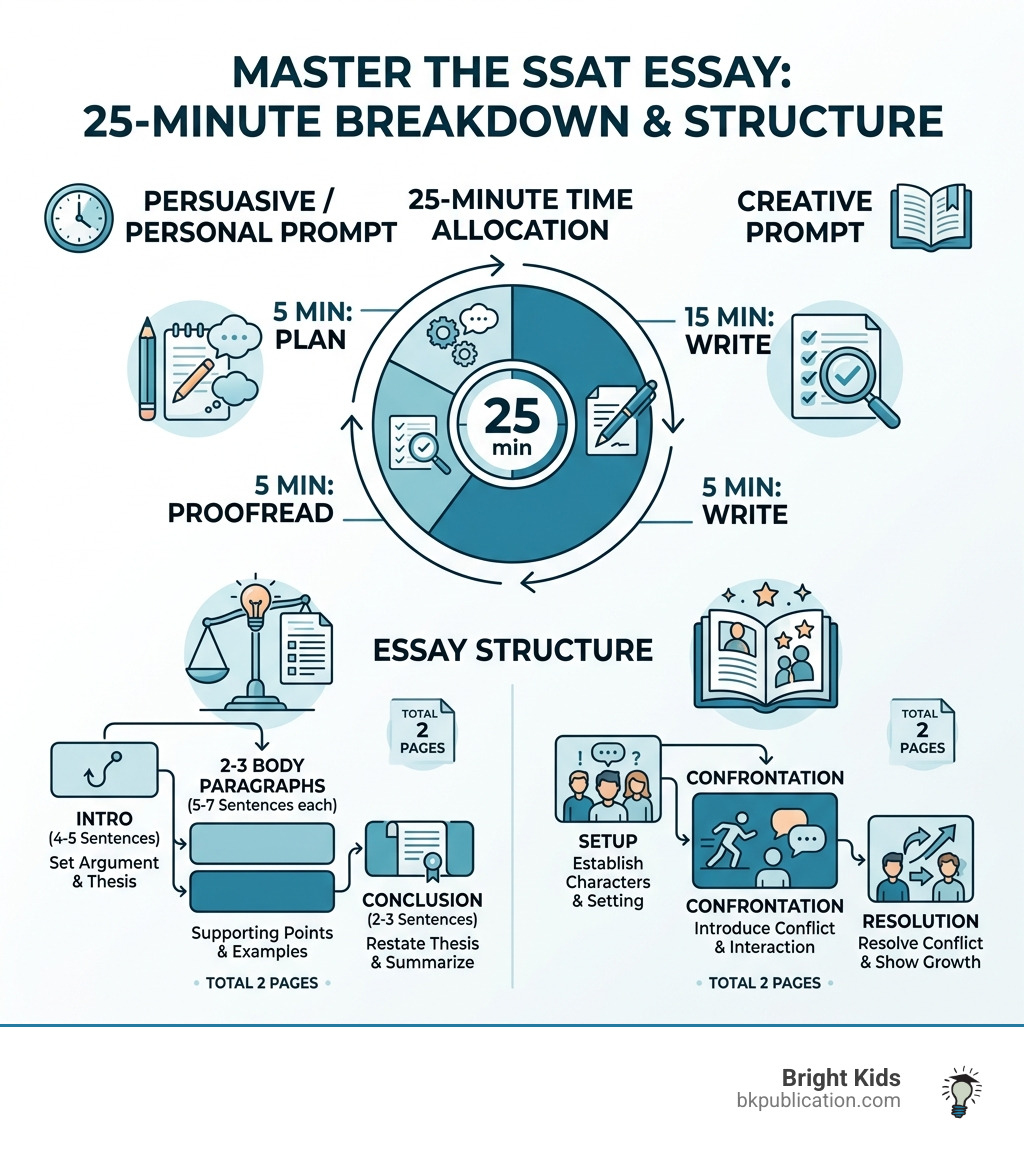
| Persuasive/Personal | Intro (4-5 sentences) → 2-3 body paragraphs (5-7 sentences each) → Conclusion (2-3 sentences) | 5 min plan / 15 min write / 5 min proofread |
| Creative Story | Setup → Confrontation (with dialogue) → Resolution (with growth) | 5 min plan / 15 min write / 5 min proofread |
The key principles:
- Plan before you write (even just 5 minutes)
- Match your structure to the prompt type
- Fill both pages — quality and quantity matter
- Proofread for spelling, grammar, and punctuation
The SSAT Writing Sample is 25 minutes long and limited to two pages. It is not graded by the test makers. But it is sent directly to every school your child applies to — and many admissions officers read it carefully alongside the rest of the application.
Think of it this way: it's one of the few places where admissions officers can see how your child thinks and communicates under pressure, in their own words, without any editing help.
That's a big opportunity — and one many students leave on the table simply because they didn't know how to structure their response.
I'm Bige Doruk, founder of Bright Kids, and over nearly two decades of helping thousands of students prepare for private school admissions tests, I've developed a clear set of SSAT essay structure tips that help students walk in confident and write with purpose. In the sections below, I'll walk you through exactly how to structure every type of SSAT essay prompt — from persuasive arguments to creative stories.
Understanding the SSAT Writing Sample Format
Before we dive into the specific SSAT essay structure tips, it is vital to understand the "playing field." As of April 2026, the SSAT continues to offer different prompt types depending on the level of the test your child is taking. While the time limit—a brisk 25 minutes—is the same across the board, the choices available to the student vary.
Upper-Level vs. Middle-Level Prompts
Students taking the Upper-Level SSAT (applying for grades 9-12) are typically given a choice between two prompts:
- A Personal Prompt: This usually asks the student to reflect on a personal experience or value (e.g., "Describe a time you overcame a challenge").
- A General/Analytical Prompt: This asks for an opinion on a broader topic or a "take a stand" question (e.g., "Is it more important to learn from mistakes or successes?").
Students taking the Middle-Level SSAT (applying for grades 6-8) also get two choices, but they look a bit different:
- A Personal Prompt: Similar to the Upper-Level, focusing on the student's own life.
- A Creative Prompt: This often provides a "story starter" or a sentence that the student must use to begin or end a creative story (e.g., "He couldn't believe his eyes when he opened the box").
Regardless of the level, the student is limited to exactly two pages. This means we must teach our students to be concise but also to "fill the booklet." A half-page response often signals a lack of effort or ideas to an admissions officer. For more official details on test day expectations, you can visit SSAT Tips & Advice.
Choosing the Right Prompt
One of the most common questions we hear is: "Which prompt should I pick?" The good news is that admissions officers do not have a preference. They aren't looking for a "creative" student over an "analytical" one; they are looking for a proficient writer.
We recommend that students spend about 60 seconds reading both options and choosing based on:
- Interest Level: Which one sparks an immediate idea?
- Evidence: Do you have a specific anecdote or historical example ready for one of them? If you are a competitive debater, the general prompt might feel like home. If you love fiction, the creative prompt is your chance to shine.
- Comfort: Don't try to be someone you aren't. If you've never written a short story, test day is not the time to start.
Mastering the 25-Minute Clock
In SSAT essay structure tips, time management is the foundation. Twenty-five minutes sounds like a lot until you start staring at a blank page. We teach our students to break this time down into three distinct phases to ensure they don't get sidetracked or run out of time mid-sentence.
The 5-15-5 Rule
We advocate for a strict time budget:
- 5 Minutes: Planning. This is non-negotiable. You cannot build a house without a blueprint, and you shouldn't write an essay without an outline.
- 15 Minutes: Drafting. This is the "meat" of the session. The goal is to get the ideas onto the page following the plan created in step one.
- 5 Minutes: Proofreading. Use this time to fix spelling, ensure your handwriting is legible, and perhaps swap out "boring" words for more sophisticated vocabulary.
| Task | Time Allocation | Goal |
|---|---|---|
| Brainstorm/Outline | 5 Minutes | Choose prompt, develop thesis, list 2-3 examples. |
| Writing | 15 Minutes | Fill the two pages with structured paragraphs. |
| Review/Edit | 5 Minutes | Check grammar, punctuation, and legibility. |
Planning Your SSAT Essay Structure Tips
During those first five minutes, the student should create a "mental roadmap." For a persuasive essay, this means writing down a clear thesis statement (your main argument) and two or three specific examples that prove it. For a creative story, it means deciding on the characters, the setting, and—most importantly—how the conflict will be resolved.
We always tell our students: "If you don't know how the essay ends before you start writing, you aren't ready to pick up the pen."
SSAT Essay Structure Tips for Persuasive and Personal Prompts
For the general or personal prompts, a traditional academic structure is the safest and most effective route. Admissions officers are looking for organization and logic.
The 4-Paragraph Structure
We recommend a 4-paragraph model for most students. It’s manageable within 25 minutes and provides enough depth to fill the space.
-
Introduction (4-5 sentences):
- The Hook: Start with a broad statement, a famous quote, or a vivid description.
- The Bridge: Connect the hook to the specific prompt.
- The Thesis: State your position clearly. If the prompt asks "Is it better to work alone or in a group?", your thesis should be "Working in a group is superior because it fosters diverse ideas and shared responsibility."
-
Body Paragraph 1 (5-7 sentences): Focus on your first major reason. Use a "worldly" example—something from history, current events, or literature. For instance, if you are discussing leadership, you might bring up Abraham Lincoln or a character from a book you read in school.
-
Body Paragraph 2 (5-7 sentences): Focus on your second reason. This is a great place for a personal anecdote. If the prompt is about teamwork, talk about your experience on a sports team or a school project.
-
Conclusion (2-3 sentences):
- Restate your thesis in different words.
- Summarize your main points.
- End with a "forward-looking" statement—why does this topic matter for the future?
The Hourglass Model for SSAT Essay Structure Tips
Think of your essay like an hourglass. You start broad in the introduction, get very specific with your evidence in the body paragraphs, and then broaden back out in the conclusion to show the "big picture."
One advanced tip we often share: if you have time, include a counterargument in your second body paragraph. Briefly mention what someone on the other side might say, and then explain why your view is still stronger. This shows incredible maturity and critical thinking skills.
SSAT Essay Structure Tips for Creative Storytelling
Middle-Level students often gravitate toward the creative prompt. However, "creative" does not mean "unstructured." A story without a clear beginning, middle, and end feels like a "cliffhanger"—and not the good kind.

The Narrative Arc
A successful SSAT story must follow a classic narrative arc:
- The Setup: Introduce 1-2 characters and a single setting. Don't try to write an epic with ten characters; you don't have the time! Use sensory details (what do they see, smell, or hear?) to ground the reader.
- The Confrontation: Introduce a conflict or problem. Maybe the character is lost, or they have to make a difficult choice. Use dialogue here to make the story feel alive.
- The Resolution: The character must solve the problem. Crucially, the character should show some form of growth or learn a lesson. Admissions officers love to see that your characters (and by extension, you) understand concepts like perseverance or empathy.
Narrative Best Practices
To keep your story polished:
- Stay Consistent: If you start writing in the past tense ("He walked"), don't switch to the present tense ("He walks") halfway through.
- Maintain POV: Usually, first-person ("I") or third-person ("He/She") works best. Stick to one.
- Show, Don't Tell: Instead of saying "Sarah was nervous," say "Sarah's hands shook as she reached for the door handle." This makes your writing much more engaging.
General Best Practices for a Polished Sample
Regardless of which SSAT essay structure tips you follow, certain "universal" rules apply to all writing samples. This is a handwritten test for many, and the visual presentation matters.

Legibility and Presentation
If an admissions officer cannot read your handwriting, they cannot appreciate your ideas.
- Print vs. Cursive: Use whichever is neater for you. Most students find that neat printing is safer under pressure.
- Indent Your Paragraphs: This is a visual cue that helps the reader follow your structure.
- Fill the Space: Aim to fill at least 1.5 to 2 pages. A very short essay looks like you ran out of ideas, while a very long essay with messy handwriting looks like you lacked focus.
Vocabulary and Mechanics
You don't need to use a "thesaurus word" in every sentence, but you should avoid repetitive, "easy" words. Instead of saying "The movie was good," try "The film was captivating" or "The performance was exemplary."
During your 5-minute proofreading window, look for:
- Run-on sentences: Do you have two thoughts joined together without a comma or period?
- Capitalization: Ensure proper nouns and the start of sentences are capitalized.
- Word Choice: Cross out "weak" words like "stuff," "things," or "very" and replace them with something more specific.
Frequently Asked Questions about the SSAT Essay
Which prompt type do admissions officers prefer?
As mentioned earlier, there is no "preferred" prompt. Schools use the writing sample to see if a student's writing ability matches their scores on the Reading and Verbal sections. They also use it to get a sense of the student’s personality. Choose the prompt that allows you to write the most organized, thoughtful response.
How can I practice for the essay with limited resources?
You don't need expensive software to practice. You can find free prompts online through official testing resources or by searching for sample prompts. The best way to practice is to set a timer for 25 minutes, pick a prompt, and write by hand. Afterward, read it aloud. If you stumble over a sentence, it probably needs to be rewritten.
What are the most common mistakes to avoid?
The biggest "traps" are:
- Not Planning: Starting to write immediately and getting stuck halfway through.
- Being Too Vague: Using generalities like "Teamwork is important for everyone" without giving a specific example of a time teamwork actually worked.
- Inappropriate Content: Avoid dark, violent, or overly controversial topics. Keep it professional and positive.
- Ignoring the Prompt: Some students have a "pre-written" essay they try to force into the prompt. Admissions officers can see this from a mile away. Always answer the specific question asked.
Conclusion
Mastering the SSAT essay structure tips we've discussed isn't about being the next great novelist; it’s about showing admissions officers that you are a clear, organized, and thoughtful communicator. By following a set structure—whether it's the 4-paragraph persuasive model or the 3-part narrative arc—you take the guesswork out of the 25-minute window.
At Bright Kids, we’ve spent 17 years perfecting the art of test preparation. We know that the right structure, paired with comprehensive practice that mimics the real exam, leads to superior results. Whether you are looking for our specialized prep books or one-on-one tutoring in NYC or nationwide, we are here to help your child navigate the admissions process with confidence.
The writing sample is your chance to "speak" to the admissions committee. Use your 25 minutes wisely, stick to your structure, and let your personality shine through on the page. For more tips on mastering the SSAT and other admissions news, stay tuned to our blog. Happy writing!