

NYC G&T Admission Guide for Parents Who Want to Keep Their Sanity
May 29, 2026
What Every NYC Parent Needs to Know About G&T Admissions (Before the Panic Sets In)
This NYC G&T admission guide covers everything you need to navigate New York City's Gifted & Talented programs — from eligibility and deadlines to school types and how offers are made.
Here's the quick version:
- What it is: G&T programs offer accelerated, enriched instruction for eligible elementary school students across NYC.
- Two program types: Citywide (open to all boroughs) and District-wide (priority to local residents), spread across most of the city's 32 school districts.
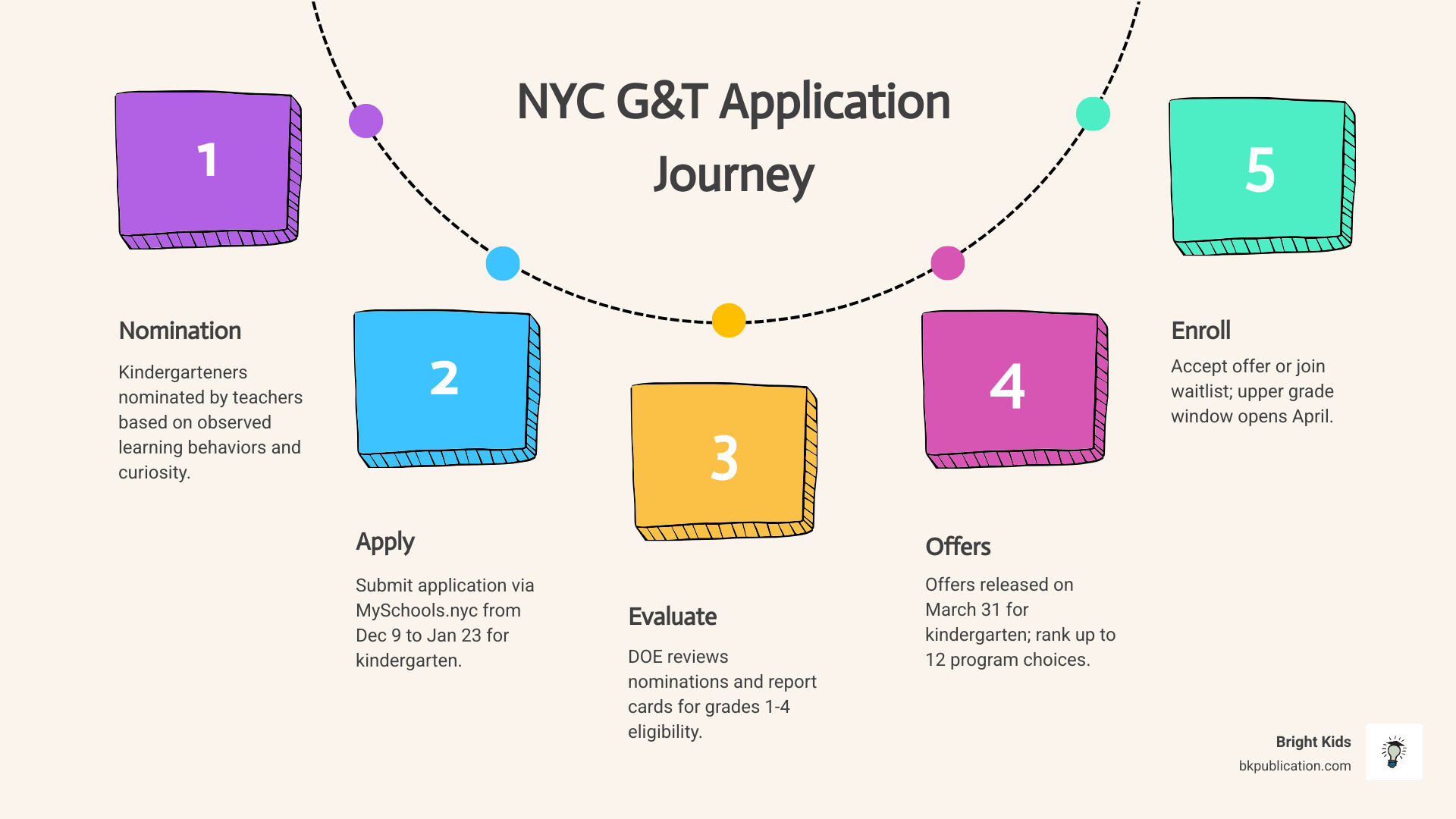
- How kids qualify: Kindergarteners are nominated by teachers based on observed learning behaviors. Students entering grades 1–4 qualify based on report card grades.
-
Key 2026 dates:
- Kindergarten application opens: December 9, 2025
- Kindergarten application closes: January 23, 2026
- Kindergarten offers released: March 31, 2026
- Upper grade (1–4) application opens: April 21, 2026
- Upper grade application closes: May 8, 2026
- Upper grade offers released: June 11, 2026
- Where to apply: MySchools.nyc — the official NYC DOE portal.
- Seats are limited: Roughly 2,500 G&T seats exist for approximately 70,000 age-eligible students citywide.
The numbers alone tell the story. Of the 14,538 kindergarteners who were once tested citywide, fewer than 16% received a placement. And with the recent shift away from standardized testing toward teacher nominations and report card grades, many parents feel like they're navigating the process without a map.
That's exactly why this guide exists.
Whether your child is just entering pre-K or already finishing second grade, understanding how the process works — before the application window opens — is the single most important thing you can do as a parent.
I'm Bige Doruk, founder of Bright Kids, and for nearly two decades I've helped over 10,000 families prepare for exactly this kind of high-stakes admissions process, including building the resources and practice materials that form the backbone of this NYC G&T admission guide. In the sections ahead, I'll walk you through every step — eligibility, timelines, school selection, and what to do if things don't go as planned.
Understanding the NYC G&T Admission Guide: Citywide vs. District Programs
When you start your journey using this NYC G&T admission guide, the first thing we need to clarify is that "G&T" isn't just one type of school. In New York City, there are two distinct flavors of Gifted & Talented programs, and understanding the difference is crucial for your application strategy.
The Two Main Types of Programs
The Gifted & Talented (G&T) Overview provided by the DOE explains that programs are divided into Citywide and District-wide options.
- Citywide G&T Schools: These are the "Ivy Leagues" of the elementary world. There are only five of them in the entire city, and they accept students from all five boroughs. Because they are standalone schools where every single student is in the G&T program, the curriculum is often more specialized and moves at a significantly faster clip.
- District G&T Programs: These are specialized "tracks" or classrooms located within a neighborhood public school. While the G&T students have separate academic classes for core subjects, they typically mix with the general education population for "specials" like gym, art, and lunch.
| Feature | Citywide G&T Schools | District G&T Programs |
|---|---|---|
| Eligibility | Open to all NYC residents | Priority to district residents |
| Structure | Entire school is G&T | G&T "track" within a regular school |
| Number of Schools | 5 specific schools | Located in most of the 32 districts |
| Admissions Priority | Siblings first, then citywide lottery | Siblings first, then district residents |
The "Big Five" Citywide Schools
If you are aiming for a Citywide spot, you are looking at these specific institutions:
- NEST+M (Lower Manhattan)
- The Anderson School (Upper West Side)
- TAG Young Scholars (East Harlem)
- Brooklyn School of Inquiry (Bensonhurst/Gravesend)
- Q300 (Astoria/Long Island City)
It is important to note that there are currently no Citywide G&T schools in the Bronx or Staten Island. Families in those boroughs often face long commutes if they secure a seat in Manhattan or Brooklyn.
District-Wide Programs
Most of NYC’s 32 districts offer G&T programs. These are excellent options because they often allow your child to stay closer to home while still receiving accelerated instruction. However, keep in mind that residency matters here. If you live in District 2 (which covers much of Lower Manhattan and the Upper East Side), you will have priority for the G&T programs within that district. While you can apply to programs in other districts, your chances of getting an offer are significantly lower unless there are empty seats after all local residents have been placed—which rarely happens in popular districts.
Eligibility and the Modern Nomination Process

The way children qualify for G&T has changed dramatically in recent years. We often hear from parents who are still looking for the "G&T Test" registration. The truth is, the era of the high-stakes OLSAT and Naglieri exams for four-year-olds is over. The current system relies on a more holistic approach.
Kindergarten Entry: The Nomination System
For children entering kindergarten, eligibility is now determined through teacher nominations. If your child is currently enrolled in a DOE Pre-K, a NYC early childhood center, or a participating charter school, their current teacher will evaluate them.
This evaluation isn't a secret test; it's a "strengths-based" observation of how your child interacts with the world. Teachers look for specific learning behaviors, such as:
- Curiosity and Initiative: Does the child ask "why" and "how"? Do they seek out new information?
- Approaches to Learning: How does the child solve problems? Do they show persistence when a task is difficult?
- Social Perception: Does the child show an advanced understanding of the feelings and perspectives of others?
If your child is not currently in a DOE school (for instance, if they are in a private preschool or at home), don't worry. You can still apply. The DOE will contact you to schedule a brief interview with an educational expert who will perform a similar evaluation. Securing a spot requires following the Winning Million Dollar Kindergarten Spot Essential Steps to ensure you don't miss the nomination window.
Grades 1-4 Eligibility: The Power of the Report Card
For older students, the process is much more data-driven. Eligibility for entry into grades 1 through 4 is based strictly on their previous year's grades. To be eligible to apply, a student must have earned a "3" or "4" (or the equivalent) in core subjects like Math, Reading, and Writing. Crucially, they cannot have a "1" in any core subject on their marking period reports.
According to the announcement that NYC's G&T Application for Grades 1–4 opens April 15, this window is much tighter than the kindergarten one, so having your documents ready is essential.
How to Navigate the NYC G&T Admission Guide for Kindergarten
Navigating the NYC G&T admission guide for the first time can feel like learning a new language. The primary tool you will use is MySchools.nyc. This is the digital portal where you will research schools, receive your eligibility notification, and ultimately submit your application.
When you submit your general kindergarten application, you should include any G&T programs you are interested in. This act "triggers" the eligibility process.
- For DOE Students: Your child's teacher will automatically receive a notification to complete the evaluation.
- For Private/Parochial Students: You will be contacted for an interview. These interviews are generally low-pressure and designed to let your child's natural curiosity shine.
While there is no "test" to study for in the traditional sense, we recommend familiarizing your child with the types of questions and thinking patterns they might encounter during an interview. Using a Gifted and Talented Practice Test can help build their confidence in answering questions for an unfamiliar adult.
Upper Grade Requirements in the NYC G&T Admission Guide
For families with children in grades 1-4, the "nomination" is essentially your child's report card. If you are in a NYC public school, the DOE already has these grades. However, if your child is in a private school, a charter school, or is homeschooled, you have a bit more homework to do.
Grade Conversions: The DOE uses a specific scale to convert letter grades or percentages to their 1-4 scale:
- 4 (Exceeding Standards): 90–100 or A
- 3 (Meeting Standards): 80–89 or B
- 2 (Approaching Standards): 65–79 or C
- 1 (Below Standards): 64 and below or D/F
If your child is in a non-public school, you must take their report card to a Family Welcome Center to have it verified and entered into the system. For homeschoolers, you should email your child's academic records and progress reports to ESenrollment@schools.nyc.gov to initiate the eligibility review.
Key Deadlines and the Application Timeline for 2026
Mark your calendars! Missing a deadline in the NYC school system is often irreversible. The 2026 admission cycle follows a very specific rhythm.
- December 9, 2025: Kindergarten G&T application opens on MySchools.
- January 23, 2026: Deadline to submit the kindergarten application.
- March 31, 2026: Kindergarten offers are released.
- April 21, 2026: G&T application for grades 1-4 opens.
- May 8, 2026: Deadline for upper grade applications.
- June 11, 2026: Upper grade offers are released.
When you apply, you can rank up to 12 program choices. We always advise parents to rank them in their true order of preference. The system uses a "matching" algorithm—ranking a school first doesn't give you a better "score" in the lottery, but it ensures that if a seat is available and you are next in line, you get your top choice.
Choosing the Right School and Managing Results
Once you know your child is eligible, the real work begins: choosing the right school. This is a personal decision, but our NYC G&T admission guide recommends looking at more than just test scores.
What to Consider During School Tours
- The Commute: A "perfect" school isn't perfect if your child is spending 90 minutes on a bus each way. Consider the impact on their sleep and extracurricular life.
- Curriculum Focus: Some G&T schools, like The Anderson School, have a heavy emphasis on advanced math and problem-solving. Others, like PS 166, might focus more on the Teachers College writing program.
- School Culture: Does the school have an active PTA? Do they offer enrichment like Lego Robotics or Town Halls? For example, the Brooklyn School of Inquiry is known for its "Town Halls" where students can actually voice concerns about school policies.
Managing the Results: Waitlists and Appeals
If you don't get into your top choice, you will automatically be placed on the waitlist for any school you ranked higher than the one you were offered. Waitlists stay active through mid-September.
If you believe your child was unfairly deemed "ineligible," you have a very short window to appeal. You must email DECEGT@schools.nyc.gov (for Kindergarten) or ESEnrollment@schools.nyc.gov (for grades 1-4) within 5 school days of receiving your eligibility letter. Your appeal must include a clear description of why the determination should be reviewed.
Frequently Asked Questions about NYC G&T Admissions
What happens if my child doesn't get a G&T offer?
First, take a deep breath. With only 2,500 seats for 70,000 kids, most families will not receive a G&T offer. Your child will still have a seat at their zoned school. Many zoned schools in NYC offer excellent "Enrichment" or "Honors" tracks that provide a similar level of rigor to G&T programs. You can also explore "un-zoned" or "Magnet" schools through the general MySchools application.
Are students with disabilities or ELLs eligible?
Absolutely. NYC law requires that students with disabilities (IEPs) or 504 plans be given full access to G&T screening and programs. They are entitled to the same accommodations during the interview or evaluation process as they receive in the classroom. Similarly, English Language Learners (ELLs) are evaluated using a process that accounts for their language development, ensuring that linguistic barriers don't hide their academic potential.
How do I appeal an eligibility determination?
As mentioned, the window is tight—just five school days. We recommend having your child's current teacher or an outside educational expert provide a letter of support if you feel the DOE's evaluation didn't capture your child's true abilities. If the DOE denies your appeal, you can further appeal to the New York State Education Department (NYSED), though this is a much longer legal process.
Conclusion
The journey through the NYC G&T process is a marathon, not a sprint. While the system has moved away from the high-pressure testing of the past, it still requires parents to be organized, informed, and proactive.
At Bright Kids, we have spent 17 years helping families navigate these exact hurdles. Whether you are looking for the right test prep books to build your child's reasoning skills or seeking specialized tutoring to ensure their report card is "G&T ready," we are here to provide the expertise you need. Our NYC-based team understands the nuances of every district, from the competitive halls of NEST+M to the local gems in District 20.
For more insights and updates on the 2026 admissions cycle, be sure to visit our news and resources page. The "best" school is the one where your child feels challenged, supported, and happy. Use this NYC G&T admission guide as your foundation, but trust your instincts as a parent—you know your child better than any algorithm ever will.